Apollo 13
Failed 1970 lunar mission whose free-return arc Artemis II replicates.
Apollo 13's 1970 free-return survival regained relevance on 6 April when Artemis II passed its human-distance record on a planned lunar arc.
Last refreshed: 22 September 2026
How does Apollo 13's survival shape Artemis II's flight plan?
Timeline for Apollo 13
Mentioned in: Crew talk; heat shield answer waits
Artemis II Moon MissionMentioned in: Heat shield: clean eye, scan pending
Artemis II Moon MissionMentioned in: Three Orion reworks named in one call
Artemis II Moon MissionMentioned in: NASA's post-mission press conference disclosed no data
Artemis II Moon MissionMentioned in: Orion splashes down in Pacific, crew recovered aboard USS Murtha
Artemis II Moon MissionBackground
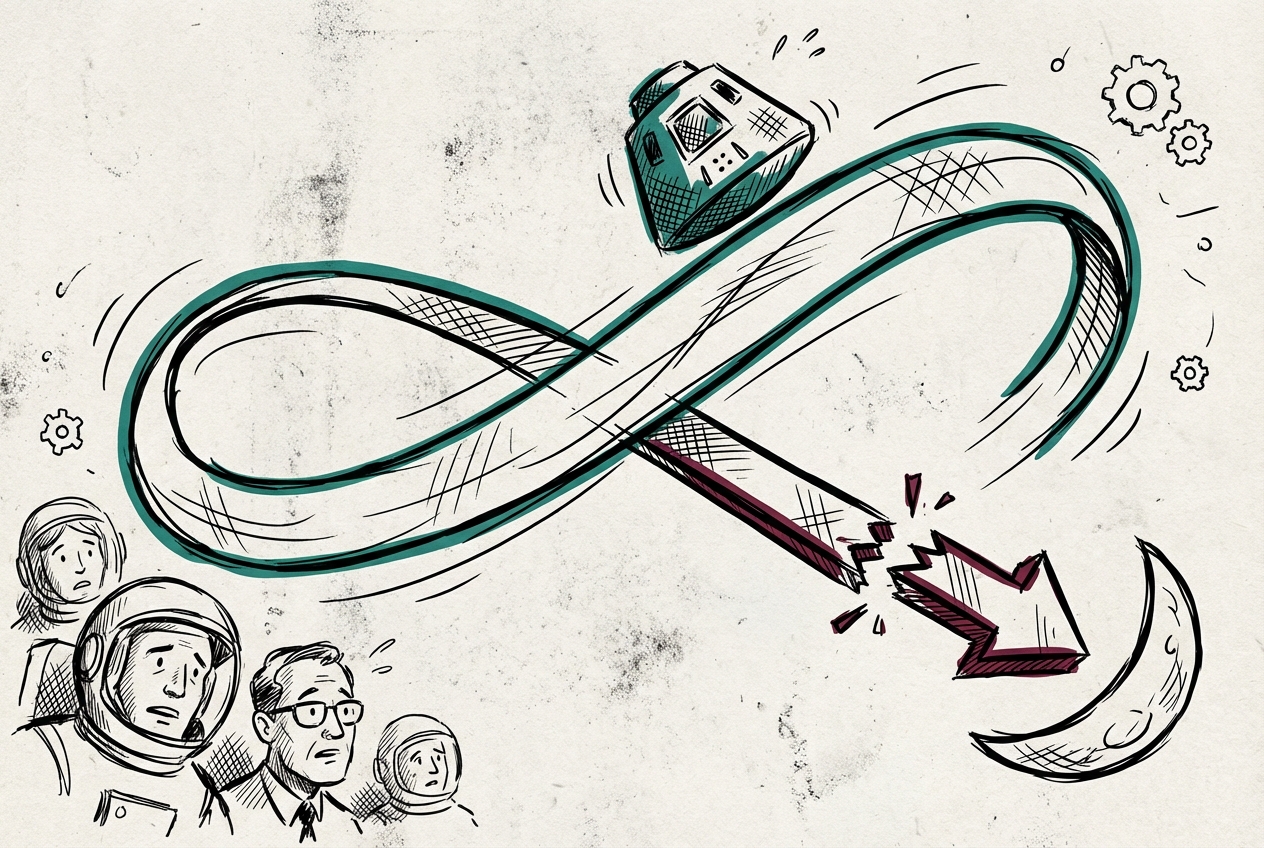
Apollo 13 was a crewed Apollo lunar mission whose planned landing was aborted after an oxygen-tank explosion in 1970. Its CREW returned safely by following a free-return trajectory, in which lunar gravity carries a spacecraft around the Moon and back towards Earth.
The mission remains a defining example of contingency planning in human spaceflight. A free-return route does not remove every danger, but it preserves a return PATH without requiring a lunar landing or a separate turn-home manoeuvre.
Apollo 13 also held the human distance record from Earth at 248,655 miles until Artemis II's planned passage beyond it on 6 April 2026. Its lasting significance lies in the link between a failed mission objective and a successful CREW recovery.