Skip to content
Briefings are running a touch slower this week while we rebuild the foundations.See roadmap
Artemis II Moon Mission
3APR

Outlook Crashes at 46,000 Miles From Earth

2 min read
12:59UTC

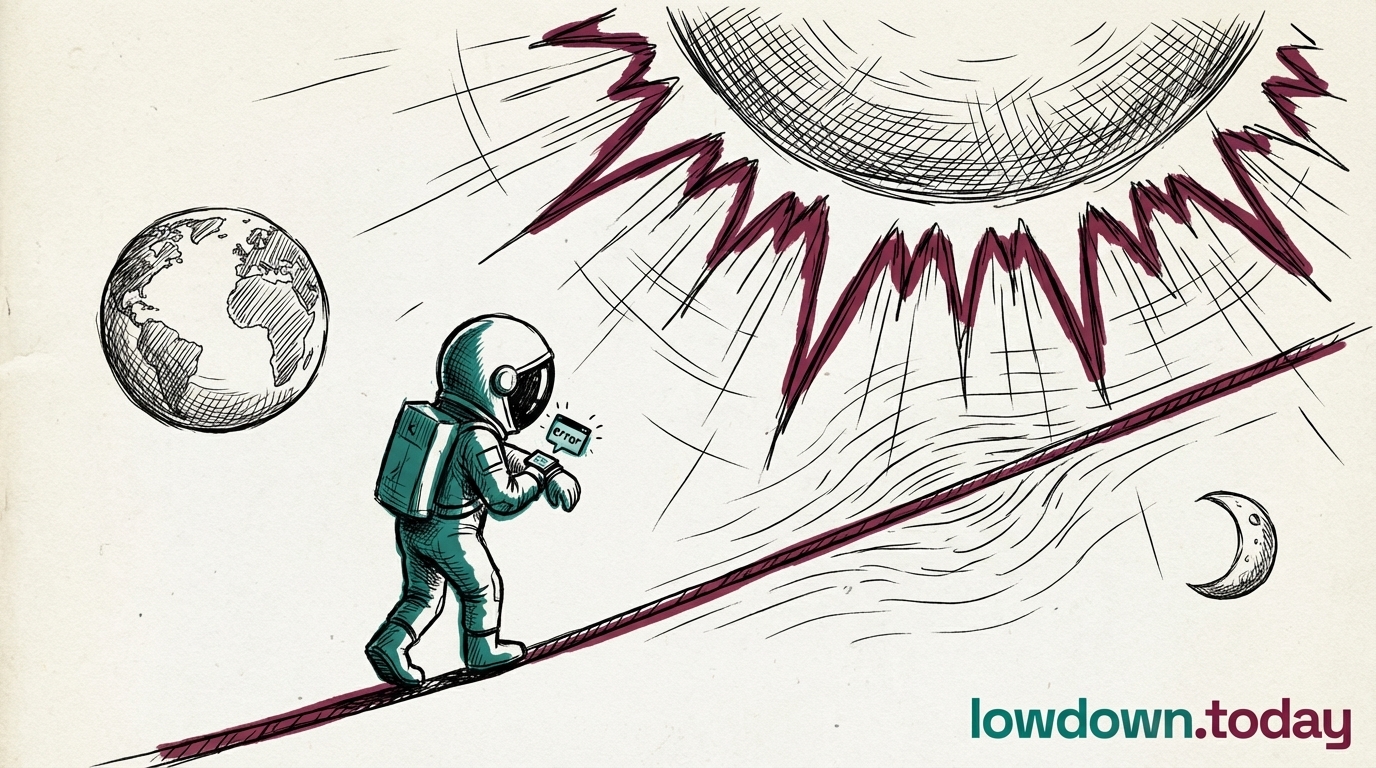
At one-fifth of the distance to the Moon, the commander's email client stopped working. Ground controllers remoted in to fix it.

ScienceDeveloping
Key takeaway

Consumer software failures aboard deep-space vehicles reveal a new category of operational risk.

Commander Reid Wiseman reported on Day 1: "I also see that I have two Microsoft Outlooks, and neither one of those are working" 1. The spacecraft was approximately 46,000 miles from Earth at the time.

Outlook is commercial off-the-shelf (COTS) software running on crew laptops, not flight-critical hardware. Ground controllers gained remote access to the personal computing devices aboard Orion and restored the application 2. Flight systems were unaffected.

The incident is trivial in isolation. In context, it is revealing. Modern crewed spaceflight layers radiation-hardened avionics with consumer software that carries its own failure modes. Scheduling, crew coordination, and communication tools run on the same commercial platforms used in any office. When those platforms fail at deep-space distances, the resolution depends on a remote-access link that itself relies on the TDRS relay network, the same network that dropped audio 51 minutes into flight .

This is the third anomaly in 36 hours, following the toilet fan fault and the TDRS dropout. None threatened the mission. Collectively, they form the first reliability dataset for a crewed vehicle beyond low Earth orbit since the Apollo programme.

Deep Analysis

In plain English

The commander's email programme stopped working while the spacecraft was already a fifth of the way to the Moon. Ground controllers remotely accessed the laptops aboard the spacecraft and fixed it, just as an IT support team would remote into your work computer. The email software is completely separate from the flight controls — nothing critical was affected. But it is a useful reminder that modern spacecraft are not just radiation-hardened computers from the 1960s; they also run the same consumer software that crashes on laptops everywhere.

First Reported In

Update #2 · Solar storm threatens Orion beyond Earth

NBC News· 3 Apr 2026
Read original
Different Perspectives
JAXA
JAXA
JAXA is an Artemis Accords signatory with the Lunar Cruiser rover planned for south-pole surface operations; Chang'e 7's first-arrival timeline compresses the window those surface systems were designed to operate in alongside American crew.
Space Research Institute RAS / Roscosmos
The LILEM instrument on Chang'e 7 gives Russia science-cooperation presence at Shackleton's rim with no independent crewed lunar capability on a public timeline. This is Roscosmos's only confirmed path to south-pole science in the current decade.
CNSA / China Manned Space Agency
Chang'e 7 at Wenchang confirmed a second-half 2026 launch for Shackleton rim, 18 to 24 months before any American crewed arrival. The mission carries a Russian LILEM instrument, giving Roscosmos a south-pole science foothold inside China's programme.
Jeremy Hansen / Canadian Space Agency
Hansen appeared at the 16 April JSC press conference in his only public moment since splashdown. Canada's Canadarm3 remains without a confirmed deployment host after Gateway cancellation, with CSA maintaining institutional silence on the programme's status.
Airbus Defence and Space
Airbus has issued no post-mission ESM performance statement; its press room returned a 404 error on a 14 April check. The only named Airbus engineer quote on the mission appeared in a Nature interview, not a company release.
Daniel Neuenschwander / European Space Agency
ESA's 11 April statement praised ESM translunar injection precision and omitted the pressurisation valve anomaly; the June 2026 Council is the sole stated review forum. ESM-3 is at KSC without a corrected-baseline disclosure to justify its readiness.