SDO
NASA Sun-monitoring spacecraft providing imagery for Artemis II solar storm forecasting.
Last refreshed: 3 April 2026
How does SDO data protect astronauts from solar storms in deep space?
Timeline for SDO
Two Storm Forecasting Models Get Their First Live Test
Artemis II Moon MissionBackground
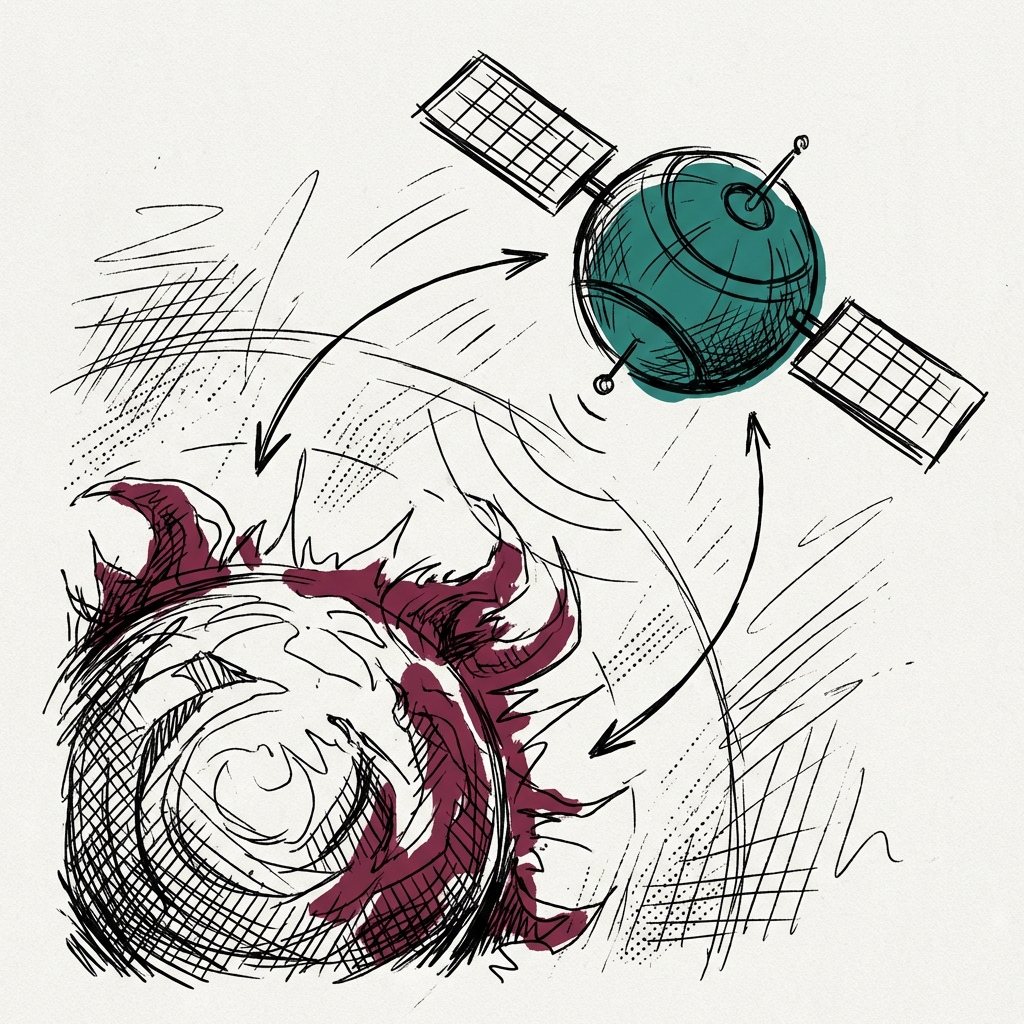
The Solar Dynamics Observatory (SDO) is a NASA spacecraft launched in February 2010 that provides near-continuous, high-resolution imagery of the Sun across multiple wavelengths, tracking sunspots, solar flares, and coronal mass ejections in real time. During Artemis II, SDO imagery is being Fed into the University of Michigan's machine-learning solar storm forecasting model, which generates daily probability scores for solar particle events that could threaten the crew during translunar transit.
SDO orbits Earth in a geosynchronous orbit, giving it an uninterrupted view of the Sun and near-continuous downlink to a dedicated ground station in New Mexico. It carries three scientific instruments: the Atmospheric Imaging Assembly (AIA), the Helioseismic and Magnetic Imager (HMI), and the Extreme Ultraviolet Variability Experiment (EVE). Together they capture the Sun's surface, atmosphere, and magnetic field at cadences fast enough to track rapidly evolving flare events.
SDO's data has become foundational infrastructure for Space weather operations. Its imagery underpins forecasting at NOAA's Space Weather Prediction Center and, now, experimental deep-space CREW safety models. The Artemis II test represents one of the first occasions where SDO data has been used in a real-time decision support system for a crewed mission beyond Earth orbit — a role likely to expand as the Moon programme matures.