Skip to content
You can now search across every topic, entity and event.What's new
Urals
ProductRU

Urals

Russia's crude benchmark; whipsawed from $41.66 to $71.40 in July on the unreplaced US waiver.

Last refreshed: 23 July 2026 · Appears in 2 active topics

Key Question

Urals below Russia's budget line with no OFAC action: is market price the new sanctions?

Timeline for Urals

#25 23 Jul
#16 13 Jul

Held in the high-$40s to mid-$50s, below Russia's $59 budget floor

European Oil Markets: Urals held below Russia's budget floor
View full timeline →

Background

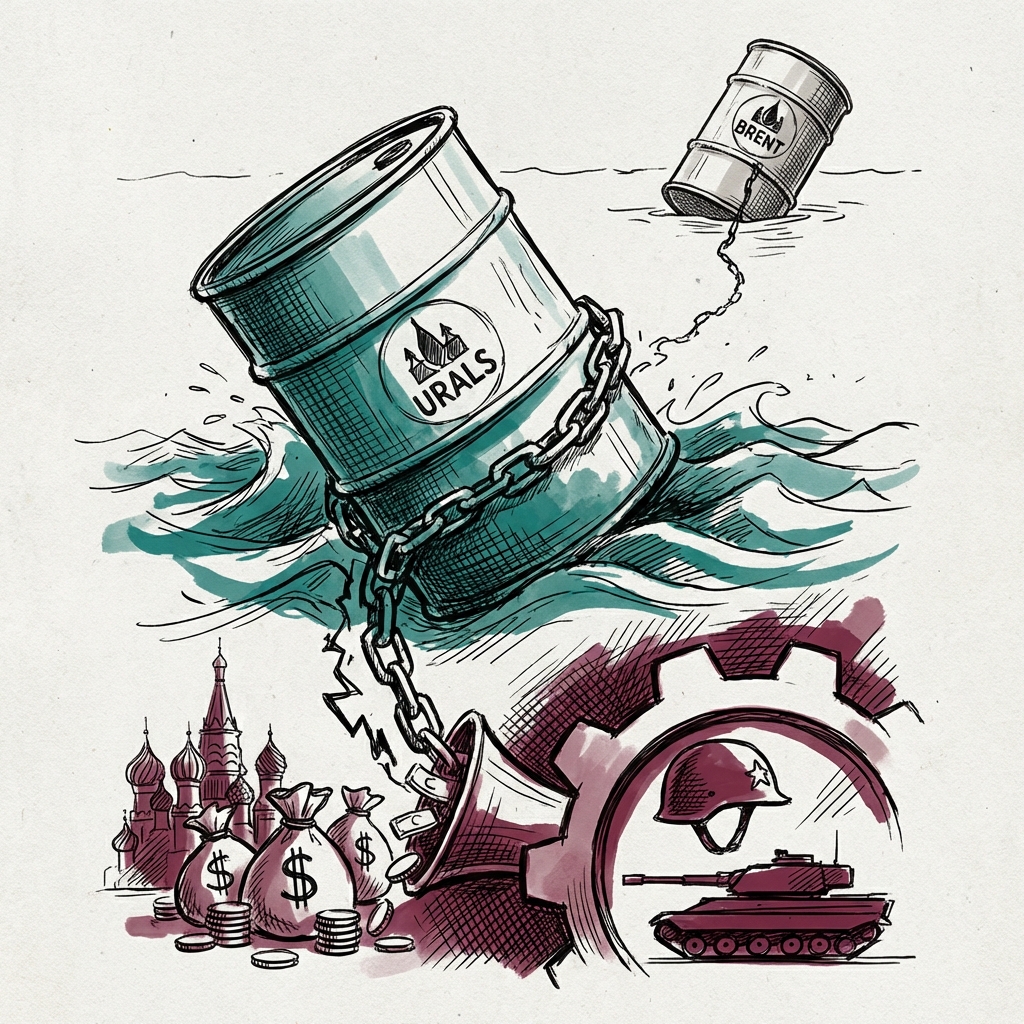
Urals is Russia's flagship crude oil export grade, produced primarily in western Siberia and exported through Baltic and Black Sea terminals. It serves as the pricing benchmark for Russian crude, trading at a persistent discount to Brent Crude driven by G7 price caps, sanctions enforcement, and physical disruption of export infrastructure. Oil and gas revenues account for roughly 30% of Russia's federal budget; Q1 2026 oil tax revenue halved year-on-year.

Ukrainian drone strikes on Ust-Luga and Primorsk between 22 and 31 March 2026 collapsed Russian seaborne exports from 4.07 to 2.32 million bpd, a 43% single-week drop. Carnegie analysis in April quantified a sustained cut: exports fell from 5.2 to 3.5 million bpd (25 March to 11 April, -33%), with revenue running 17% below the preceding two weeks but 62% above late February due to the Iran war price premium. SSU Alpha drones extended the campaign to Samara dispatch station and Tuapse refinery in April, while the EU's 20th sanctions package added seven Russian refineries. India and China remain dominant Urals buyers but demand larger discounts as Baltic disruption raises freight and insurance costs. 56% of Russian crude moved on sanctioned shadow tankers in February 2026. CREA's June 2026 monthly assessment put Urals averaging $63.18 a barrel, down 26% month-on-month, the sharpest monthly slide of 2026 and consistent with the discount widening through early July.

Urals then whipsawed hard through July: the price fell further to an average of $41.66 in early July before rebounding to $71.40 by 23 July, a near-tripling in weeks. The swing tracks the continued absence of a US crude waiver successor to General License 134C rather than any new sanctions action: with no OFAC replacement for the lapsed licence, market appetite for shadow-fleet cargo, not an enforcement lever Washington has pulled, is setting the price. Ukraine also intensified the tanker campaign over the same period, striking 159 shadow-fleet vessels in 12 days through mid-July, up sharply from 35 strikes in the previous 96 hours.

The Iran conflict has been a significant cross-topic variable in Urals pricing. The Iran war pushes global Brent upward: on 30 April 2026 Brent settled at $123 a barrel, the wartime settle high, following the UAE's OPEC exit and OPEC+ members agreeing a 206,000 bpd June increase. The Brent-Urals spread has widened to approximately $25 at these levels: while the Iran premium lifts Brent, OFAC enforcement of the $60/barrel price cap limits how much of that premium Urals captures. Russia partially benefits from a higher floor, but the physical volume attrition from Ukraine's strike campaign means it earns the margin on fewer barrels. The net effect is the Iran oil premium partially masking, but not cancelling, Ukraine's attrition campaign against Russian export infrastructure.

In the European oil markets context, Urals (rebranded KEBCO post-2022 to obscure Russian origin and evade EU price-cap enforcement) is tracked via the Brent-KEBCO differential. The G7 price cap formula, frozen at $44.10/BBL since January 2026, was designed to squeeze this spread; EU ambassadors could not agree the 21st sanctions package or a durable freeze duration on 13 July, but bridged the gap on 15 July with a one-week stopgap that holds the cap at $44.10/BBL to 23 July, avoiding the automatic six-monthly formula lift, which would otherwise have carried the cap to roughly $58/BBL rather than the ~$75 figure earlier reporting had suggested. Greece, backed by Cyprus and Malta, continues to push a shorter freeze against the Commission's preference for a freeze to January 2027; the one-week stopgap defers rather than resolves that fight. By 24-25 June 2026, Urals had fallen to approximately $50/barrel, dropping $9 below Russia's $59 federal-budget benchmark. Ten days on, Urals held near $51.25 on 6 July, barely moved, while Brent firmed on the OPEC+ August-hike decision and Hormuz normalisation, widening the Brent-Urals discount to roughly $20, beyond the $10-15 band the spread held through 2024-25 and confirming market price, not sanctions enforcement, is now the primary channel carrying Moscow's fiscal squeeze.

The discount is also bifurcating by delivery basis, and this split has widened further this week. On 7 July it had already widened past $10 a barrel at Indian ports, a destination-delivered (DAP) read, while the Baltic loading-basis discount tracked at Primorsk the same week held near $20 a barrel, roughly double. Reporting into mid-July describes that Baltic-versus-India gap continuing to stretch, but the precise price levels on each basis this week are not yet independently confirmed on this desk, so no single clean floor or cap-crossing figure should be read into it: the safest characterisation is a widening basis split, not a settled new price band. The gap remains a freight and insurance function rather than a change in the crude itself: shadow-fleet costs and enforcement risk are added between loading and delivery, so the same barrel prices cheaper leaving the Baltic than it does once it reaches an Indian buyer's port.

Common Questions

Reference

What is KEBCO and how does it relate to Urals crude?
KEBCO (Kazakhstan Export Blend Crude Oil) is the rebranded name for Urals crude adopted post-2022 to obscure Russian origin and evade EU price-cap enforcement; the two grades are physically identical.
How does Urals oil fund Russia's war?
Oil and gas revenues account for approximately 30% of Russia's federal budget. Urals crude is the primary source, exported via Baltic terminals to shadow-fleet buyers after the EU import ban.
What is Urals crude oil?
Urals is Russia's main crude oil export grade, produced in western Siberia. It is a medium-sour crude that trades at a discount to Brent and is the pricing benchmark for Russian oil exports.
Why did Urals crude price nearly triple in July 2026?
Urals swung from a $41.66 average in early July to $71.40 by 23 July 2026 as the US crude waiver (General License 134C) stayed lapsed with no OFAC successor licence, letting market appetite rather than sanctions enforcement set the price.Source: Lowdown
Why is the Urals discount different in India and at the Baltic loading point?
The Indian figure is a destination-delivered (DAP) discount of over $10 a barrel, while the Baltic loading-basis discount at Primorsk held near $20 a barrel in early July 2026; freight and insurance costs added in transit account for the gap.Source: event
What is the G7 oil price cap on Russian crude in 2026?
The G7 price cap on Russian crude has been frozen at $44.10/BBL since January 2026. EU ambassadors failed to close the 21st sanctions package by 13 July, but agreed a one-week technical rollover on 15 July holding the cap at $44.10 to 23 July, avoiding the automatic six-monthly formula lift, which would have carried the cap to roughly $58/BBL, not the ~$75 figure earlier reporting had suggested.Source: EU Council
How much has Russia's oil export dropped in 2026?
Ukrainian drone strikes on Ust-Luga and Primorsk between 22 and 31 March 2026 collapsed Russian seaborne exports from 4.07 to 2.32 million bpd, a 43% single-week drop.Source: CREA
What share of Russian oil moves on shadow tankers?
CREA found 56% of Russian crude moved on sanctioned shadow tankers in February 2026, with 23 false-flag vessels involved, illustrating the scale of sanctions circumvention.Source: CREA
How far has the price of Urals crude fallen in June 2026?
CREA's June 2026 assessment put Urals averaging $63.18 a barrel, down 26% month-on-month, the sharpest monthly slide of the year, consistent with the Brent-Urals discount continuing to widen into early July.Source: CREA
Source Material