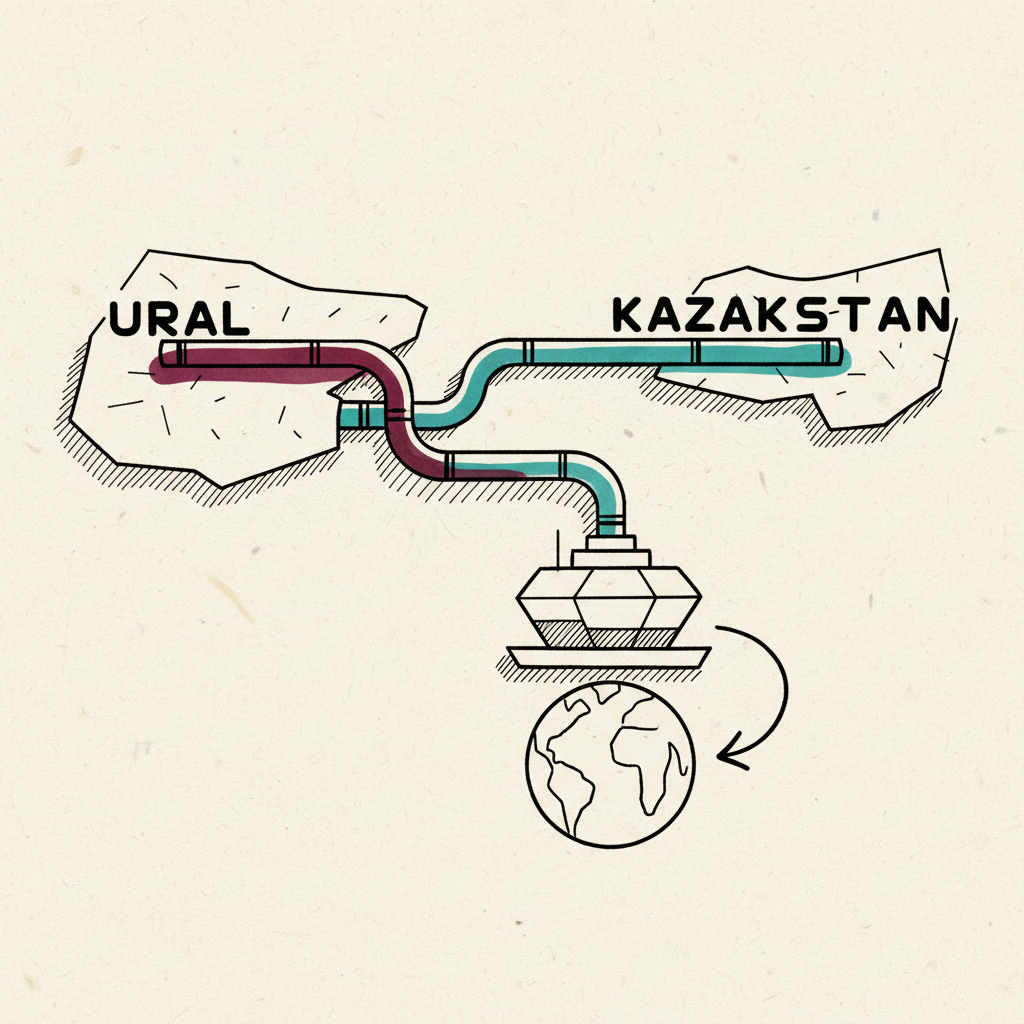
Is KEBCO genuinely Kazakh crude or a sanctions-evasion vehicle for Russian barrels?
Timeline for KEBCO
OFAC signs GL 134C, third Russia bridge
European Oil MarketsGL 134B dies, Urals $28 over the cap
European Oil MarketsBackground
KEBCO (Kazakhstan Export Blend Crude Oil) is a crude grade exported primarily via the Caspian Pipeline Consortium (CPC) terminal at Novorossiysk on the Black Sea. It was introduced as a distinct marketing grade in 2022 following the EU's progressive sanctions on Russian crude imports, rebranding barrels that physically commingle Kazakh and Russian crude in the CPC pipeline system as Kazakh-origin to qualify for exemptions from the G7 price cap and EU import restrictions.
The grade occupies a contested legal grey zone. Kazakh crude extracted from fields such as Tengiz and Kashagan does genuinely flow through the CPC pipeline to Novorossiysk; however, the pipeline also carries Russian crude production, and Independent analysis has consistently found that the actual composition of a loaded KEBCO cargo may diverge significantly from a pure Kazakh slate. The G7 and EU have declined to formally designate KEBCO barrels as Russia-origin, leaving buyers — primarily Indian, Chinese, and Turkish refiners — to judge their own compliance exposure.
The Brent-KEBCO discount is the primary traded spread: the amount by which a KEBCO cargo at Novorossiysk prices below Brent dated reflects both the quality differential (KEBCO is a medium-sour crude broadly similar to Urals) and the sanctions risk premium buyers demand. By May 2026, with GL 134B expired and Urals FOB assessed at approximately $76/BBL against a G7 CAP of $47.60 and Brent above $100/BBL, the political and pricing dynamics around KEBCO intensified, as buyers sought to source legitimately discounted Russian-adjacent barrels without triggering OFAC enforcement.
What is KEBCO crude oil?
How does KEBCO help Russia evade oil sanctions?
What is the Brent-KEBCO spread?
Where is KEBCO crude exported from?
