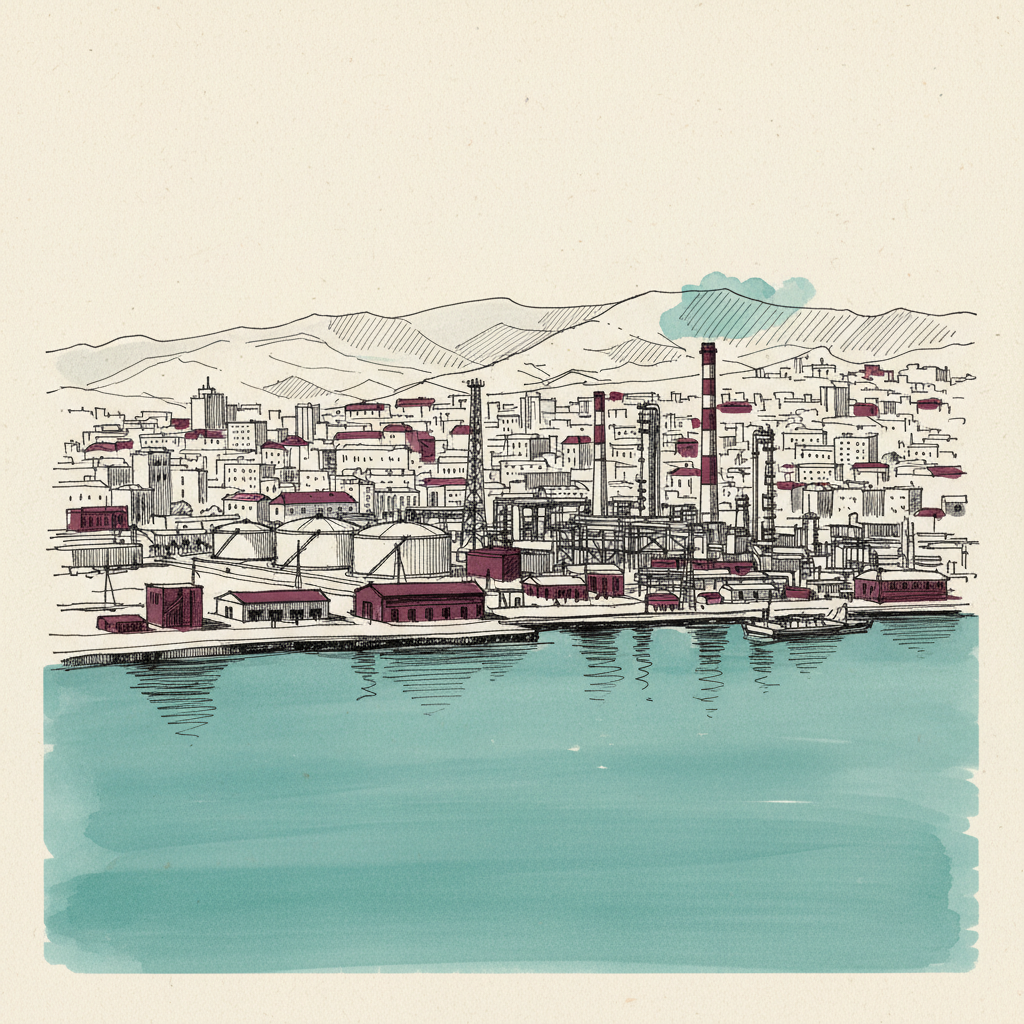
Tuapse
Russian Black Sea refinery city; exports ran 91% below May 2025 after sustained Ukrainian strikes in 2026.
Last refreshed: 16 June 2026 · Appears in 1 active topic
Why did Ukraine strike Tuapse refinery just days before the EU sanctioned it?
Timeline for Tuapse
Ran exports 91% below May 2025 after sustained Ukrainian strikes
Russia-Ukraine War 2026: Urals falls 12% as China cuts buysMentioned in: Refineries hit 16-year low; drones flip
Russia-Ukraine War 2026Mentioned in: Kyiv's Druzhba gambit unlocks €90bn loan
Russia-Ukraine War 2026Designated in the EU 20th sanctions package alongside six other Russian refineries
Russia-Ukraine War 2026: EU 20th package hits crypto and KyrgyzstanStruck by Ukrainian drones on 20 April, subsequently listed in EU 20th sanctions package
Russia-Ukraine War 2026: SSU Alpha drones hit Samara, Tuapse, GorkyBackground
Tuapse is a port city of approximately 55,000 people on Russia's Black Sea coast in Krasnodar Krai. It is home to the Tuapse refinery, operated by Rosneft and one of Russia's largest coastal refineries, processing Siberian crude delivered by pipeline for Black Sea export and domestic distribution. The refinery is a critical node in Russia's southern Energy infrastructure, distinct from the Baltic corridor centred on Ust-Luga and Primorsk.
Ukraine began targeting Tuapse as part of its 2026 Energy infrastructure campaign. Ukrainian drones struck the refinery on 20 April 2026; it was subsequently hit again and again through May, with Ukraine's deep-strike campaign reaching four strikes in two weeks by 1 May. By May 2026, CREA data showed Tuapse refinery exports running 91% below May 2025 levels, making it the standout casualty of the refinery campaign and a more severe ongoing disruption than the partially-recovered Baltic terminals. Three days after the first April strike, on 23 April 2026, the European Union's 20th sanctions package listed the Tuapse refinery among seven Russian refineries designated for EU sanctions, applying simultaneous Ukrainian kinetic and Western economic pressure.
The 91% export collapse at Tuapse is more severe than the disruption at Baltic terminals, which partially recovered by May. Its persistence reflects the intensity of the strike campaign rather than infrastructure fragility: repeated hits have prevented the refinery from completing repairs between engagements. Combined with the EU sanctions listing, Tuapse has become one of the clearest demonstrations that Ukraine's Energy infrastructure strategy, reinforced by Western designations, can achieve sustained rather than temporary disruption of Russian export capacity.
How badly damaged is the Tuapse refinery after Ukrainian drone strikes?
Is the Tuapse refinery under EU sanctions?
Why is Tuapse strategically important to Russia?


