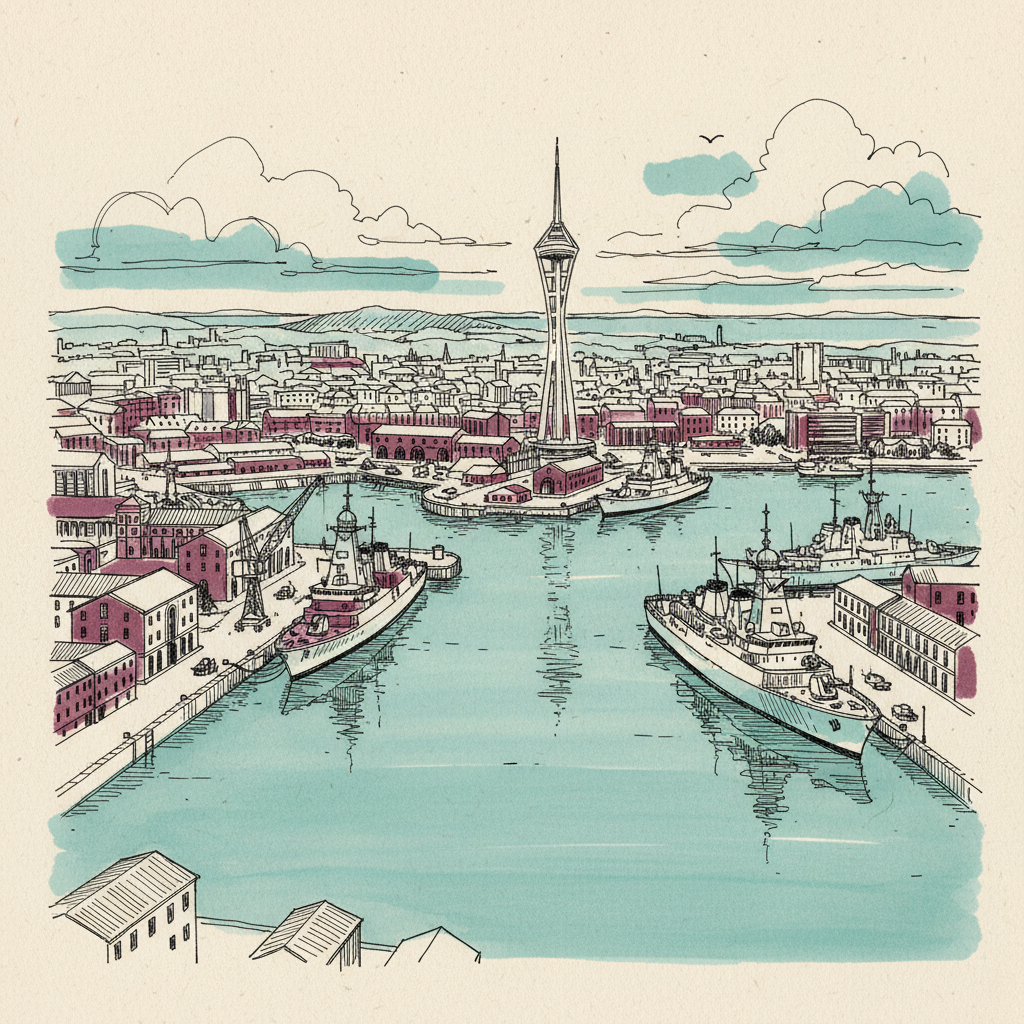
Portsmouth
Royal Navy's principal home base on the south coast of England.
Navy Commercial at Portsmouth's Whale Island published two notices on 5 August 2026: one on certifying uncrewed maritime systems, the other funding a £10m testbed robot boat for trials from March 2027.
Last refreshed: 7 October 2026 · Appears in 3 active topics
Why did a Royal Navy destroyer leave Portsmouth for Hormuz before any ceasefire was agreed?
Timeline for Portsmouth
Mentioned in: Kraken trials a Saab radar picket boat
Autonomous Systems: Land & SeaMentioned in: Navy robot boats' cameras called China
Autonomous Systems: Land & SeaMentioned in: Navy asks how to certify a robot ship
Autonomous Systems: Land & SeaMentioned in: £10m buys a robot boat testbed
Autonomous Systems: Land & SeaHarlow becomes fifth council to sue
UK Local Elections 2026Background
Portsmouth is a port city on the south coast of England and home to HM Naval Base Portsmouth, the Royal Navy's principal operating base. The base hosts the Queen Elizabeth-class aircraft carriers, Type 45 destroyers and Type 23 frigates, and is the main departure point for Royal Navy deployments beyond European waters; HMS Dragon sailed from it in March 2026.
The naval base has anchored British SEA power since the sixteenth century. Whale Island, within it, houses Navy Commercial, the office that runs procurement for the fleet, including work on certifying and testing uncrewed vessels. The city also hosts Kraken Technology Group, a British maritime-autonomy firm that builds the K3 SCOUT uncrewed boats used by the Royal Marines and Special Boat Service.
Portsmouth City Council has been a unitary authority since 1997. That status underpins its legal challenge to the government's local government reorganisation programme, one of five such suits by July 2026.
Whale Island writes the robot-boat rules
On 5 August 2026 Navy Commercial, the Royal Navy's procurement office at Whale Island, published a market notice seeking industry views on a Platform Authority to certify uncrewed maritime systems. Responses closed on 19 August, with a tender expected the following day.
A second Whale Island notice the same day funds a £10m testbed uncrewed surface vessel for the Defence Chief Technology Officer, on a three-year contract running from March 2027 to March 2030. It will compare shore-controlled, mothership-integrated and distributed control before the fleet settles on one design. The two notices put Portsmouth at the administrative centre of the Navy's move towards crewless ships, alongside its long-standing role as the base for crewed deployments.
Portsmouth takes the government to court
Portsmouth City Council has sought judicial review of the government's local government reorganisation programme. When Harlow filed on 22 July 2026, it became the fifth council to sue, joining Portsmouth, Essex, Norfolk and Suffolk.
Portsmouth has been a unitary authority since 1997, so its case concerns how the programme treats established unitaries rather than any plan to merge the city itself. None of England's four unitarisations since 2019 drew a legal challenge. Portsmouth's suit makes the city one of the earlier litigants against a reorganisation wave that has now drawn five, and its outcome will shape how much say an existing unitary has over boundaries drawn around it.
A home-port destroyer heads for Hormuz
HMS Dragon, a Type 45 destroyer based at Portsmouth, sailed from the port in March 2026 for the Eastern Mediterranean. On 11 May the Royal Navy confirmed she was forward-deploying to the Middle East for a future Hormuz security mission, with actual deployment conditional on a sustainable ceasefire.
The same day Britain and France hosted the first Hormuz Coalition defence ministers' meeting, lifting planning from headquarters staff to political level. For Portsmouth, Dragon's departure repeated the base's standing function as the starting point for Royal Navy operations beyond European waters, and put a ship from its quaysides at the front of a Coalition mission before any Ceasefire existed to trigger it.
What Royal Navy ships are deployed from Portsmouth to Hormuz?
Where is HMS Dragon based?
Why did HMS Dragon leave Portsmouth before a ceasefire was agreed?
Is Portsmouth City Council part of the challenge to local government reorganisation?


