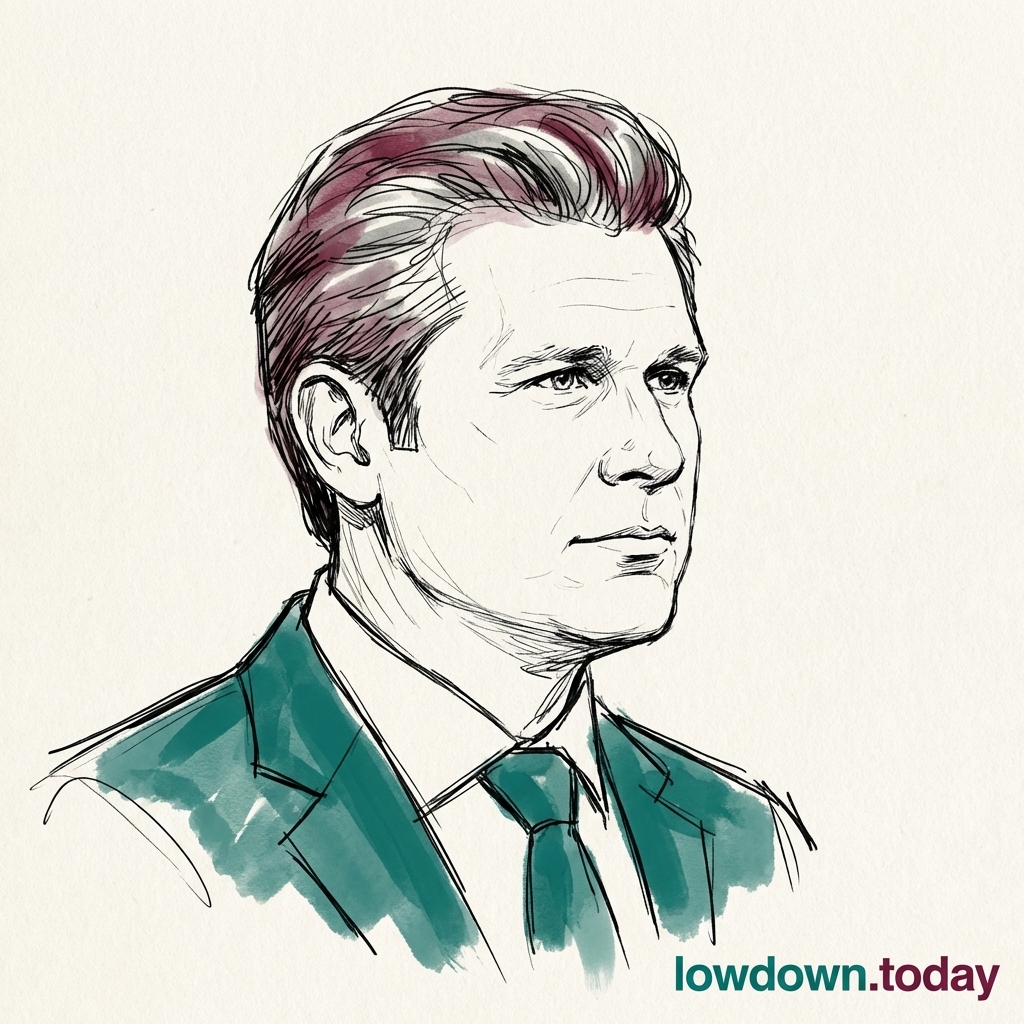
Pete Hegseth
US Secretary of War (formerly Defense); claimed Article 2 overrides any Iran AUMF, 12 May 2026.
Last refreshed: 14 May 2026 · Appears in 1 active topic
Hegseth said Trump needs no AUMF. Does Article 2 cover a 75-day undeclared war?
Timeline for Pete Hegseth
Mentioned in: Cooper: 90% of Iran's mines cleared
Iran Conflict 2026Mentioned in: AUMF unfiled, blackout hits 1,728 hours
Iran Conflict 2026Testified Article 2 covers Iran strikes, making AUMF unnecessary, destroying Murkowski's bipartisan vehicle
Iran Conflict 2026: Murkowski's Iran AUMF collapses after Hegseth Article 2 testimonyMentioned in: Trump flies east, desk still empty
Iran Conflict 2026- Who is Pete Hegseth?
- Pete Hegseth is the US Secretary of Defense (signing as Secretary of War since April 2026), confirmed by a Vice President tiebreaker. A former Fox News host and Army National Guard officer, he is overseeing the largest US military operation since the 2003 Iraq invasion.Source: editorial
- Has Pete Hegseth ever served in combat?
- Hegseth served in the Army National Guard with deployments to Guantanamo Bay, Iraq, and Afghanistan, though not in frontline combat command roles. He held the rank of Major before transitioning to media.Source: editorial
- How much is the Iran war costing the US?
- The Pentagon has requested $200 billion in war supplemental funding, quadrupling initial estimates. Republican opposition in Congress has blocked the bill.Source: editorial
- Why did Republicans block the Iran war funding?
- GOP members opposed the $200 billion supplemental over concerns about cost, lack of a clear exit strategy, and no timeline for ending operations.Source: editorial
- Why is Pete Hegseth calling the Pentagon the Department of War?
- In his 29 April 2026 HASC Posture Statement, Hegseth signed as 'Secretary of War' and used 'Department of War' 18 times in FY27 appropriations text. The rebranding reflects his stated view that the Department of Defense should adopt a more overtly warfighting identity.Source: HASC
- How much has the Iran war cost so far?
- Hegseth's 29 April 2026 HASC posture statement put the Iran war cost at $25 billion, the first public figure. The figure covers mostly munitions and excludes reconstruction, strategic munitions replacement, and veterans care costs. The $1.5 trillion FY27 budget request is 40% above FY26.Source: HASC
- What did Hegseth say about NATO allies and the Iran war?
- In his 29 April HASC posture statement, Hegseth condemned NATO allies who refused base, overflight, and basing rights during the Iran campaign as 'unconscionable, and we will remember'. All five named allies — UK, France, Germany, Japan, Australia — declined to join the Hormuz escort Coalition.Source: HASC
- Why does Hegseth say Trump doesn't need an AUMF for Iran?
- On 12 May 2026 Hegseth told the Senate Appropriations Committee that Trump has 'all the authorities he needs under Article 2' of the Constitution, making a congressional war authorisation unnecessary. This converts 75 days of no signed Iran instruments from an oversight gap into a stated doctrine.Source: US Senate Appropriations Committee testimony
- What is the 'Department of War' rebrand Hegseth announced?
- On 29 April 2026 Hegseth filed his FY27 posture statement signed as 'Secretary of War'. The phrase 'Department of War (DoW)' appears 18 times in formal congressional appropriations text, marking the first formal use of the pre-1947 name in federal documents since the National Security Act merged it into the Department of Defense.Source: HASC FY27 Posture Statement
- How much has the Iran war cost the US so far?
- Hegseth's April 2026 posture statement disclosed $25 billion as the first public cost figure for the Iran war, described as mostly munitions. This figure excludes reconstruction, veterans' care, and longer-term costs. A $200 billion war supplemental request was separately blocked by Republican opposition in Congress.Source: HASC FY27 Posture Statement
- Was Pete Hegseth confirmed by the full Senate?
- Hegseth was confirmed by the narrowest margin in modern history, with Vice President JD Vance casting the tie-breaking vote after the Senate split evenly. His lack of senior defence experience drew sustained scrutiny during and after confirmation.
- What is bipartisan frustration with Hegseth about?
- Both parties expressed frustration at Hegseth's Senate testimony on 12 May 2026: Republicans and Democrats objected to his assertion that no AUMF was needed, the administration's $29 billion war-spending request, and the 75-day pattern of zero signed Iran instruments. WaPo described the reaction as 'intense bipartisan frustration'.Source: Washington Post
- Why did Pete Hegseth say no AUMF is needed for the Iran war?
- Hegseth testified before the Senate Appropriations Committee on 12 May 2026 that Trump has 'all the authorities he needs under Article 2' of the Constitution, making a formal congressional authorisation unnecessary. The statement converted 75 days of unsigned Iran instruments from an oversight gap into a stated doctrine.Source: Senate Appropriations Committee testimony, 12 May 2026
- Who is Pete Hegseth and what did he do before becoming Defence Secretary?
- Pete Hegseth is the US Secretary of Defense, confirmed by a Vice Presidential tiebreaker after nomination by Donald Trump. Before taking office he spent a decade as a Fox News weekend host; prior to that he served in the Army National Guard with deployments to Iraq, Afghanistan, and Guantanamo Bay. He holds degrees from Princeton and Harvard Kennedy School.
- What is the 'Secretary of War' rebrand Hegseth is pushing?
- On 29 April 2026 Hegseth signed a 27-page posture statement to Congress as 'Secretary of War' rather than Secretary of Defense. The phrase 'Department of War' (DoW) appears 18 times in FY27 appropriations text, and the document names Operation EPIC FURY publicly for the first time alongside a $1.5 trillion FY27 defence request.Source: HASC Posture Statement, 29 April 2026
- How did Hegseth justify the Iran war under the War Powers Resolution?
- Hegseth told the Senate Armed Services Committee on 30 April 2026 that the WPR 60-day clock pauses during a Ceasefire, a theory Senator Tim Kaine rejected as unsupported by statute. By 12 May the administration had shifted further, asserting the WPR clock never started at all because the US is 'not at war' with Iran.Source: SASC testimony, 30 April 2026; White House statement, 1 May 2026
- What is the US defence budget request for FY27 under Hegseth?
- Hegseth's posture statement requests $1.5 trillion for FY27, a 40% increase above FY26 and the largest absolute rise since 2003. The statement also surfaces a $25 billion Iran war cost as the first public figure for the conflict, rising to $29 billion by 12 May 2026.Source: HASC Posture Statement, 29 April 2026; Senate Appropriations testimony, 12 May 2026
Background
Pete Hegseth was confirmed as Secretary of Defense by the narrowest margin in modern history — Vice President Vance casting the tie-breaking vote — after a nomination by Donald Trump. A Princeton and Harvard Kennedy School graduate, he served in the Army National Guard with deployments to Iraq, Afghanistan and Guantanamo Bay before a decade as a Fox News weekend host.
On 29 April 2026, Hegseth filed a 27-page Posture Statement to HASC (the House Armed Services Committee), signed Secretary of War. The phrase DoW (Department of War) appears 18 times in FY27 appropriations text; Operation EPIC FURY is named in a congressional document for the first time; NATO allies who refused base and overflight rights during the Iran campaign are condemned as 'unconscionable, and we will remember' . The statement surfaces a $25 billion Iran war cost — the first public figure of the conflict, mostly munitions — and a $1.5 trillion FY27 defence request, 40% above FY26 and the largest absolute rise since 2003. He led the campaign overseeing over 9,000 targets struck and 130 Iranian warships destroyed in the first 25 days .
His management of the conflict has drawn scrutiny from both parties. Republican opposition blocked the $200 billion war supplemental , and DNI Tulsi Gabbard contradicted Pentagon claims under oath. He held a 7 April press conference claiming the day's strike volume was 'the largest since Day 1' as both US carriers repositioned out of Iranian missile range and Iranian outbound volume reached its lowest level since the war began . Hegseth's transition from cable news pundit to wartime defence secretary — now publicly rebranding the department he leads — is without precedent in American history.
On 12 May 2026, Hegseth testified before the Senate Appropriations Committee on $29 billion of Iran war spending. Asked by Senator Lisa Murkowski whether an AUMF would be 'helpful', Hegseth replied that Trump has 'all the authorities he needs under Article 2' and that 'we don't need' an AUMF. The testimony was the first time a cabinet officer formally named the verbal-track method as policy rather than merely leaving it unstated, converting 75 consecutive days without a signed Iran instrument from an oversight gap into a stated doctrine .
The statement drew intense bipartisan frustration (WaPo) and rendered Murkowski's threatened AUMF procedurally moot — her filing preconditions are now irrelevant if the administration asserts no authorisation is needed. Hegseth had previously told SASC on 30 April that the WPR 60-day clock pauses during a Ceasefire, a theory Senator Tim Kaine rejected as unsupported by statute .