Skip to content
Briefings are running a touch slower this week while we rebuild the foundations.See roadmap
Iran Conflict 2026
30APR

Hegseth signs as Secretary of War

4 min read
11:30UTC

Pete Hegseth filed a 27-page FY27 Posture Statement to the House Armed Services Committee on 29 April, signed Secretary of War, naming Operation EPIC FURY for the first time and disclosing a $25 billion Iran war cost.

ConflictDeveloping
Key takeaway

Hegseth rebranded the Pentagon in FY27 budget ink and disclosed the $25 billion Iran war cost.

Pete Hegseth filed a 27-page Fiscal Year 2027 (FY27) Posture Statement to HASC (the House Armed Services Committee) on Wednesday 29 April, signed Secretary of War 1. The phrase Department of War (DoW) appears eighteen times in the formal appropriations text. Operation EPIC FURY, the Iran campaign, is named in a congressional document for the first time. NATO allies who refused base, overflight and basing rights during the campaign are condemned in writing as "unconscionable, and we will remember".

The Posture Statement is the annual defence-policy brief Congress uses to size next year's appropriation. By placing the rebrand inside that vehicle, Hegseth has bypassed the statutory route by which the War Department became the Department of Defense in 1947. That earlier change ran from law (the National Security Act) to title; this one runs from title to law, with budget language as the wedge. Once committee staff mark up FY27 against text that already says Department of War, removing the phrase would require a House vote rather than a presidential reversal.

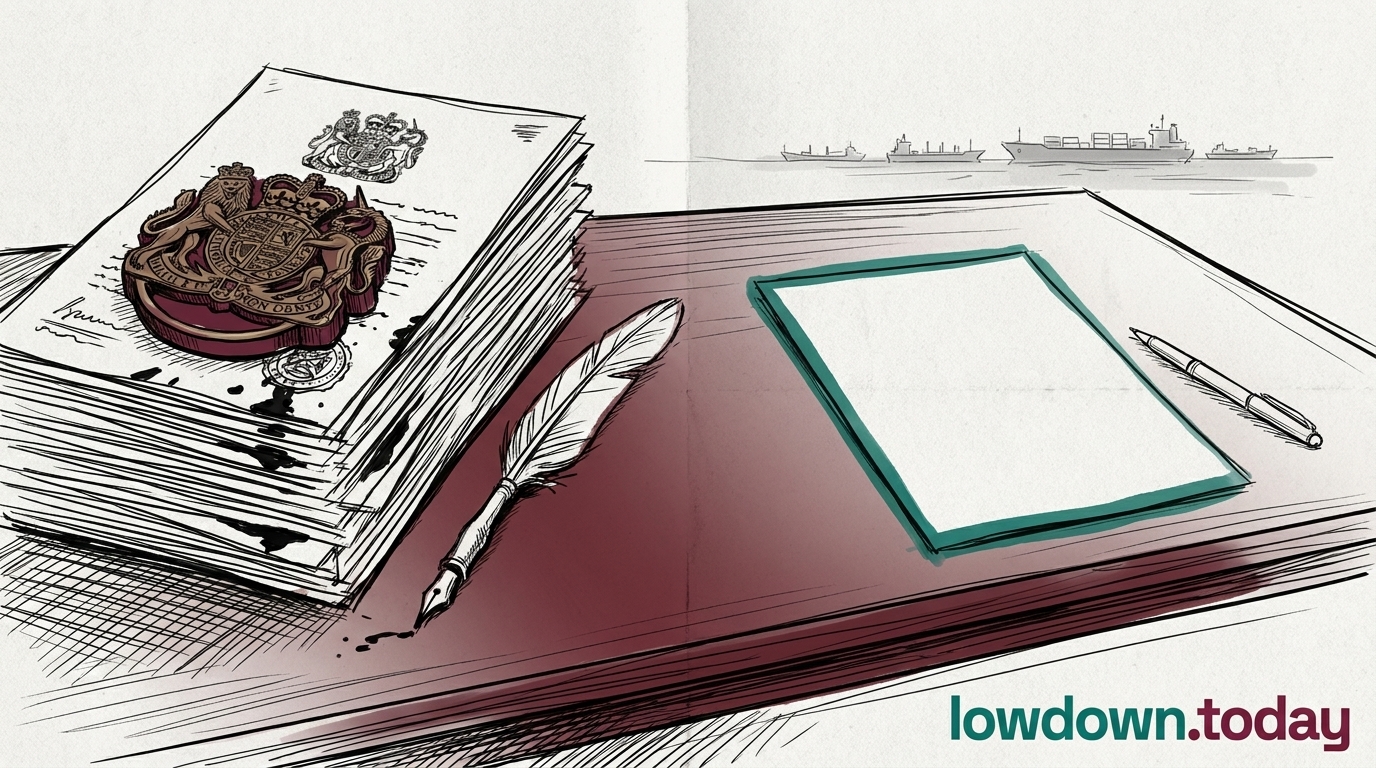
Pentagon CFO Jules Hurst III disclosed the first public cost figure of the conflict: $25 billion, mostly munitions 2. The number excludes reconstruction, replacement strategic munitions and veterans' care; it is roughly two months of NHS spending in a single Pentagon line, on a campaign Trump has signed nothing for, the same blank-paper pattern documented across the war , . The headline ask is bigger still: a $1.5 trillion FY27 defence request, 40% above FY26, the largest absolute appropriations rise since 2003.

The NATO clause is the foreign-policy bomb buried in the posture. Spain, Belgium and Italy were the names mentioned in informal Pentagon briefings as the allies who declined basing during EPIC FURY. Putting their refusal into formal HASC testimony, with the words "we will remember" preserved, hands future US administrations a template for procurement and intelligence-sharing reciprocity. The Senate's fifth WPR rejection on 22 April failed at 51-46; the appropriations track Hegseth has chosen does not require the same margin. Congress will spend money against the language he has written, even if Donald Trump never signs a single Iran instrument.

Deep Analysis

In plain English

Pete Hegseth runs the US military as its top civilian official. In a document submitted to Congress on 29 April, he called himself "Secretary of War" rather than "Secretary of Defense" and referred to his department as the "Department of War" throughout. This is not the department's legal name. Congress created the Department of Defense in 1947 specifically to replace the old War Department. The document also revealed for the first time that the Iran campaign has an official military codename: Operation Epic Fury. It put a price tag on the war for the first time: $25 billion, mostly spent on weapons. The same document asked Congress to approve a defence budget of $1.5 trillion for next year, which is 40% more than this year. Congress has not yet agreed to this.

Deep Analysis
Root Causes

Iran's JCPOA withdrawal in 2018-2019 removed the inspection architecture that had constrained the nuclear programme; by 2026, Washington faced an Iran with advanced enrichment capacity and no verification mechanism, producing a military-first response without the political groundwork that treaty-based diplomacy would have required.

Trump's second-term administrative theory that the executive branch can rebrand agencies unilaterally through presidential direction rather than statute drives the DoW language. The same logic produced the Department of Government Efficiency operating outside the statutory framework that governs executive agencies.

Congress's failure to pass an AUMF across 62 days left Hegseth with appropriations as the only available instrument to build legal-adjacent legitimacy. Budget text cannot authorise a war, but it can establish narrative precedent that shapes subsequent political debate.

What could happen next?
  • Precedent

    DoW branding in appropriations text normalises the conflict's framing before any AUMF exists, constraining future de-escalation rhetoric.

    Short term · High
  • Consequence

    The $25 billion cost disclosure triggers supplemental funding negotiations that may expose the 62-day legal gap to sharper congressional scrutiny.

    Immediate · High
  • Risk

    NATO allies condemned in writing face domestic political pressure to respond publicly, compounding the alliance fracture already visible at HASC.

    Short term · Medium
  • Consequence

    Munitions-dominated cost structure creates an 18-24 month readiness gap in US precision-strike inventory regardless of conflict outcome.

    Medium term · Medium
First Reported In

Update #84 · Department named, war unsigned

House Armed Services Committee· 30 Apr 2026
Read original
Causes and effects
This Event
Hegseth signs as Secretary of War
Congressional appropriations text now carries the institutional rebrand of the Pentagon, the official operation name and the war's cost figure, none of which the President who ordered the campaign has signed into formal effect.
Different Perspectives
Israel
Israel
Israeli strikes on Hezbollah positions in Lebanon continued through the weekend, maintaining the secondary front. The IDF has publicly named Mojtaba Khamenei as an assassination target; his courier-governance mode complicates targeting but does not remove him from the order.
Russia
Russia
Putin told a Moscow press conference that Washington, not Tehran or Moscow, killed the Russia-custody uranium arrangement by demanding US-territory-only storage. Neither Tehran nor Washington has corroborated the account, which appeared in second-tier outlets only, consistent with a trial balloon rather than a formal position.
United Kingdom
United Kingdom
HMS Dragon was redeployed from the Eastern Mediterranean to the Middle East on 9 May, the first physical European platform commitment to the Gulf. The Ministry of Defence called it "prudent planning" while publishing no rules of engagement, no tasking order, and no vessel name, committing a named asset to a conflict zone before the political instrument authorising it exists.
United Arab Emirates
UAE air defences intercepted two Iranian drones over its territory on 10 May, a kinetic escalation six days after the Fujairah oil terminal strike that drew no formal protest. The three-state simultaneous operation, not the severity of individual strikes, appears to have crossed the threshold at which the GCC states collectively began responding.
Saudi Arabia
Saudi Arabia
Riyadh issued the first formal Gulf-state protest of the conflict on 10 May, demanding an "immediate halt to blatant attacks on territories and territorial waters of Gulf states", ending 10 weeks of channelling displeasure through OPEC+ quota discussions. The protest forecloses Saudi Arabia's preferred quiet-channel role and reduces the functioning back-channel architecture to Pakistan alone.
Qatar
Qatar
Doha is simultaneously a strike target, the site of the Safesea Neha attack 23 nautical miles offshore, and an active MOU mediator: Qatar's prime minister met Rubio and Vance in Washington the same weekend. Whether Qatar issues its own formal protest or maintains its dual role is the critical escalation indicator for the week of 11 May.