Skip to content
Briefings are running a touch slower this week while we rebuild the foundations.See roadmap
Iran Conflict 2026
6MAY

Truxtun and Mason run the gauntlet

3 min read
10:13UTC

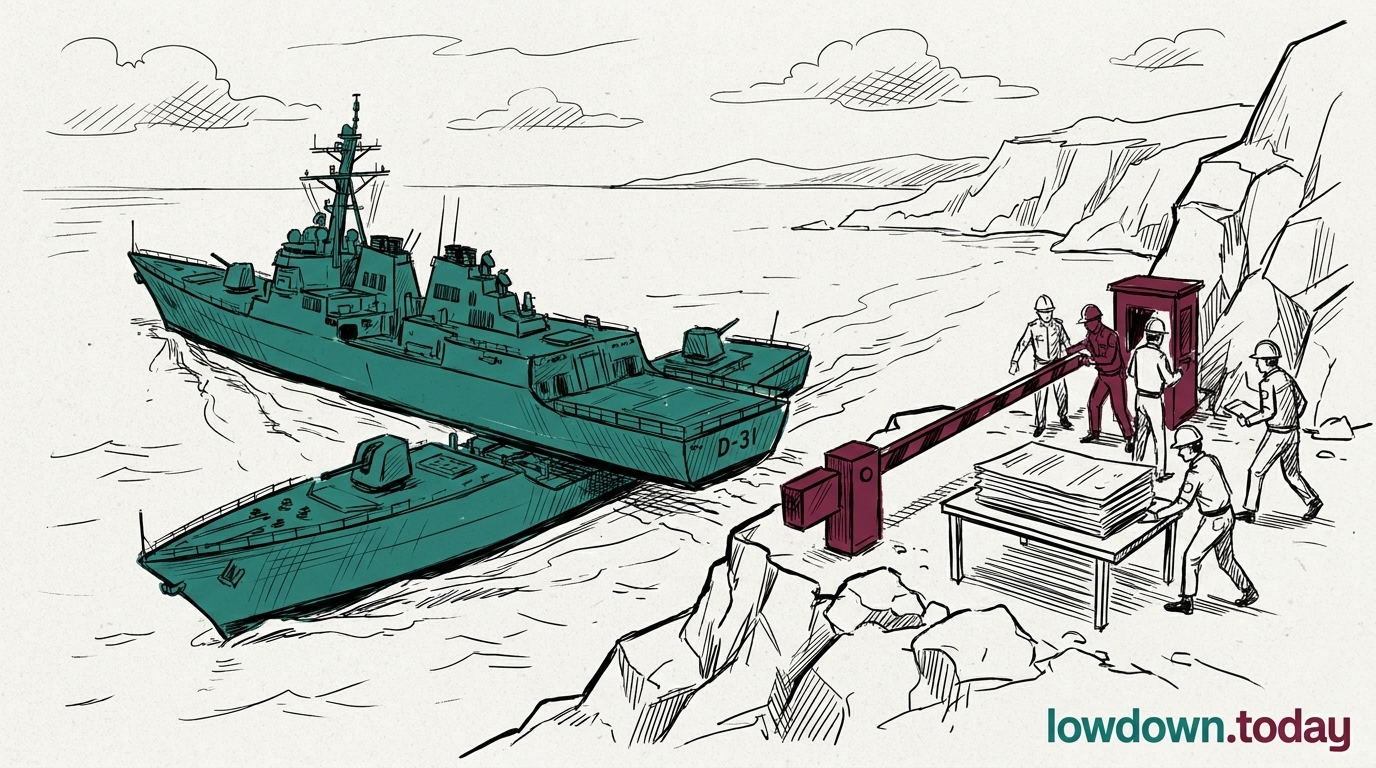
USS Truxtun and USS Mason completed the first armed Hormuz escort transit on 4 May under sustained IRGC fire, sinking six to seven Iranian small craft and shepherding two American-flagged merchant vessels through unscathed.

ConflictDeveloping
Key takeaway

American destroyers won the first contact; Iran's territorial claim over the strait was untouched.

USS Truxtun (DDG-103) and USS Mason (DDG-87) made the first successful armed escort transit of the Strait of Hormuz under sustained IRGC (Islamic Revolutionary Guard Corps) fire on Monday 4 May, the opening day of Project Freedom . CENTCOM (US Central Command) said its destroyers defeated 'each and every threat' from small boats, cruise missiles and drones; attack helicopters and naval gunfire accounted for the losses, with CBS News reporting seven Iranian craft sunk and Al Jazeera six 1. Two American-flagged merchant vessels followed the destroyers through. No US casualties; both ships unscathed.

The attacks came from the Bandar Abbas flotilla, with cruise missiles from IRGC Navy coastal batteries and drones launched from southern provinces 2. Iran claimed it had hit a US naval vessel, a claim CENTCOM denied 3. The boat-loss count matters because the IRGC told the Majlis (Iran's parliament) on Saturday 2 May that 60 per cent of its small attack-boat fleet had survived the opening Israeli airstrikes . On Tehran's own arithmetic, six or seven losses is a tolerable rate of attrition: the doctrine that treats the strait as home water remained intact through the contact.

The Truxtun and Mason transit ran through a corridor Iran's elected legislature now treats as territorial. The Majlis National Security Commission ratified a 12-article Hormuz sovereignty law on 2 May , built on Mojtaba Khamenei's written claim of 'new management' over the waterway . CENTCOM's written order, like the version issued before Project Freedom, covers Iranian-port traffic only and does not incorporate Trump's Truth Social toll-interdiction provision , . The American flag passed through the channel; the Iranian institutional claim over it did not move.

Deep Analysis

In plain English

Two US Navy destroyers sailed through the Strait of Hormuz on 4 May while Iran fired missiles, drones and fast-attack boats at them. Both destroyers shot down every attack and came through without a scratch. Two American cargo ships behind them completed the journey safely. The Strait of Hormuz is a narrow waterway between Iran and the Arabian Peninsula through which about a fifth of the world's oil passes. Iran has been blocking ships since late February. This was the US Navy's first attempt to force a ship through under fire, and it worked militarily. But Iran lost only a handful of small boats, and its threat to keep attacking has not gone away.

Deep Analysis
Root Causes

The doctrinal asymmetry behind this engagement runs to 1979: the IRGC Navy was constitutionally designed to be a politicised guerrilla force inside the regular navy's structure, not a symmetric peer. Its small-boat doctrine derives from the Iran-Iraq 'tanker war' (1984-1988), when speedboat swarms and Silkworm missiles proved more cost-effective than the conventional surface engagements Iran lost.

CENTCOM's written operational order for Project Freedom was never published in the Federal Register, and no presidential executive instrument has appeared on the White House actions index across 67 days of conflict.

A commander executing a mission with no executive instrument cannot publicly define escalation thresholds, which is why CENTCOM reported the 4 May engagement as purely 'defensive' while simultaneously confirming six to seven Iranian craft destroyed. That gap in the legal record gives the IRGC a standing information advantage in any post-engagement narrative contest.

What could happen next?
  • Consequence

    IRGC will now calibrate follow-on attacks based on the ammunition and kill-chain data revealed by the 4 May engagement, making the next escort transit higher-intensity.

    Short term · 0.72
  • Precedent

    The first successful contested escort transit sets a legal and operational precedent that Project Freedom can be repeated, increasing pressure on Iran to negotiate before the pause ends.

    Immediate · 0.81
  • Risk

    Without a signed AUMF, CENTCOM cannot define escalation thresholds publicly; any Iranian escalation to anti-ship ballistic missiles produces a presidential decision with no institutional guardrails.

    Short term · 0.68
First Reported In

Update #89 · Truxtun gets through; Trump pulls back

Al Jazeera· 6 May 2026
Read original
Different Perspectives
Israel
Israel
Israeli strikes on Hezbollah positions in Lebanon continued through the weekend, maintaining the secondary front. The IDF has publicly named Mojtaba Khamenei as an assassination target; his courier-governance mode complicates targeting but does not remove him from the order.
Russia
Russia
Putin told a Moscow press conference that Washington, not Tehran or Moscow, killed the Russia-custody uranium arrangement by demanding US-territory-only storage. Neither Tehran nor Washington has corroborated the account, which appeared in second-tier outlets only, consistent with a trial balloon rather than a formal position.
United Kingdom
United Kingdom
HMS Dragon was redeployed from the Eastern Mediterranean to the Middle East on 9 May, the first physical European platform commitment to the Gulf. The Ministry of Defence called it "prudent planning" while publishing no rules of engagement, no tasking order, and no vessel name, committing a named asset to a conflict zone before the political instrument authorising it exists.
United Arab Emirates
UAE air defences intercepted two Iranian drones over its territory on 10 May, a kinetic escalation six days after the Fujairah oil terminal strike that drew no formal protest. The three-state simultaneous operation, not the severity of individual strikes, appears to have crossed the threshold at which the GCC states collectively began responding.
Saudi Arabia
Saudi Arabia
Riyadh issued the first formal Gulf-state protest of the conflict on 10 May, demanding an "immediate halt to blatant attacks on territories and territorial waters of Gulf states", ending 10 weeks of channelling displeasure through OPEC+ quota discussions. The protest forecloses Saudi Arabia's preferred quiet-channel role and reduces the functioning back-channel architecture to Pakistan alone.
Qatar
Qatar
Doha is simultaneously a strike target, the site of the Safesea Neha attack 23 nautical miles offshore, and an active MOU mediator: Qatar's prime minister met Rubio and Vance in Washington the same weekend. Whether Qatar issues its own formal protest or maintains its dual role is the critical escalation indicator for the week of 11 May.