Skip to content
Welcome, thoughtbot's Giant Robots listeners!Start here
US Midterms 2026
24SEP

Court ruling could break the firewall

4 min read
11:45UTC

The Supreme Court is expected to rule by the end of June in NRSC v. FEC, a Republican challenge that could let party committees spend without limit hand-in-hand with their own candidates.

PoliticsDeveloping
Key takeaway

If the Supreme Court strikes the coordination caps, a Democratic fundraising edge stops being a structural one.

The Supreme Court is expected to rule by the end of June in NRSC v. FEC, the National Republican Senatorial Committee's challenge to limits on how much a party committee can spend in coordination with its own candidates⁠1. Those limits sit in the Federal Election Campaign Act (FECA), the 1971 statute that governs US campaign finance, and are enforced by the Federal Election Commission (FEC). The case was argued on 9 December 2025.

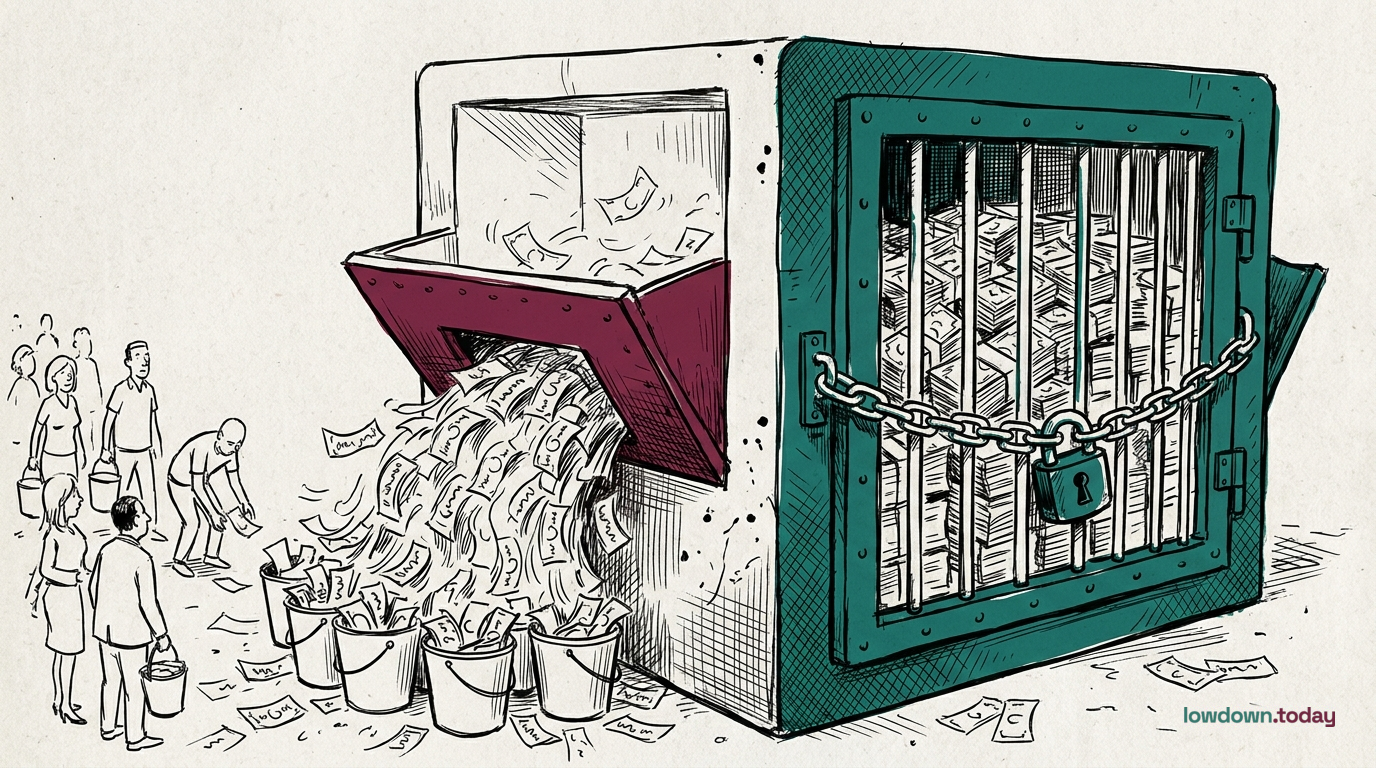
At argument, Justice Brett Kavanaugh said the caps had weakened parties relative to outside groups, and the conservative majority signalled it was ready to strike them⁠2. The mechanism decides the stakes. Today a super PAC, a group that raises unlimited money but cannot legally coordinate with a campaign, must run a parallel operation. That is why the Senate Leadership Fund, the main Republican Senate super PAC, builds its own $342 million plan rather than handing the cash to candidates. An independent expenditure (IE) is spending that backs a candidate without the campaign's involvement, and the firewall between the two is what the caps police.

Strike the caps and the NRSC, the NRCC, the DSCC and the DCCC, the four party campaign committees, could all spend without limit in direct consultation with named candidates: same message, same targeting, no firewall. The Democratic committee-cash lead, the $12.6 million edge the DCCC banked over the NRCC, rests on the assumption that parties can spend only within the caps. Remove them and a fundraising advantage stops being a structural one, because Republicans could match it through direct coordination instead.

The Sixth Circuit, the federal appellate court for Michigan, Ohio, Kentucky and Tennessee, upheld the law before the Supreme Court took the case. The justices could rule narrowly rather than abolishing the limits outright, and the opinion had not issued at publication.

Deep Analysis

In plain English

In US elections, political parties and their candidates are not supposed to spend money in lockstep with each other: the law sets a cap on how much a party committee, like the Democrats' or Republicans' national senatorial or congressional committees, can spend in direct coordination with its candidates. The idea is to limit the influence of any single funding stream over a campaign. the Supreme Court is looking at a challenge from the National Republican Senatorial Committee (NRSC), the Republican Party's Senate arm, which argues those limits are unconstitutional. If the Court agrees, both parties' committees could spend unlimited amounts in direct coordination with their candidates, meaning the same people running the campaign could also direct the party's money with no ceiling. That is different from a super PAC, which must run a genuinely independent operation by law.

Deep Analysis
Root Causes

The coordinated-spending cap exists because the 1974 post-Watergate FECA reforms treated party committees and candidate campaigns as institutionally separate, subject to the same anti-corruption logic applied to other contributors.

The gap between that 1974 architecture and the post-Citizens United spending environment is the structural root cause: when super PACs can spend unlimited sums independently, a cap that constrains only party committees achieves the opposite of its original purpose, shifting power from accountable party structures to unaccountable outside groups.

The second root cause is the asymmetry the cap creates between parties and their own nominees. A donor writing a cheque to a super PAC faces no coordination limit with the campaign; a party committee doing the same faces a per-state cap running from roughly $50,000 to $100,000 depending on state population. Justice Kavanaugh named this asymmetry at oral argument as constitutionally anomalous, and it has been the doctrinal entry point for the challenge.

What could happen next?
  • Consequence

    Party committees gain the ability to spend unlimited sums in direct coordination with named candidates, collapsing the functional distinction between a campaign operation and a party committee for the November 2026 cycle.

    Immediate · Reported
  • Consequence

    The Senate Leadership Fund's $342 million parallel structure loses its legal justification if the caps fall; the SLF may redirect to House races or wind down Senate operations, reshaping the Republican outside-spending map.

    Short term · Reported
  • Risk

    A narrow ruling, upholding some caps while striking others, or remanding to the lower courts, would leave the legal architecture uncertain for the autumn campaign window with insufficient time to build coordinated plans from scratch.

    Immediate · Reported
  • Precedent

    A broad ruling striking the caps would complete the arc from Colorado Republican I (1996) through Citizens United (2010): the last major structural constraint on party-candidate coordination in federal elections would be gone.

    Long term · Assessed
First Reported In

Update #9 · Florida locks the map; the rulebook locks next

CBS News· 14 Jun 2026
Read original →
Different Perspectives
Missouri and Secretary of State Denny Hoskins
Missouri and Hoskins, held in contempt by the state's own supreme court on 10 September for prematurely reverting to HB 1, filed against a pause of the 8th Circuit's order restoring the same 2025 map.
Richard von Glahn and People Not Politicians
Von Glahn and People Not Politicians filed emergency application 26A388 on 22 September asking Justice Kavanaugh to pause the 8th Circuit's order restoring the 2025 map, days after Missouri mailed overseas ballots under the 2022 lines. A refusal to pause it would leave those ballots carrying the wrong districts.
Harmeet Dhillon, Justice Department
Dhillon said the department will send about 1,000 election monitors to Nevada, Pennsylvania and Rhode Island in November, calling it "the biggest DOJ election observer effort in history" and citing "67 election-related indictments and convictions" against 13 under the Biden administration.
National Association for the Advancement of Colored People and co-plaintiffs
The NAACP and eight other groups sued DHS in Washington on 18 September to keep ICE away from polling places, citing federal statutes barring armed officers and troops at elections. The suit follows a released 2025 DHS email listing non-English-language voting jurisdictions beside a Justice Department prosecution checklist.
Cook Political Report
Cook wrote that "the amount of money national Republicans have dedicated to this race is a flashing red light for Democrats" when it moved New Hampshire from Lean Democrat to Toss Up on 15 September, citing the NRSC's $5.18m for Sununu. It is the one state where Republican spending and the rating move the same direction.
Democratic Senate strategists
Strategists note the DSCC held a $37.6m cash lead over the NRSC's $18.7m at the end of August, after coordinating just $1.00m of spending itself. One reading holds the committee is banking that cash for the campaign's final weeks rather than matching Republican spending dollar-for-dollar in August.