Skip to content
Welcome, thoughtbot's Giant Robots listeners!Start here
US Midterms 2026
24SEP

DCCC banks record quarter on borrowed time

4 min read
11:45UTC

The DCCC raised a cycle-record $45.3 million in Q2, the DSCC outraised the NRSC in June, and Democratic committees filed against the one Supreme Court case that could erase the whole advantage.

PoliticsDeveloping
Key takeaway

The Democratic money advantage is real and contingent on a Court ruling its own lawyers are fighting to shape.

The DCCC, the House Democrats' campaign arm, raised a cycle-record $45.3 million in the second quarter, edging its own 2024 record of $44 million, on self-reported figures that face the FEC filing deadline of 15 July⁠1. On the Senate side, the DSCC outraised the NRSC in June, $8.3 million to $8.0 million⁠2. The Democratic committee lead, already the widest this cycle after April's $12.6 million swing, has widened again.

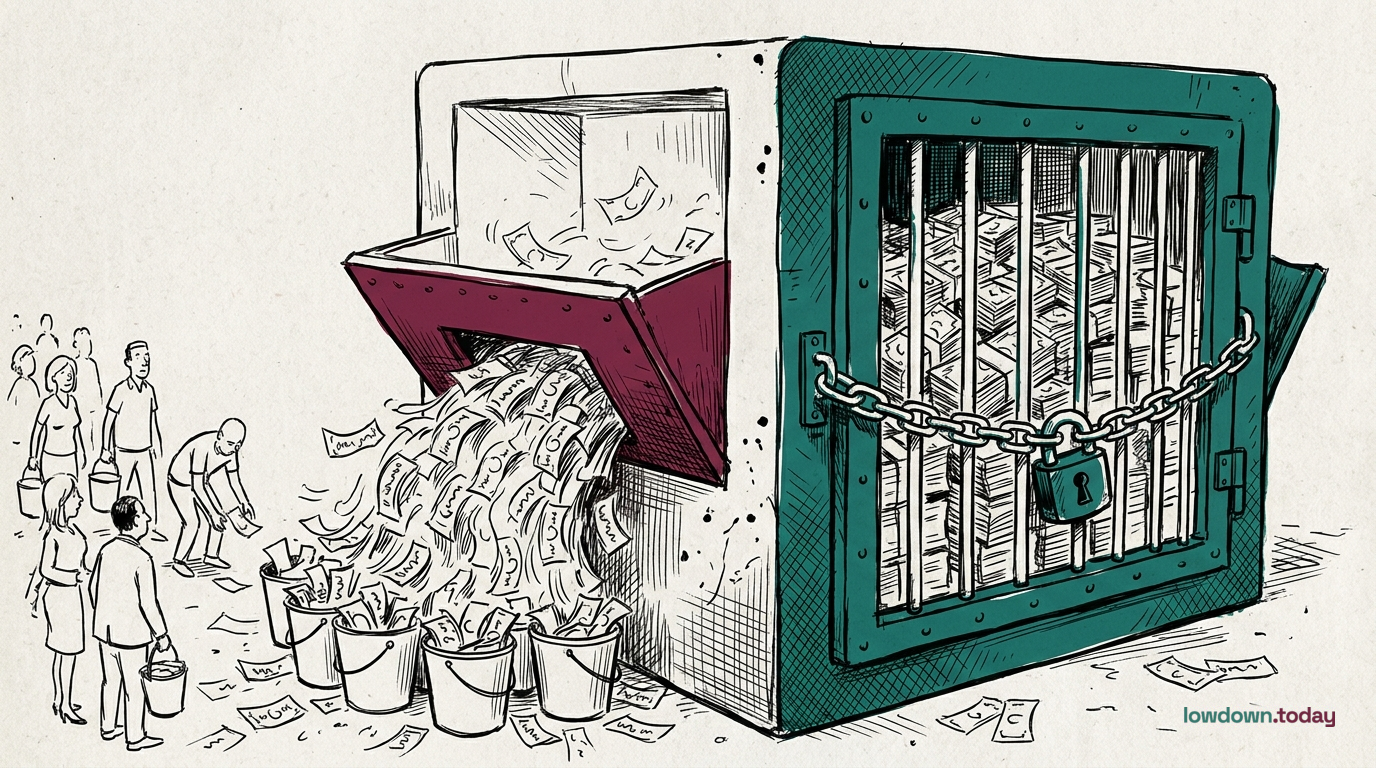
The same committees filed their brief against NRSC v. FEC in this window. That case asks the Supreme Court to strike the FECA caps, the Federal Election Campaign Act limits on how much a party may spend in coordination with its own candidates, which run from roughly $61,800 to $3.7 million per race. Coordinated party money is qualitatively different from super-PAC money because it can be aimed straight into a named candidate's strategy. That is the lever the NRSC argues it is denied and the lever Democratic committees are defending.

Strike the caps, and Republican committees could deploy unlimited coordinated money, at which point a quarterly fundraising lead stops deciding much. A single end-of-term ruling could neutralise the $45.3 million edge Democrats spent the quarter building. Until any ruling lands, that total still funds the ground game, the field offices and voter-registration drives, that super PACs are barred from running. The NRSC's counter is that the caps are an unconstitutional limit on political speech, not a structural favour to either party; the liberal justices warned at December's argument that lifting them invites corruption.

Deep Analysis

In plain English

US campaign finance law creates a distinction between what a political party can spend coordinating directly with a candidate (subject to caps) and what it can spend independently on advertising without talking to the candidate (unlimited). The Democratic Congressional Campaign Committee, which works to elect House Democrats, just announced its best fundraising quarter ever: $45.3 million. But the Supreme Court is about to rule in a case called NRSC v. FEC, brought by the Republican Senate committee. If Republicans win that case, the legal caps on what party committees can spend in coordination with their own candidates will disappear. That would let party committees deploy their cash directly alongside campaign operations, making the official committee fundraising totals far more powerful than they currently are. The irony: the Democratic committees filed a court brief opposing this change in the same week they announced record fundraising. They are winning the current rules while fighting to keep those rules in place.

Deep Analysis
Root Causes

Three structural dynamics intersect in this event. First, DCCC fundraising reflects small-donor enthusiasm driven by opposition to Trump's economic management. The Marist 33% economy approval (D+6 generic ballot environment) generates grassroots Democratic fundraising in a cycle when the DCCC benefits from the same retail energy that fuelled Talarico's $27 million Q1 Senate quarter in Texas.

Second, the NRSC v. FEC case exists because the post-Citizens United super-PAC structure created an incentive problem for party committees: their money had to flow through less-efficient parallel structures while outside groups like the Senate Leadership Fund operated without coordination constraints. The NRSC's legal theory is that FECA's caps perversely weakened the party apparatus relative to unaccountable outside money.

Third, the Democratic committees filing an opposition brief while simultaneously announcing record fundraising reflects a genuine strategic paradox: they are defending a legal architecture that they are simultaneously beating within. If they win the NRSC v. FEC case, they preserve the legal structure that currently benefits their Q2 record. If they lose, the money still exists but the tactical advantage of coordinated deployment disappears.

What could happen next?
  • Risk

    A ruling against the FECA coordinated-spending caps in NRSC v. FEC before 30 June would convert the DCCC's $45.3 million Q2 record from a structural advantage into a fundraising headline, as Republican party committees with smaller cash totals could still deploy coordinated spending without limit.

    Immediate · Assessed
  • Opportunity

    If NRSC v. FEC preserves the caps, DCCC's cash lead enters Q3 intact, allowing the committee to begin early advertising buys in the seven seats Cook just moved to competitive territory before Republican outside money can mobilise.

    Short term · Assessed
  • Precedent

    A ruling striking coordinated-spending caps would structurally dissolve the legal firewall between party spending and campaign operations that forces the Senate Leadership Fund to run parallel operations; the post-ruling campaign finance architecture would resemble a pre-Watergate party-committee model.

    Long term · Assessed
First Reported In

Update #10 · Wave or grind: the measure splits

DCCC· 21 Jun 2026
Read original →
Different Perspectives
Missouri and Secretary of State Denny Hoskins
Missouri and Hoskins, held in contempt by the state's own supreme court on 10 September for prematurely reverting to HB 1, filed against a pause of the 8th Circuit's order restoring the same 2025 map.
Richard von Glahn and People Not Politicians
Von Glahn and People Not Politicians filed emergency application 26A388 on 22 September asking Justice Kavanaugh to pause the 8th Circuit's order restoring the 2025 map, days after Missouri mailed overseas ballots under the 2022 lines. A refusal to pause it would leave those ballots carrying the wrong districts.
Harmeet Dhillon, Justice Department
Dhillon said the department will send about 1,000 election monitors to Nevada, Pennsylvania and Rhode Island in November, calling it "the biggest DOJ election observer effort in history" and citing "67 election-related indictments and convictions" against 13 under the Biden administration.
National Association for the Advancement of Colored People and co-plaintiffs
The NAACP and eight other groups sued DHS in Washington on 18 September to keep ICE away from polling places, citing federal statutes barring armed officers and troops at elections. The suit follows a released 2025 DHS email listing non-English-language voting jurisdictions beside a Justice Department prosecution checklist.
Cook Political Report
Cook wrote that "the amount of money national Republicans have dedicated to this race is a flashing red light for Democrats" when it moved New Hampshire from Lean Democrat to Toss Up on 15 September, citing the NRSC's $5.18m for Sununu. It is the one state where Republican spending and the rating move the same direction.
Democratic Senate strategists
Strategists note the DSCC held a $37.6m cash lead over the NRSC's $18.7m at the end of August, after coordinating just $1.00m of spending itself. One reading holds the committee is banking that cash for the campaign's final weeks rather than matching Republican spending dollar-for-dollar in August.