Skip to content
You can now search across every topic, entity and event.What's new
US Midterms 2026
7SEP

Jeffries sends Morelle to Albany on retaliation

3 min read
13:32UTC

House Minority Leader Hakeem Jeffries dispatched Joseph Morelle to Albany on Monday 4 May to coordinate New York's redistricting response and named Illinois and Maryland as further targets.

PoliticsDeveloping
Key takeaway

Democrats named three retaliation targets; each one's machinery moves slower than red-state line-drawing.

House Minority Leader Hakeem Jeffries asked Ranking Member Joseph Morelle to travel to Albany on Monday 4 May 2026 to coordinate New York's redistricting response to Louisiana v. Callais. 1 Jeffries also publicly named Illinois and Maryland as Democratic retaliation targets.

None of the three runs on a Republican-style executive timetable. New York requires either court action or a constitutional amendment by referendum, the latter at minimum a multi-year track. Illinois Governor JB Pritzker signalled openness without committing to a session call. Maryland is structurally closed: the state's redistricting bill was killed by Senate President Bill Ferguson on 14 April . Jeffries naming Maryland anyway reads as positioning, given the Senate had already buried the bill.

The announcement matters as Morelle's travel rather than its substance. Jeffries is signalling the party will fight the redistricting harvest in public; the absent fourth name is the one that matters. California's independent redistricting commission, established by 2010 referendum, is the only mechanism that could match Texas's gain at scale, and it requires a referendum to bypass. Within forty-eight hours of the cascade beginning, the Democratic playbook reads as messaging, not maps.

Deep Analysis

In plain English

After Republicans used a Supreme Court ruling to trigger a wave of redistricting in Southern states, Democrats want to respond by redrawing their own states' congressional maps to gain seats. Hakeem Jeffries, the House Democratic leader, publicly named New York, Illinois, and Maryland as potential targets. But each state faces a different obstacle. New York created an independent redistricting commission in 2014, which means the state legislature cannot simply redraw maps whenever it wants; it takes multiple votes and possibly a court case. Illinois is possible but depends on whether the governor calls a special session. Maryland's bill was already killed by the state Senate President a few weeks ago. The practical result is that Republican states acted within days of the Callais ruling, while Democratic states are still working out if they legally can.

Deep Analysis
Root Causes

The Democratic retaliation problem has two structural roots. First, the states where Democrats have the clearest redistricting leverage, namely New York, California, and Illinois, each have different constraints: New York has a commission and a court that blocked the last gerrymander, California has an independent commission that cannot be bypassed without a referendum, and Illinois has no commission but requires the governor to call a session.

Second, Jeffries named Maryland despite the bill being dead. Maryland Senate President Bill Ferguson blocked the redistricting bill in April. Naming Maryland publicly either signals an attempt to pressure Ferguson or reflects a gap between Jeffries's messaging and the operational reality on the ground.

What could happen next?
  • Consequence

    Without a New York or California redistricting response, Democrats cannot offset the 12-15 seat Republican redistricting gain through new maps alone; the flip path relies on the generic ballot advantage and competitive-seat performance.

  • Opportunity

    A New York court challenge to the current map, if filed immediately, could produce a court-drawn replacement map on a timeline compatible with the November 2026 election.

First Reported In

Update #5 · Callais lands; maps move

Office of Hakeem Jeffries· 7 May 2026
Read original
Different Perspectives
New Hampshire student voters
Students who hold no accepted photo ID under HB 323 cannot vote in the 8 September primary after Judge Laplante declined to block the law on timing grounds. Whether the same rule applies on 3 November is still open.
Alaska Democratic Party
The Alaska Democratic Party moved $884,835 in coordinated spending to Mary Peltola between 17 and 30 July, more than the DCCC spent nationally in the same fortnight.
National Republican Senatorial Committee
The NRSC, which sued to remove coordinated-spending caps in NRSC v. FEC, put $2,230,472 behind candidates in the first complete month after winning that case, more than double the total for the prior six months combined.
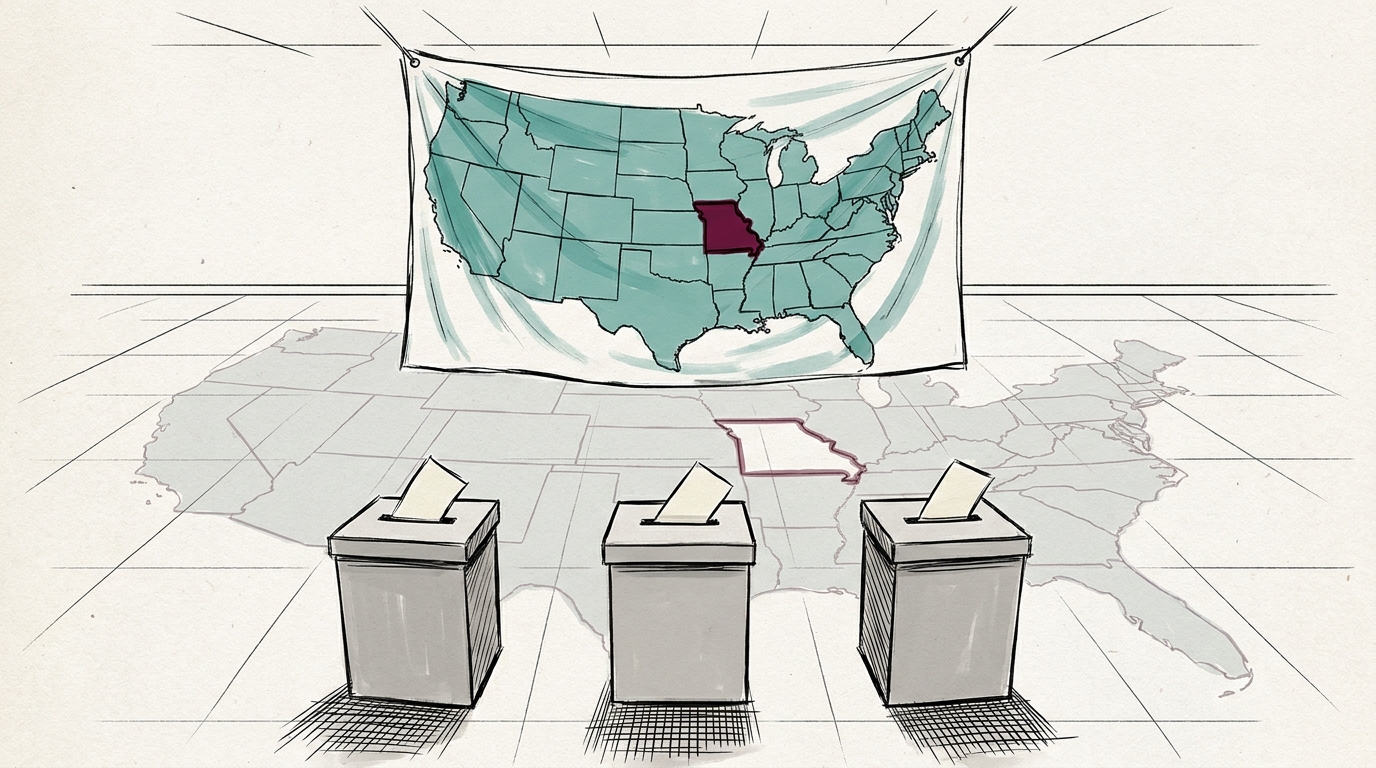
Supreme Court of Missouri
The unanimous court held that Article III, section 49 carries no redistricting exception, so a referendum petition against a congressional map is as valid as against any other law. It ordered the 2022 map to govern unless voters approve HB 1 on 3 November.
Denny Hoskins, Missouri Secretary of State
Hoskins told the Supreme Court that changing the congressional map after 1.2 million primary votes and ahead of the 19 September overseas-ballot deadline violates Purcell and the Elections Clause. He wants HB 1 reinstated before ballots print for November.
Senate Republican leadership
Floor time is finite at 51-47 with a bipartisan funding negotiation running, and a contested procedural fight over grant conditions is not the best use of it this month. Nothing has been abandoned; the resolution keeps its place on the calendar.
