Skip to content
You can now search across every topic, entity and event.What's new
US Midterms 2026
7SEP

Four more courts toss DOJ voter-data suits

3 min read
13:32UTC

Federal courts in California, Michigan, Oregon, and Rhode Island dismissed DOJ voter-data lawsuits between 9 and 17 April, all relying on the procedural reasoning the Massachusetts court established earlier in the month.

PoliticsDeveloping
Key takeaway

Five district court dismissals strain the DOJ's voter-data architecture; they do not yet collapse it.

Four federal district courts dismissed Department of Justice (DOJ) voter-data lawsuits in the fortnight after Massachusetts voided its case on 9 April . California, Michigan, Oregon, and Rhode Island all leaned on the same reasoning: each cited state law did not explicitly grant the federal government authority to demand voter records. The California ruling held that the administration "may not unilaterally usurp the authority over elections". Rhode Island dismissed on Friday 17 April 1. The University of Wisconsin Law School tracker now records five dismissals across the DOJ's nationwide suit wave .

The Massachusetts reasoning attacks a procedural defect rather than the substantive question of whether the 1960 Civil Rights Act authorises bulk voter-data demands. That makes the DOJ's loss curable on refiling, but expensive: each refiled case restarts the discovery clock and gives defendants a roadmap of which arguments survived in the first round. Five dismissals out of roughly 30 originating cases leaves the architecture straining but not collapsing.

The DOJ is appealing California, Michigan, and Oregon. Counter-view from the Trump administration, attributed to Attorney General Pam Bondi: the suits are routine compliance enforcement and the dismissals are procedural defects the department can cure on refiling. That framing has not yet been tested in any appellate court. The 9th Circuit hears the Oregon appeal on Tuesday 19 May, the first circuit-level test of whether the trial-court reasoning survives review.

Deep Analysis

In plain English

The US government has sued states to force them to hand over voter registration data, including sensitive personal information. Five states have gone to court and won, but not because the government's underlying goal was wrong: they won because the government's lawyers wrote the lawsuits incorrectly, failing to specify exactly which law gave them the right to demand the records. The government can refile those lawsuits with better paperwork. Whether the underlying demand is actually legal is a question that no court has answered yet.

Deep Analysis
Root Causes

The 1960 Civil Rights Act's section on voter-data access was drafted to address specific discriminatory voting practices, not to authorise bulk national voter registration file demands. The DOJ chose to build its voter-data programme on that statutory foundation without first testing whether the foundation would hold in federal court.

Five independent courts have now found the same gap: the department cited the statute without specifying which provision authorised the precise demand it was making. That drafting failure is correctable on refiling, but each refiling restarts the litigation clock and gives defending states a clearer roadmap of which arguments survived the first round.

What could happen next?
  • Consequence

    The 9th Circuit Oregon hearing is the first appellate test; an affirmance would convert trial-court reasoning into binding precedent across the western circuit, covering California, Oregon, and Washington, making refiling those cases substantially harder for the DOJ.

  • Risk

    If the DOJ refiles all five dismissed cases with corrected statutory citations before the autumn, the litigation restarts with a discovery clock running through the November 2026 election period, creating maximum disruption to state election administration.

First Reported In

Update #4 · Calendar versus court

University of Wisconsin Law School State Democracy Research Initiative· 28 Apr 2026
Read original
Different Perspectives
New Hampshire student voters
Students who hold no accepted photo ID under HB 323 cannot vote in the 8 September primary after Judge Laplante declined to block the law on timing grounds. Whether the same rule applies on 3 November is still open.
Alaska Democratic Party
The Alaska Democratic Party moved $884,835 in coordinated spending to Mary Peltola between 17 and 30 July, more than the DCCC spent nationally in the same fortnight.
National Republican Senatorial Committee
The NRSC, which sued to remove coordinated-spending caps in NRSC v. FEC, put $2,230,472 behind candidates in the first complete month after winning that case, more than double the total for the prior six months combined.
Supreme Court of Missouri
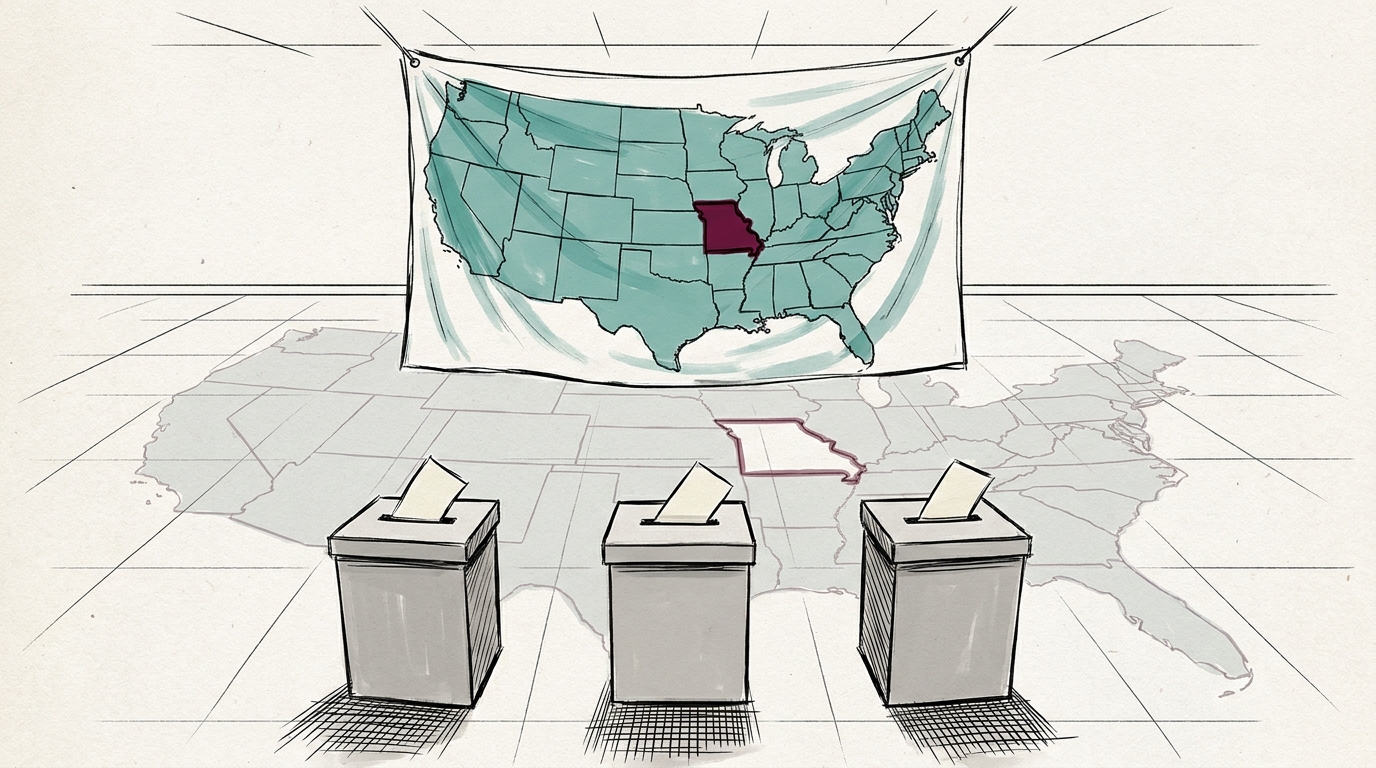
The unanimous court held that Article III, section 49 carries no redistricting exception, so a referendum petition against a congressional map is as valid as against any other law. It ordered the 2022 map to govern unless voters approve HB 1 on 3 November.
Denny Hoskins, Missouri Secretary of State
Hoskins told the Supreme Court that changing the congressional map after 1.2 million primary votes and ahead of the 19 September overseas-ballot deadline violates Purcell and the Elections Clause. He wants HB 1 reinstated before ballots print for November.
Senate Republican leadership
Floor time is finite at 51-47 with a bipartisan funding negotiation running, and a contested procedural fight over grant conditions is not the best use of it this month. Nothing has been abandoned; the resolution keeps its place on the calendar.
