Skip to content
You can now search across every topic, entity and event.What's new
US Midterms 2026
7SEP

SCOTUS orders Callais into immediate effect

2 min read
13:32UTC

The Supreme Court issued judgment forthwith on Tuesday 5 May, ordering Louisiana v. Callais into immediate effect and skipping the standard 32-day remand wait.

PoliticsDeveloping
Key takeaway

An immediate-effect order on 5 May converted the Callais doctrine into an operational tool inside one election cycle.

The Supreme Court issued a judgment forthwith on Tuesday 5 May, ordering immediate effect for Louisiana v. Callais and bypassing the standard 32-day remand wait. 1 Louisiana must now redraw its congressional map at once; every other state is freed in the same instant from the Voting Rights Act (VRA) Section 2 mandate to draw majority-minority districts (constituencies engineered for a minority-voter majority).

Samuel Alito's 6-3 opinion six days earlier set the law; the Tuesday order operationalised it before May's Southern filing calendars began to bind. Ron DeSantis had already submitted Florida's 24R-4D draft on 27 April waiting on this exact signal , and his session timing had been calibrated weeks earlier . The procedural shortcut left no gap between doctrine and execution.

Read against the Court's own slip opinion, the immediate-effect order is treated as routine remand management. Read against the calendar, it is the gate that turned a doctrinal change into a 2026 line-drawing instrument. Five states moved within forty-eight hours.

Deep Analysis

In plain English

When the Supreme Court rules on a case, there is usually a wait of about 32 days before the ruling actually takes effect, to give lower courts time to process it. A judgment forthwith skips that wait entirely and makes the ruling effective immediately. On 5 May, the Court used this mechanism for the Callais ruling it had issued a week earlier. That ruling said states no longer have to draw special electoral districts designed to give minority communities a majority of voters. By making it immediate, the Court ensured that states like Louisiana had to act at once, while also instantly freeing every other state from the old requirement. The practical consequence was that governors and state legislatures across the South began calling special sessions the same week, because the legal all-clear had arrived with no delay.

Deep Analysis
Root Causes

Two structural pressures produced the forthwith order. First, state candidate filing deadlines in Louisiana, Florida, and Tennessee were weeks away; a 32-day remand wait would have rendered the Callais doctrine unreachable for the 2026 cycle before maps could be drawn and candidates could file against them.

Second, the same six-justice majority that decided Callais on 29 April controlled the 5 May order. There was no institutional friction between the doctrinal outcome and its operationalisation: the ruling and the implementation instrument came from the same aligned bloc, with no dissenting procedural objection recorded.

What could happen next?
  • Consequence

    Louisiana must redraw its congressional map immediately, likely shifting its delegation from 4-2 Republican to 5-1 or 6-0 Republican ahead of 2026 primaries.

    Immediate · 0.85
  • Precedent

    The judgment-forthwith mechanism has now been used to accelerate a major redistricting ruling; future election-law litigants on both sides will invoke this precedent to seek immediate effect.

    Medium term · 0.75
  • Risk

    Black voter plaintiffs who challenged the fast-track order were rejected around 6-7 May; further emergency applications to block redistricting under the new baseline face a Court that has already declined to stay its own order.

    Short term · 0.8
First Reported In

Update #5 · Callais lands; maps move

SCOTUSblog· 7 May 2026
Read original
Causes and effects
This Event
SCOTUS orders Callais into immediate effect
The procedural shortcut converted a 29 April doctrinal ruling into an operational instrument before state filing calendars began to bind.
Different Perspectives
New Hampshire student voters
Students who hold no accepted photo ID under HB 323 cannot vote in the 8 September primary after Judge Laplante declined to block the law on timing grounds. Whether the same rule applies on 3 November is still open.
Alaska Democratic Party
The Alaska Democratic Party moved $884,835 in coordinated spending to Mary Peltola between 17 and 30 July, more than the DCCC spent nationally in the same fortnight.
National Republican Senatorial Committee
The NRSC, which sued to remove coordinated-spending caps in NRSC v. FEC, put $2,230,472 behind candidates in the first complete month after winning that case, more than double the total for the prior six months combined.
Supreme Court of Missouri
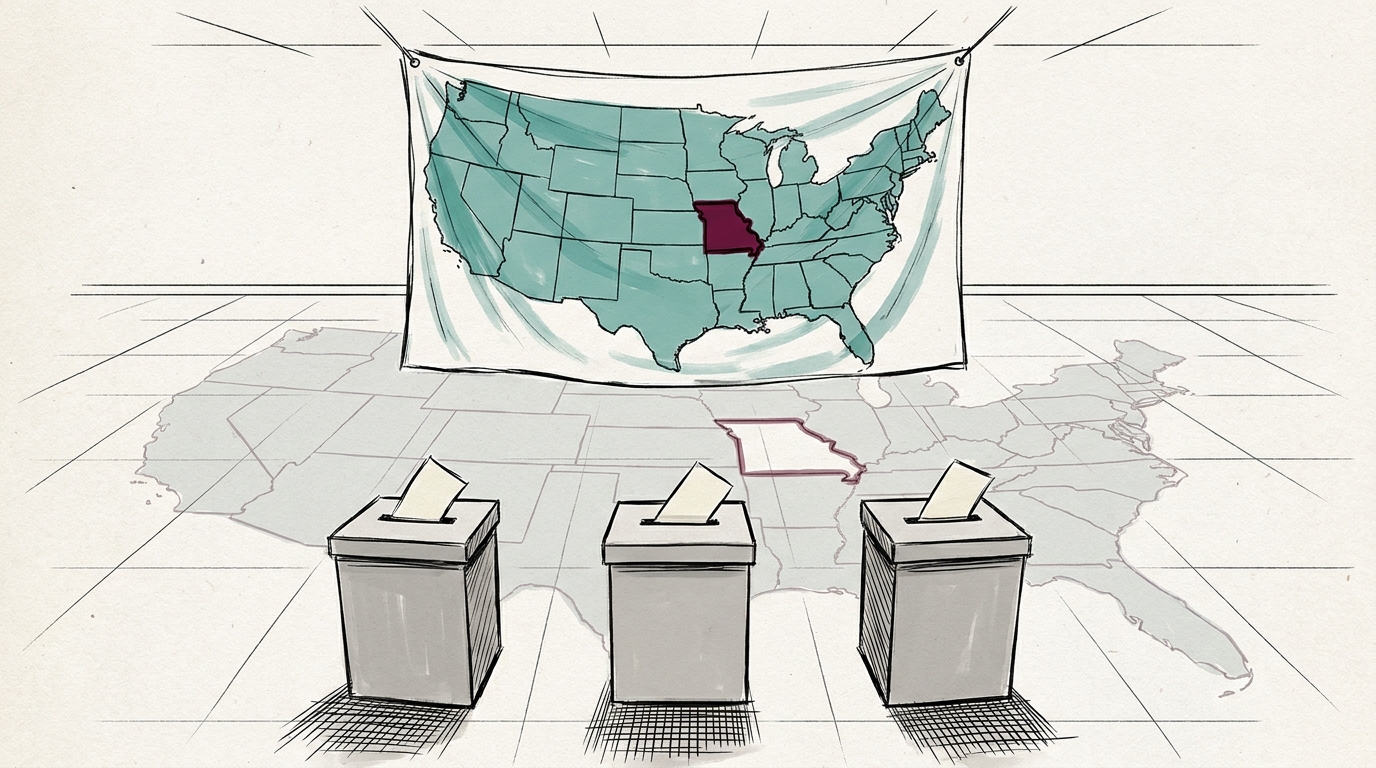
The unanimous court held that Article III, section 49 carries no redistricting exception, so a referendum petition against a congressional map is as valid as against any other law. It ordered the 2022 map to govern unless voters approve HB 1 on 3 November.
Denny Hoskins, Missouri Secretary of State
Hoskins told the Supreme Court that changing the congressional map after 1.2 million primary votes and ahead of the 19 September overseas-ballot deadline violates Purcell and the Elections Clause. He wants HB 1 reinstated before ballots print for November.
Senate Republican leadership
Floor time is finite at 51-47 with a bipartisan funding negotiation running, and a contested procedural fight over grant conditions is not the best use of it this month. Nothing has been abandoned; the resolution keeps its place on the calendar.
