Skip to content
You can now search across every topic, entity and event.What's new
US Midterms 2026
7SEP

DOJ loses again on state voter files

3 min read
13:32UTC

A Kentucky federal court threw out the Justice Department's voter-file demand on 23 July, the seventeenth dismissal in a programme that has yet to win a single ruling.

PoliticsDeveloping
Key takeaway

Seventeen dismissals rest on a pleading defect, not on any ruling that the demand itself is unlawful.

A federal court in Kentucky dismissed the Department of Justice (DOJ)'s suit for the state's voter file on 23 July, the seventeenth such dismissal since the programme began. The department filed a notice of appeal against a separate loss the same day, in Connecticut, where its case had been thrown out on 17 July. DOJ has sued 30 states and Washington DC, 31 cases in all: seventeen dismissed on the merits, one settled in Oklahoma, thirteen still live.

The State Democracy Research Initiative at the University of Wisconsin Law School, which maintains the public tracker of the litigation, updated it on 24 July with a flat sentence: "To date, no court at either the district court or appellate court level has ruled in favor of the Justice Department." 1 What the department asks each state for is the unredacted roll, the version carrying fields officials strip out before releasing voter lists to the public.

Those rulings share a defect rather than a doctrine. A Massachusetts court threw out the first of them in April on the narrow ground that DOJ never identified the statute authorising its demand , and defendant states have copied the argument since, in front of judges appointed by presidents of both parties. None of the seventeen holds that the data may not be obtained. They hold that the department has not said why it may.

The programme has not stopped. DOJ took all eight of its early losses upward at once in June , and the one appeal decided so far went against it when a 6th Circuit panel affirmed the Michigan dismissal . The department reached for the courts only after the executive route closed. Judge Denise Casper permanently blocked Donald Trump's elections executive order, ruling that the president has no authority over how states run their elections . An executive order needs no statute behind it. A federal complaint does.

Deep Analysis

In plain English

The Department of Justice (DOJ) is the US government's main law-enforcement agency. It has asked more than 30 states to hand over their full voter rolls, including details states normally keep private. Courts have said no seventeen times in a row, not because judges decided the government has no right to the data, but because DOJ never told them which law gives it that right. Until it does, states keep saying no, and no judge has to decide the bigger question.

Deep Analysis
Root Causes

DOJ's litigation programme depends on two federal statutes written for different purposes. The National Voter Registration Act's Section 8(i) creates a public-inspection right, but it runs to any person, not a special power for the department to demand unredacted files.

The Help America Vote Act sets minimum standards for statewide voter databases, but assigns enforcement to the states themselves, not to Washington. Neither obviously grants a federal production power over the sensitive fields states withhold from public release.

The Massachusetts court's dismissal on 9 April supplied the template every subsequent state has copied : rule against the pleading, not the underlying demand. Seventeen courts adopting the same narrow ground, rather than seventeen independent rulings on the merits, is why the department can still refile if it ever names a statute that fits.

What could happen next?
  • Precedent

    Thirteen still-active defendant states can now cite seventeen concurring district-court rulings in their own motions to dismiss, raising DOJ's cost in every remaining case.

  • Risk

    A cleanly repleaded complaint naming NVRA Section 8(i) would test a question no court has yet decided: whether the underlying demand for unredacted voter files is lawful at all.

First Reported In

Update #14 · 0-for-17 in court, and the map that held

State Democracy Research Initiative, University of Wisconsin Law School· 26 Jul 2026
Read original
Different Perspectives
New Hampshire student voters
Students who hold no accepted photo ID under HB 323 cannot vote in the 8 September primary after Judge Laplante declined to block the law on timing grounds. Whether the same rule applies on 3 November is still open.
Alaska Democratic Party
The Alaska Democratic Party moved $884,835 in coordinated spending to Mary Peltola between 17 and 30 July, more than the DCCC spent nationally in the same fortnight.
National Republican Senatorial Committee
The NRSC, which sued to remove coordinated-spending caps in NRSC v. FEC, put $2,230,472 behind candidates in the first complete month after winning that case, more than double the total for the prior six months combined.
Supreme Court of Missouri
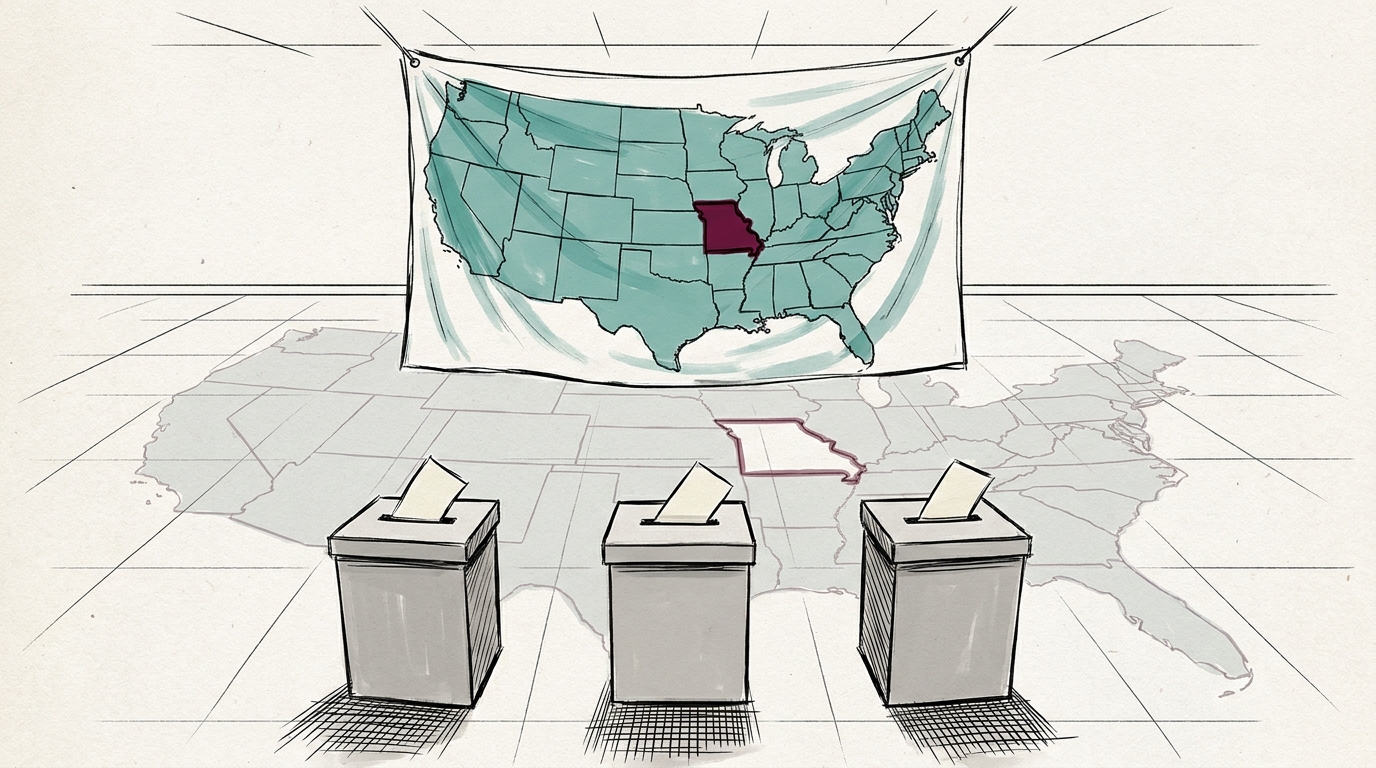
The unanimous court held that Article III, section 49 carries no redistricting exception, so a referendum petition against a congressional map is as valid as against any other law. It ordered the 2022 map to govern unless voters approve HB 1 on 3 November.
Denny Hoskins, Missouri Secretary of State
Hoskins told the Supreme Court that changing the congressional map after 1.2 million primary votes and ahead of the 19 September overseas-ballot deadline violates Purcell and the Elections Clause. He wants HB 1 reinstated before ballots print for November.
Senate Republican leadership
Floor time is finite at 51-47 with a bipartisan funding negotiation running, and a contested procedural fight over grant conditions is not the best use of it this month. Nothing has been abandoned; the resolution keeps its place on the calendar.
