Skip to content
You can now search across every topic, entity and event.What's new
US Midterms 2026
7SEP

Sixth Circuit rejects DOJ roll demand

2 min read
13:32UTC

A Sixth Circuit panel affirmed 2-1 the dismissal of the Justice Department's demand for Michigan's unredacted voter rolls, the first appellate ruling in the year-old voter-data fight.

PoliticsDeveloping
Key takeaway

The administration's voter-data push lost for the first time at an appeals court, binding four states.

A federal appeals court rejected the Justice Department's (DOJ) demand for Michigan's unredacted voter rolls on Wednesday 24 June, the first circuit-level ruling anywhere in the year-old voter-data fight 1. In United States v. Benson, a Sixth Circuit panel affirmed the dismissal 2-1. Judge Mathis wrote that Title III of the Civil Rights Act of 1960 cannot bear the weight of a demand for every voter's date of birth, partial Social Security number and driving-licence number. The ruling binds Michigan, Ohio, Kentucky and Tennessee.

Congress wrote Title III to help the DOJ investigate officials who suppressed the vote. The department now invokes it, in the panel's words, 'for an inverse purpose, to ensure that some people have not voted' 2. The two-judge majority refused to read the 1960 statute as authority for auditing whether individuals had cast ballots.

The DOJ reached this appeal already losing. It had appealed all eight of its trial-court dismissals in mid-June and, weeks earlier, had dropped its own national voter-database case rather than defend it . The panel handed the department its first outright loss at the circuit level. Judge Nalbandian dissented, preserving the DOJ a path to the full Sixth Circuit or the Supreme Court.

Deep Analysis

In plain English

The Department of Justice has spent more than a year trying to get Michigan to hand over its full voter roll, including personal details usually kept private, using a law originally passed in 1960 to stop officials from blocking Black Americans from voting. A federal appeals court just ruled the department cannot use that particular law for that purpose. It is the first time an appeals court, rather than a lower district court, has weighed in, and the ruling now applies to Michigan, Ohio, Kentucky and Tennessee alike.

Deep Analysis
Root Causes

Title III of the 1960 Civil Rights Act lets the DOJ sue over the 'deprivation... of the right to vote', language drafted to unblock ballot access, not to justify bulk pre-litigation demands for unredacted voter files. Unlike the National Voter Registration Act, it contains no provision authorising the kind of disclosure the department sought.

The DOJ narrowed its own case in June by dropping the NVRA and HAVA claims that could have supplied that authority, after courts had already rejected those theories elsewhere. That left only a statute textually mismatched to the request it was being used to support.

Escalation

Escalation direction: down. Benson closes one of the DOJ's last live statutory theories, adding to a retreat already underway. The department has already dropped eight of its 31 original suits and voluntarily narrowed its legal theory twice this year. A further appellate loss in the remaining circuits would end the initiative entirely rather than escalate it.

What could happen next?
  • Consequence

    The ruling binds Michigan, Ohio, Kentucky and Tennessee, ending the DOJ's Title III approach in those four states unless the full Sixth Circuit or the Supreme Court reverses the panel.

  • Risk

    With only one statutory theory left standing, the DOJ risks its entire voter-data programme collapsing on a single ruling from any of the other circuits still hearing the remaining appeals.

First Reported In

Update #11 · Money uncapped, ballot rules untouched

US Court of Appeals for the Sixth Circuit· 1 Jul 2026
Read original
Different Perspectives
New Hampshire student voters
Students who hold no accepted photo ID under HB 323 cannot vote in the 8 September primary after Judge Laplante declined to block the law on timing grounds. Whether the same rule applies on 3 November is still open.
Alaska Democratic Party
The Alaska Democratic Party moved $884,835 in coordinated spending to Mary Peltola between 17 and 30 July, more than the DCCC spent nationally in the same fortnight.
National Republican Senatorial Committee
The NRSC, which sued to remove coordinated-spending caps in NRSC v. FEC, put $2,230,472 behind candidates in the first complete month after winning that case, more than double the total for the prior six months combined.
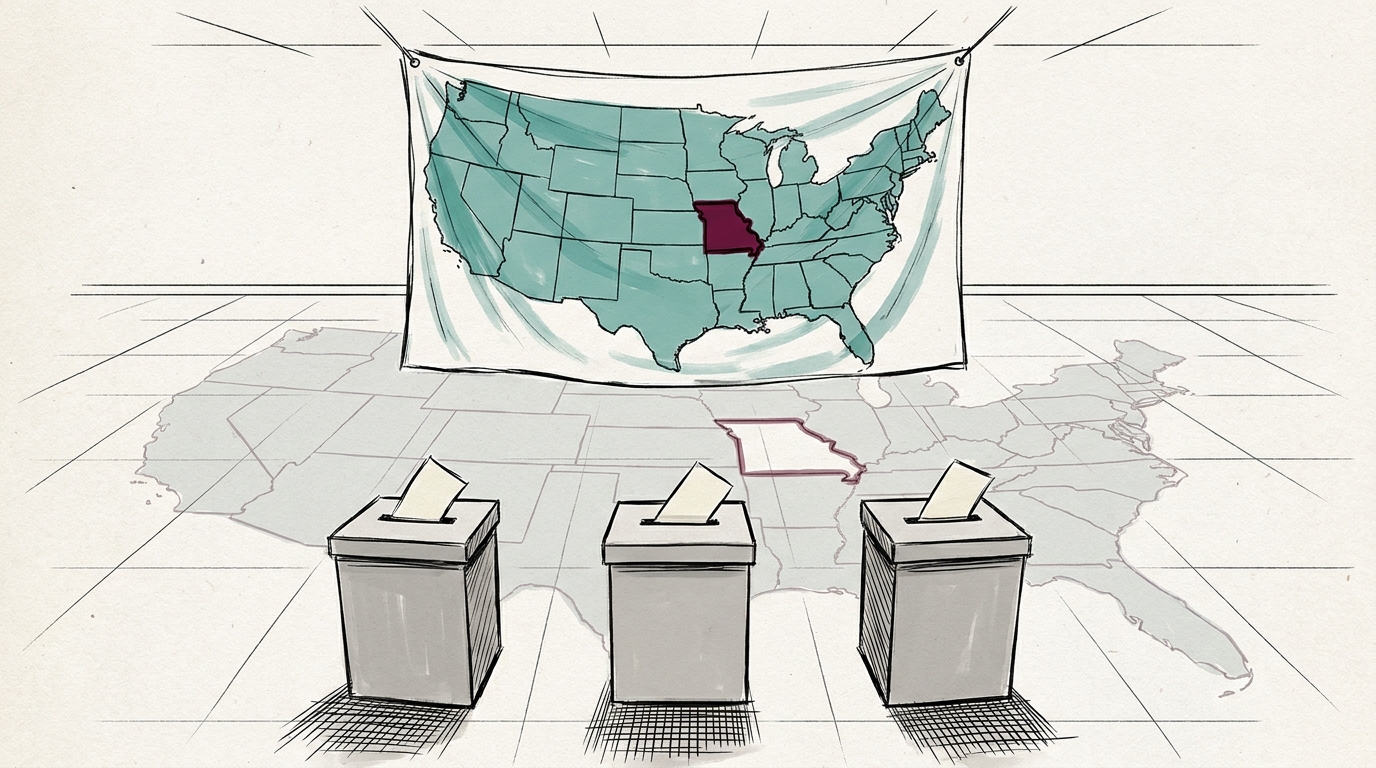
Supreme Court of Missouri
The unanimous court held that Article III, section 49 carries no redistricting exception, so a referendum petition against a congressional map is as valid as against any other law. It ordered the 2022 map to govern unless voters approve HB 1 on 3 November.
Denny Hoskins, Missouri Secretary of State
Hoskins told the Supreme Court that changing the congressional map after 1.2 million primary votes and ahead of the 19 September overseas-ballot deadline violates Purcell and the Elections Clause. He wants HB 1 reinstated before ballots print for November.
Senate Republican leadership
Floor time is finite at 51-47 with a bipartisan funding negotiation running, and a contested procedural fight over grant conditions is not the best use of it this month. Nothing has been abandoned; the resolution keeps its place on the calendar.
