Skip to content
Briefings are running a touch slower this week while we rebuild the foundations.See roadmap
Russia-Ukraine War 2026
18MAR

UAE: 16 missiles, 120+ drones launched

3 min read
11:41UTC

The first consolidated government accounting shows a nine-day bombardment dominated by one devastating Friday — and a defence system consuming interceptors faster than any factory can replace them.

ConflictDeveloping
Key takeaway

The 7.5:1 drone-to-missile ratio signals Iran is treating drones as the primary interceptor-depletion tool and conserving ballistic missile stocks for harder targets where lower-signature weapons are less effective.

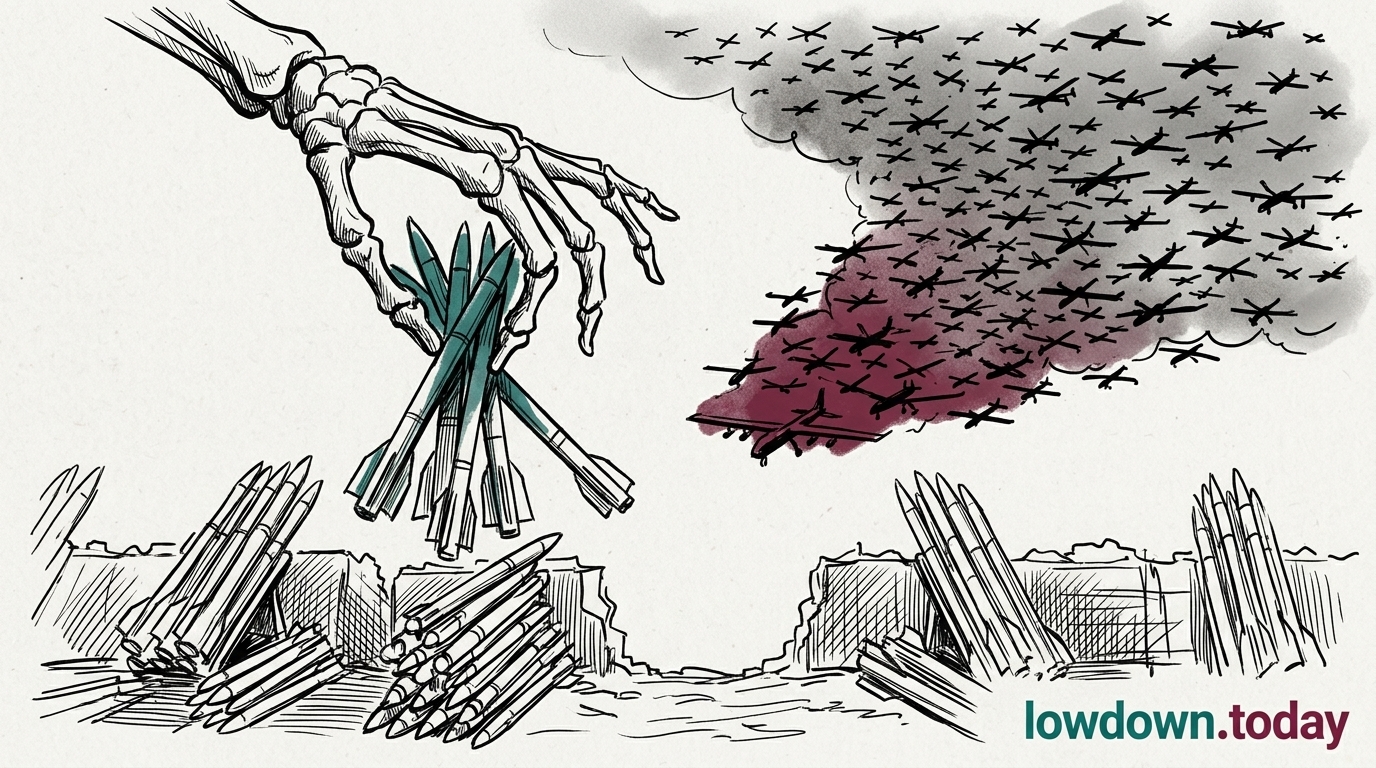
The UAE Ministry of Defence released its first consolidated accounting of Iranian attacks since the conflict began: 16 ballistic missiles and more than 120 drones launched at the UAE since 28 February.

Friday's single-day barrage alone accounted for 109 of the 120-plus drones and 9 of the 16 ballistic missiles . The preceding six days saw roughly 11 drones and 7 ballistic missiles combined — then a massive concentration in one salvo. The surge fits the IRGC's Decentralised Mosaic Defence doctrine: after early US strikes degraded central launch infrastructure, autonomous provincial units rebuilt capacity and delivered it in a mass attack rather than a sustained daily rate of fire.

Bahrain reported 86 missiles and 148 drones intercepted over the same period — a higher missile count against a country with one-tenth the UAE's population and a fraction of its air defence depth. Both countries depend on the THAAD missile defence system. Between 100 and 150 THAAD interceptors have been expended globally since 28 February — over a quarter of the entire world stockpile. Lockheed Martin's facility in Troy, Alabama produces approximately 48 per year. At current expenditure rates, the interceptor reserve shielding The Gulf's most exposed economies will be exhausted before any production line can begin to restore it.

Gulf governments have historically avoided publishing consolidated attack data, preferring to manage the appearance of vulnerability. The UAE's decision to release precise cumulative figures builds a documented public record — one that supports future reparations claims, provides justification for the reported Iranian asset freeze under consideration, and establishes the scale of what Iran has inflicted on a country it has not declared war against.


Deep Analysis

In plain English

The UAE has absorbed 136+ projectiles over roughly nine days — mostly cheap drones, with a smaller number of expensive ballistic missiles. Its air defences are intercepting them, but those systems carry a finite number of interceptors before they need resupplying. Iran appears to be deliberately using drones in high volume to run down UAE interceptor stocks, saving its bigger missiles for targets where they are hardest to stop. The public disclosure of cumulative figures now — days into the conflict — is itself a strategic act, establishing a documented record that legitimises non-military countermeasures.

Deep Analysis
Synthesis

The UAE's decision to release a consolidated tally now — rather than in real time — reflects a calibrated information strategy: releasing the figures establishes a documented public record of Iranian aggression that legitimises economic countermeasures without triggering a military response obligation, sequencing the response options from least to most escalatory.

Escalation

The sustained tempo of roughly 15 projectiles per day, sustained across nine days, is too high for coercive signalling and too low for a decisive strike — the volume is calibrated for attrition of interceptor magazines, not for inflicting infrastructure damage. This points toward a months-long harassment campaign rather than a climactic exchange.

What could happen next?
  • Risk

    If Iran escalates drone sortie rates, UAE interceptor magazine depth becomes a genuine constraint within weeks without accelerated US resupply — and US stockpiles face competing demands from Ukraine and Taiwan.

    Short term · Assessed
  • Consequence

    The public cumulative tally creates documented grounds for UAE economic countermeasures against Iran that would previously have been politically difficult to justify domestically or to regional partners.

    Immediate · Assessed
  • Precedent

    The UAE's continued non-military response despite 136+ projectile attacks establishes a tolerance threshold that Iran and other Gulf states are now calibrating their own response calculus against.

    Medium term · Suggested
First Reported In

Update #28 · Iran and Israel swap refinery strikes

Al Jazeera· 8 Mar 2026
Read original
Causes and effects
This Event
UAE: 16 missiles, 120+ drones launched
First consolidated UAE government tally of attacks received, establishing a documented record of sustained Iranian bombardment against a country Iran is not formally at war with.
Different Perspectives
North Korea / DPRK
North Korea / DPRK
ISW confirmed the first mounting of DPRK Type-75 MLRS on Russian autonomous UGVs near Kharkiv on 7 June, the latest step in a supply axis that escalated from shells in 2023 to troops in 2024. Pyongyang gains live battlefield data on its ordnance and on Russia's uncrewed-systems programme.
IAEA / Rafael Grossi
Grossi confirmed Chornobyl structural damage with nuclear material metres away and could not attribute the ZNPP 15-hour blackout during the agreed repair window. Six ceasefires brokered and broken at ZNPP, compounded by Rosatom's May attack on IAEA neutrality, have eroded his ability to enforce the windows he negotiates.
Emmanuel Macron / France
Macron co-signed the E3 framework whose line-of-contact baseline marks Europe's first formal acceptance that 1991 borders are not the opening position. France's role carries weight because Macron had previously proposed a European force for Ukraine, and the framework's multinational force point is the vehicle for that.
Keir Starmer / E3
Keir Starmer / E3
Starmer, Macron and Merz met Zelenskyy on 7 June and backed a five-point framework taking the line of contact as the talks baseline, conceding roughly one fifth of Ukraine in exchange for a multinational force and frozen assets. With US mediation ended, the NATO Ankara summit on 7-8 July is the next test.
Vladimir Putin / Kremlin
Putin used SPIEF to reject Zelenskyy's summit letter, citing 'elements of rudeness', and repeated the pre-agreed treaty precondition that has frozen every diplomatic round since May. The SPIEF platform's message of investor confidence was punctured by naval fires visible from St Petersburg, which Moscow declined to dispute in scale.
Ukraine / Unmanned Systems Forces
Commander Brovdi confirmed USF units tracked and set fire to Boikyi at Kronstadt, while Code 9.2 struck the Chonhar Bridge the following day. Ukraine is sequencing strikes for rear-area interdiction and political timing rather than ground gains, trading the Baltic Fleet's home base for the logistics squeeze Russia cannot absorb without rationing its own occupied territory.



