Skip to content
You can now search across every topic, entity and event.What's new
Russia-Ukraine War 2026
23JUL

IRGC fires hours after halt order

2 min read
20:33UTC

Hours after Pezeshkian's broadcast, Iranian missiles hit Dubai, Saudi oil facilities, and Bahrain. The 31 autonomous IRGC provincial commands — built to survive decapitation — cannot be halted by a president who never commanded them.

ConflictDeveloping

Within hours of Pezeshkian's address, Iranian missiles and drones struck Dubai, Saudi oil facilities, and Bahrain. The Interim Leadership Council's ceasefire directive was ignored before its broadcast had finished circulating across state media. Pezeshkian attributed the defiance to "miscommunication within the ranks" following Khamenei's death — a characterisation that treats institutional insubordination as a communications error.

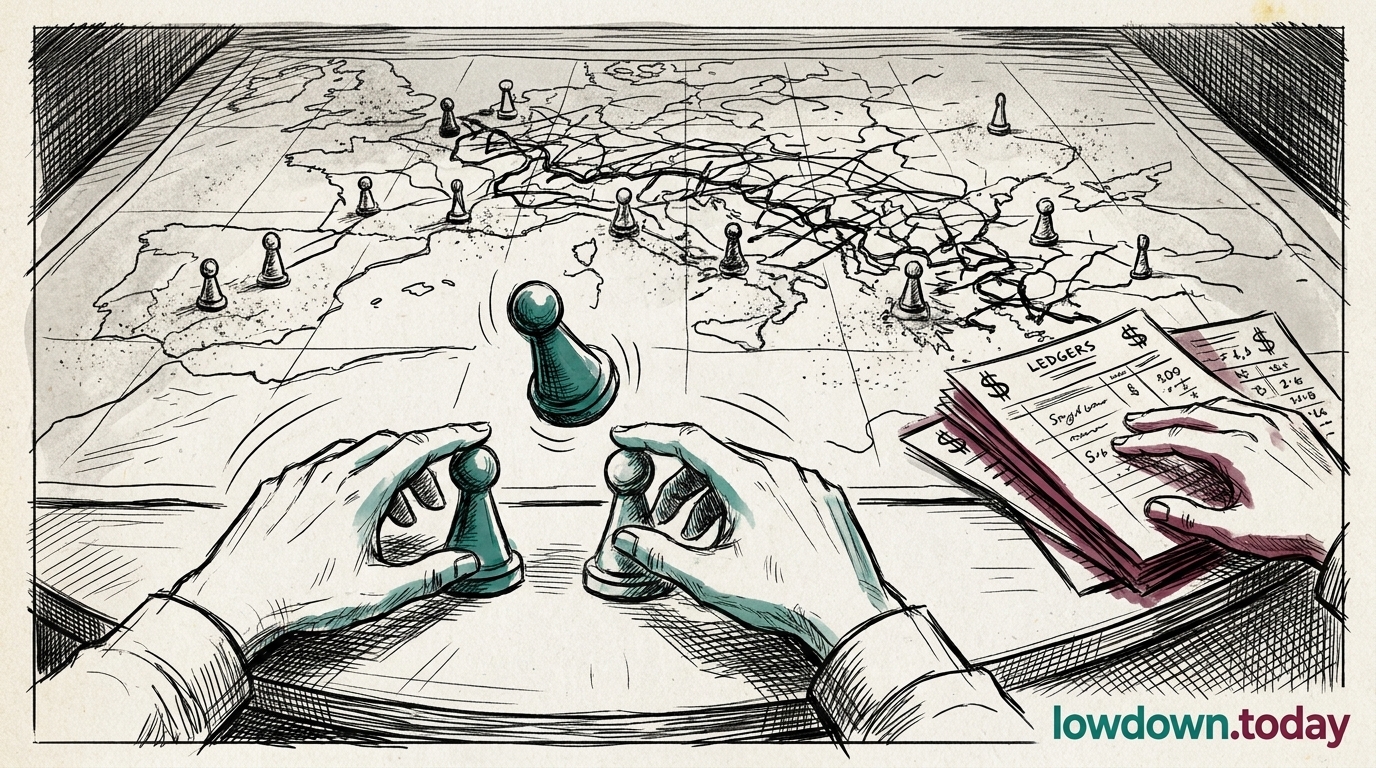
The IRGC's 31 autonomous provincial commands were designed for exactly this kind of operational independence. The Decentralised Mosaic Defence structure that sustained 109 drones and 9 ballistic missiles against UAE targets in a single day — days after CENTCOM claimed a 90% reduction in Iran's ballistic missile capacity — does not require orders from Tehran to function. It was built not to. The provincial commands' continued strikes on Gulf targets are not a malfunction; they are the system operating as engineered, with one consequence its designers did not anticipate: the system cannot be switched off by anyone except The Supreme Leader, and The Supreme Leader is dead.

"Miscommunication within the ranks" does not describe what happened. The IRGC does not report to the civilian president. It has never reported to the civilian president. The chain of command from The Supreme Leader to the IRGC was personal and religious, grounded in the doctrine of velayat-e faqih — the guardianship of the Islamic jurist. No interim council composed of political figures can replicate that authority, particularly when the council's own legitimacy is contested and the IRGC's operational culture was specifically hardened against dependence on any single node of authority. The IRGC fought a war against Iraq for eight years under conditions of institutional autonomy that were formalised, not improvised. The current situation differs only in that no Supreme Leader exists to reimpose direction if he chose to.

The strike on Saudi Arabia's Shaybah oilfield — approximately one million barrels per day of production — followed the same escalation pattern visible since Day 4: military infrastructure first, then diplomatic targets, then energy infrastructure, reprising the September 2019 Abqaiq-Khurais playbook. Whether the Shaybah strike was ordered before or after Pezeshkian's address is unknown, but operationally irrelevant. The IRGC provincial commands hold pre-delegated targeting authority. The missiles that hit Shaybah did not need a phone call from Tehran.


First Reported In

Update #26 · President orders halt; IRGC ignores him

NPR· 7 Mar 2026
Read original
Causes and effects
This Event
IRGC fires hours after halt order
The IRGC's defiance within hours of the presidential halt order confirms that Iran's decentralised military architecture, built to survive external decapitation, has made the civilian government unable to control its own offensive operations. The system that kept Iran fighting after the loss of central command cannot be switched off from above.
Different Perspectives
IAEA (Rafael Grossi)
IAEA inspectors logged Zaporizhzhia's 22nd loss of off-site power, ten of them in the last three months, after a thunderstorm knocked out the plant's sole surviving backup line. Grossi reads the accelerating frequency, not any single outage, as the safety signal now that the plant's redundancy is exhausted.
United States (Treasury/OFAC)
Washington has let general licence 134C, its Russian crude waiver, lapse for 36 days with no successor, the longest gap of the war. Treasury has not said whether the non-renewal reflects deliberate policy or administrative delay, leaving buyers to price in compliance risk rather than wait for clarity.
Slovakia
Slovakia
Slovakia dropped its hold-out on the EU's 21st sanctions package only after winning a 2028 guarantee phasing out Russian gas, the exact pipeline dependency, roughly 80% of its crude supply, that gave it leverage. Bratislava's climbdown clears the package but leaves the same single-veto mechanism intact for the next round.
Russia (Kremlin and general staff)
General staff chief Gerasimov claimed Donetsk captures on 18 July that ISW says it cannot corroborate, extending a pattern ISW clocked at a 5:1 exaggeration ratio earlier this year. Moscow is conditioning its public for a possible autumn mobilisation after September's Duma elections rather than acknowledging the front has stalled.
Ukraine (Zelenskyy government)
Zelenskyy dismissed his commander-in-chief, defence minister and chief of general staff within eight days, replacing Syrskyi with Drapatyi and Hnatov with Skybiuk as protesters demanded Syrskyi go and Fedorov return. Kyiv frames the sweep as a bet on manoeuvre capacity ahead of a feared Russian autumn surge, not the disarray critics read into three changes in a week.
The United Kingdom
The United Kingdom
Starmer pledged £300 million in Kyiv on 16 July toward Ukraine's Gripen E squadron, adding to the PURL expansion Trump and Rutte had announced two days earlier. London is paying into a scheme built around a shortfall NATO's own published $4bn-plus pledge does not close against Zelenskyy's roughly $15bn stated need.



