Skip to content
You can now search across every topic, entity and event.What's new
Russia-Ukraine War 2026
19JUL

Trump strikes Iran with no war authority

3 min read
13:35UTC

Donald Trump ordered missiles onto Iranian soil with no AUMF and no UN notice, days after both chambers of Congress moved to constrain him.

ConflictDeveloping
Key takeaway

Trump executed an act of war while every document that would normally authorise it stayed unsigned.

Donald Trump ordered strikes on sovereign Iranian territory with no Article 51 notification to the UN Security Council and no new AUMF (Authorisation for Use of Military Force), the statute Congress would normally pass to sanction a war 1. He acted as both chambers moved against him. The House voted 215-208 on 3 June to wind down US involvement , and Senate cloture on a parallel war-powers resolution fell ten votes short . Congress voted to limit the president; the strike order on 9 June bypassed that vote within days of it.

Washington's legal defence rests on Article II self-defence: a president may protect US forces under fire without prior congressional authorisation, and the downed AH-64 Apache supplies the trigger 2. Critics will counter that striking radar sites across four locations on Iranian soil exceeds the immediate defence of one aircraft's crew, both of whom had already been recovered. Whether "self-defence" describes the rescue or the retaliation is the hinge on which the whole claim turns.

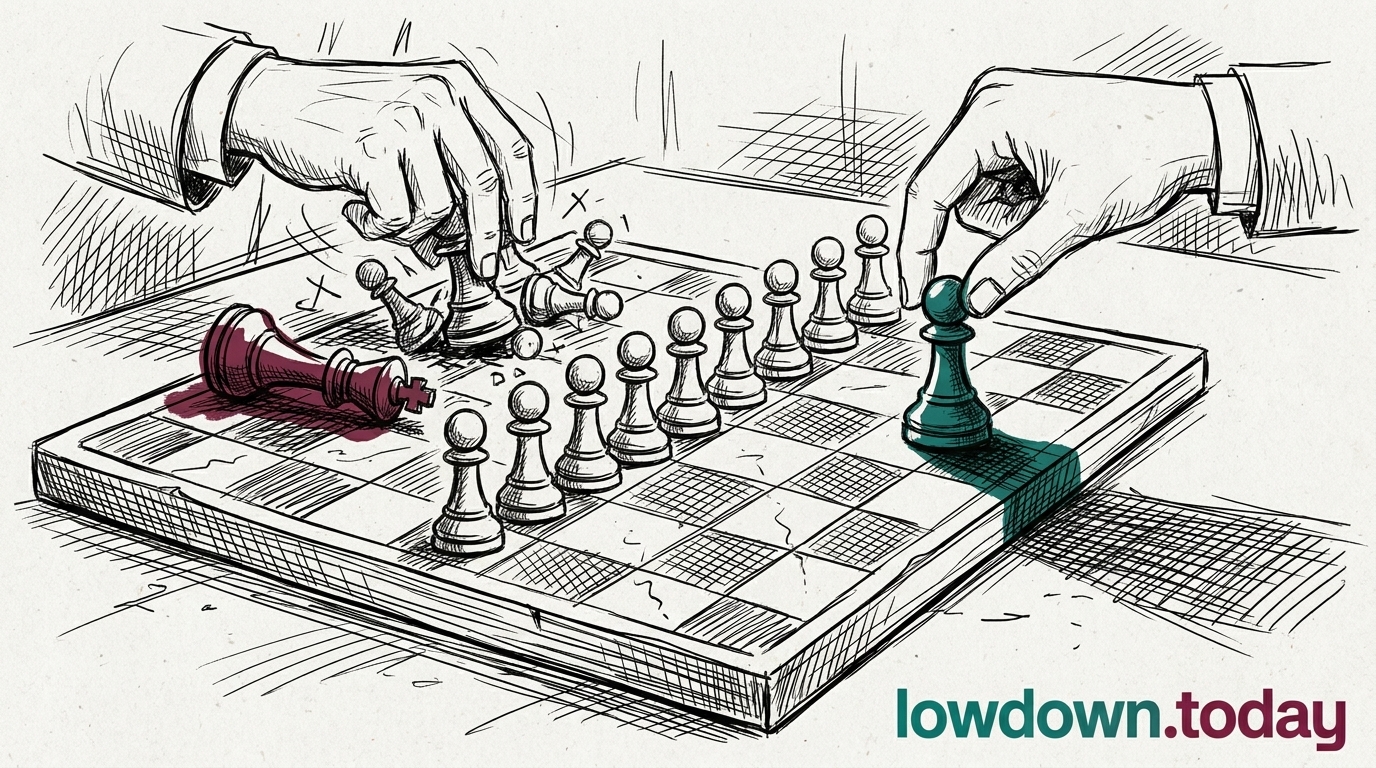
The self-defence framing matters because it sidesteps the AUMF question entirely. A defensive strike needs no fresh authorisation, so the recovered Apache crew become the legal pivot rather than a vote on the floor. Trump spent 100 days pairing optimistic deal talk with an unsigned MOU; his first instrument of consequence on Iran arrived as ordnance, not a signature. That distinction is the point. An act of war was executed while every document that would normally precede it stayed unsigned, which leaves Congress legislating against a fact already on the ground.

Deep Analysis

In plain English

In the United States, Congress has the power to declare war. Since 1973 there has also been a law called the War Powers Resolution that says the President must notify Congress within 48 hours of starting a military operation and must stop within 60 days unless Congress approves. President Trump ordered the 9 June strikes without asking Congress for permission, without notifying the United Nations, and days after the House of Representatives voted 215-208 to tell him to wind down the Iran conflict. The administration's legal argument is that the President can order strikes in self-defence as Commander-in-Chief without needing Congress. Critics, including Georgetown Law professors, argue that argument has never been tested in a case where Congress had just voted against the action.

Deep Analysis
Root Causes

Three converging structural conditions made the legal collision on 9 June inevitable. First, the Trump administration's deliberate policy of keeping all Iran-related authority on the verbal track rather than signed paper meant that when it needed a legal basis for strikes, Article II was the only instrument in the field. An AUMF would have required specifying objectives and constraints Congress could hold the administration to.

Second, the War Powers Resolution's own enforcement gap, demonstrated across three consecutive lapse cycles at Days 60, 72 and 93, signalled to the executive that Congress lacked both the votes and the institutional will to constrain it. A resolution that lapses unremedied three times becomes, in practice, a dead letter regardless of its statutory force.

Third, the House 215-208 margin was too thin and too recent to survive a Senate cloture test. With ten senators absent from the cloture count, the administration calculated, correctly in the short term, that no enforcement mechanism would activate before the strikes could be executed.

First Reported In

Update #123 · Trump orders strikes on Iranian soil

Al Jazeera· 10 Jun 2026
Read original
Different Perspectives
The United Kingdom
The United Kingdom
Starmer pledged £300 million in Kyiv on 16 July toward Ukraine's Gripen E squadron, adding to the PURL expansion Trump and Rutte had announced two days earlier. London is paying into a scheme built around a shortfall NATO's own published $4bn-plus pledge does not close against Zelenskyy's roughly $15bn stated need.
Brussels
Brussels
The EU's 21st sanctions package missed its Coreper vote on 15 July over Greek LNG re-export rights and an Austrian bank compensation demand, the same week Hungary stalled accession clusters on procedure rather than veto. Both processes run on unanimity, so a single national interest, not Russia policy, sets the pace either can move at.
Hungary's Tisza government
Budapest refused to open EU accession Clusters 2 and 3 for Ukraine at COELA on 17 July, offering Moldova a standalone opening instead, and the question returns on 22 July. Having ended Orbán's blanket loan veto in May, it now blocks the narrower rule-of-law chapters where its own electorate is least comfortable.
Washington
Washington
Trump and Rutte expanded PURL on 14 July, letting allies fund the American interceptors and jets Washington will license but no longer gift outright. The same week, Lockheed Martin told allies it cannot guarantee PAC-3 MSE delivery timelines even after tripling output, so Washington now shapes Ukraine's air defence through a supply queue rather than a donation decision.
Moscow
Moscow
Novak ordered a study into cutting the diesel exchange quota to 10% within a week of his export ban, while June delivered Russia's first budget surplus of 2026 and National Wealth Fund liquidity above its own May forecast. Its own investors disagree: the Moscow Exchange has fallen for its longest losing streak since 1997.
Ukraine's government and its street protesters
Zelenskyy sacked Fedorov on 15 July, installed an acting SBU officer in his place, and did not move against three days of protest that followed across eight cities. He is betting that visible tolerance for dissent, timed to EU accession hearings on rule of law, outweighs whatever command dispute forced the reshuffle.
