Skip to content
Welcome, thoughtbot's Giant Robots listeners!Start here
Russia-Ukraine War 2026
24JUN

Drones hit the pipeline built to dodge Hormuz

2 min read
16:16UTC

Drones struck Petroline on the morning of Thursday 10 September and the Saudi Ministry of Energy shut the line as a precaution. The ministry named no pumping station, no segment, no damage figure and nobody to blame.

ConflictDeveloping

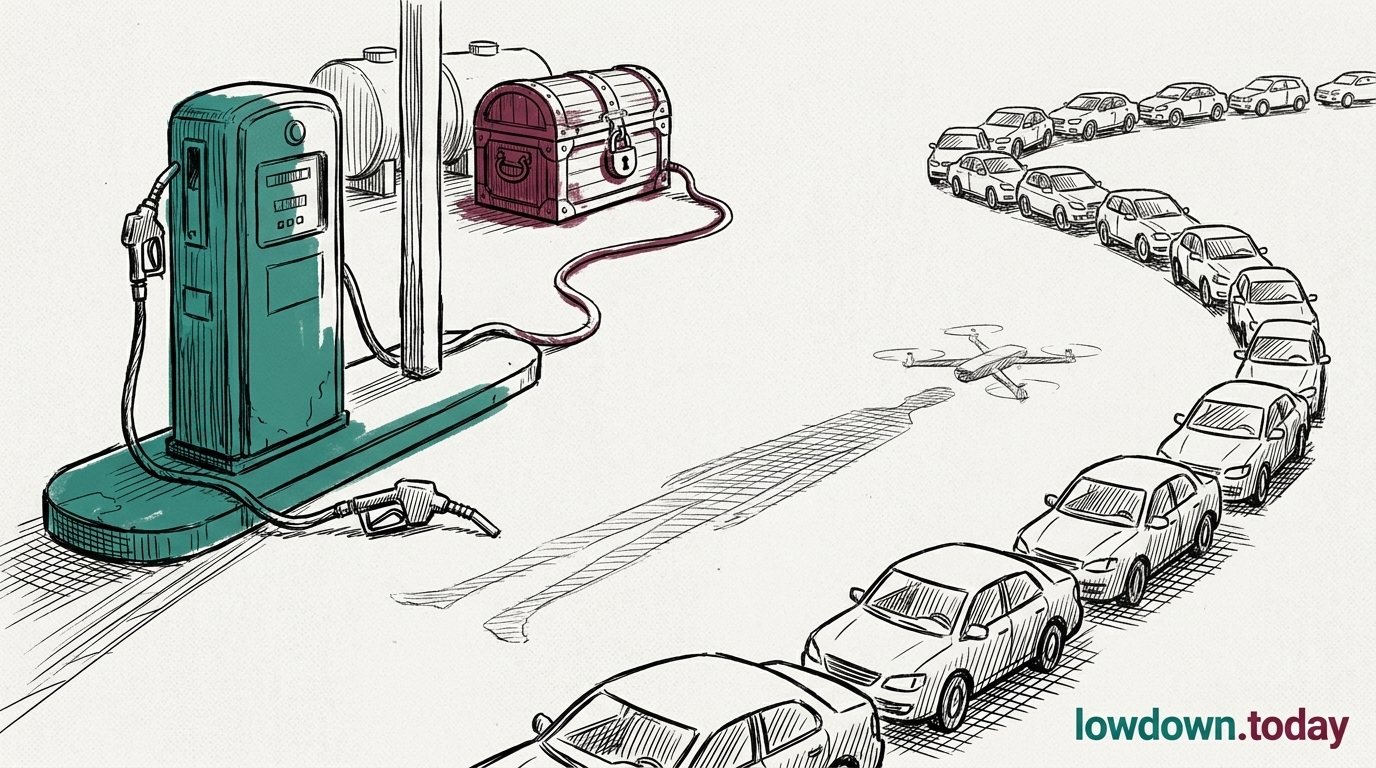
Drones struck Petroline, the east-west crude line Saudi Arabia built to reach the Red Sea without entering the Strait of Hormuz, on the morning of Thursday 10 September 2026. The Saudi Ministry of Energy said the line had been "subjected to multiple attacks on the morning of Thursday, September 10, 2026" and was shut as a precaution⁠1. The statement named no pumping station, no segment, no damage figure and no party responsible.

The line carries crude from The Kingdom's Eastern Province to Yanbu, the Red Sea export terminal that lets Saudi barrels reach the water without a Gulf transit. Nameplate capacity, the volume a line is built to carry, is 7 million barrels a day on the ministry's own April 2026 figure⁠2, the level Saudi Arabia restored the line to on 12 April. Early September loadings at Yanbu ran below that, and the two tanker trackers do not agree by how much: Vortexa reads 2.9 million barrels a day, Kpler 3.7 million⁠3.

Petroline had value precisely because nobody had hit it. Tanker operators had already shifted to a US-guided southern track around the strait on 3 September, which left the overland line as the one export path in the region nobody had attacked. A shut pipeline does not strand the crude; it pushes the same barrels back towards the water that the line was dug to avoid, and leaves The Kingdom without a fallback if the strait closes again.

Deep Analysis

In plain English

Saudi Arabia pumps most of its oil near the Gulf coast in the east. To sell it, tankers normally load there and sail out through the strait of Hormuz, a narrow sea passage that Iran can threaten. Petroline, also called the East-West pipeline, avoids that. It carries crude across the country to Yanbu on the Red Sea, so some barrels can leave without going near Iran at all. On Thursday 10 September drones hit that pipeline and Saudi Arabia switched it off while it checks the damage. The country has not said which part was hit, how bad it is, or when the oil starts moving again.

Deep Analysis
Root Causes

Saudi Arabia's producing fields sit on the Gulf coast, so every barrel loaded there has to pass the strait of Hormuz. Petroline carries crude west to Yanbu so that some of it does not have to, and that is the whole of the line's strategic value.

The design assumes the Red Sea end still works. Riyadh has loaded no crude for export through Bab al-Mandeb since the Houthi embargo of 23 July , and Yanbu barrels have gone north into the Suez Canal instead . The line was already feeding a longer and more expensive exit before the drones arrived.

The drones launched from Iraqi soil, in Maysan province. An attack mounted from a third country's soil turns retaliation into a question about Baghdad rather than a question about Tehran, and Riyadh answered it as one.

Escalation

Sideways, and the next move belongs to Baghdad rather than to Riyadh. The Saudi Ministry of Energy has set no restart date, and the Iraqi investigative council appointed on 12 September is the body whose findings would decide whether The Kingdom treats this as an Iraqi failure or an Iranian act.

What could happen next?
  • Consequence

    Saudi barrels that would have left through Yanbu have to compete for tanker space at Gulf loading terminals, which puts them back into the water Petroline was dug to avoid.

    Immediate · Assessed
  • Risk

    With no published restart date, a buyer pricing Saudi supply for October has to guess at the outage length rather than plan around it.

    Short term · Assessed
  • Precedent

    An inland pipeline well away from the Gulf coast has now been hit from Iraqi territory, which extends the campaign's reach past the coasts and the strait.

    Medium term · Suggested
First Reported In

Update #178 · Saudi bypass hit, and Riyadh holds fire

Middle East Eye· 13 Sept 2026
Read original →
Different Perspectives
Belgium
Belgium
Belgium blocked outright confiscation of the roughly EUR 210bn in frozen Russian assets held at Euroclear in December 2025, because Euroclear would carry the legal liability. Ukraine has since proposed moving custody to the EU instead.
European Commission
European Commission
The Commission said on 2 September that Ukraine has drawn EUR 3.2bn against an EUR 8.35bn annual target, and that a revenue-mobilisation law stuck in the Rada is one of twelve conditions for the next EUR 3.7bn payment.
Steve Witkoff and Jared Kushner
The US envoys met Putin in Moscow on 5 September and Zelenskyy in Kyiv on 6 September without an announced result from more than three hours of talks. Their mediation continues with no public outcome to show for this round.
Robert Brovdi
Robert Brovdi
Brovdi said on 12 September that his Unmanned Systems Forces struck 285 Russian tankers in ten weeks. His own monthly breakdown sums to 79, and he has given no account of the remaining 206.
Sergei Lavrov
Sergei Lavrov
Lavrov said on 12 September that Russia is ready to negotiate but will not suspend military operations while it does. He treats talking and fighting as compatible policies, ruling out a ceasefire as a precondition for further talks.
Belarus
Belarus
Minsk announced completion of its own 37th Separate Airborne Assault Brigade near Gomel, under plans dating to August 2025 rather than a response to any single frontline event this window, keeping its hedge of hosting the war without formally joining Russia's mobilisation drive.
