Skip to content
You can now search across every topic, entity and event.What's new
Russia-Ukraine War 2026
16JUN

Urals held below Russia's budget floor

2 min read
10:25UTC

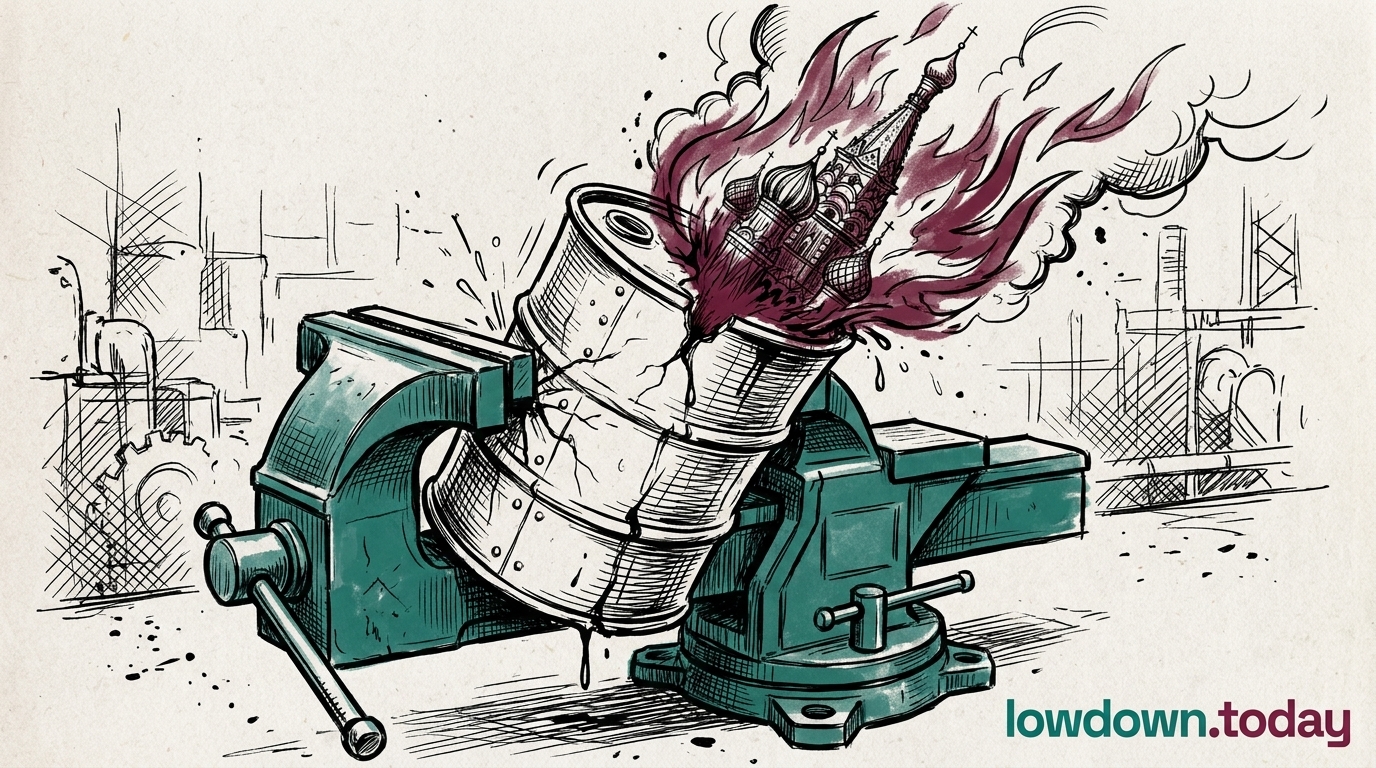
TankerMap put Urals at $48.95 on 13 July, down from $51.25, while Brent added about $6, leaving Moscow's export grade beneath its $59 budget assumption.

ConflictDeveloping
Key takeaway

Urals below the $59 floor deepens Russia's budget squeeze even through a Brent rally.

Urals, Russia's flagship export grade, held in the high-$40s to mid-$50s on 13 July while Brent climbed toward multi-week highs, staying below the $59 a barrel Moscow's 2026 budget assumes. TankerMap assessed the grade at $48.95 on 13 July, down from $51.25 on 6 July 1, while a second retail tracker put it nearer $55 around 12 July 2. The gap between the two softens the exact figure, not the direction: both readings sit under the federal-budget floor.

Brent added about $6 over the same run, so on the desk's own calculation from the flat prices the discount to Dated Brent widened further, beyond the $10-a-barrel India and $20-a-barrel Baltic split of 7 July . TankerMap publishes the flat price alone, so the widening is a derivation from the two legs, not a lifted assessment.

The squeeze compounds through a rally that should have relieved it. Oil and gas fund roughly a third of Russia's federal budget, and with the National Wealth Fund already drawing down reserves rather than banking a surplus, a Urals price stuck below $59 tightens the fiscal vice even as the headline benchmark rises. The wider discount hands Indian and Chinese buyers a better basis, letting state refiners lock cheaper term barrels regardless of how Brussels votes the cap freeze.


Deep Analysis

In plain English

Urals is the main type of crude oil Russia exports. Because Western sanctions limit who can buy it and how, Urals typically sells for less than Brent, the global oil benchmark. In mid-July, Urals traded in the high-$40s to mid-$50s a barrel, below the $59 a barrel that Russia's government budget assumes it will earn per barrel. Two different price trackers disagreed on the exact figure, one put it at $48.95, the other closer to $55, but both confirm Urals stayed below Russia's budget target even as Brent, the global benchmark, climbed about $6 over the same period.

Deep Analysis
Root Causes

The discount's persistence traces to a basis mismatch: Urals pricing reflects buyer-specific discounts negotiated by sanctioned counterparties (Indian and Chinese refiners) rather than the open benchmark-setting mechanism that prices Brent, so when Brent rallies on a geopolitical event like Hormuz, Urals has no equivalent mechanism to reprice upward at the same pace.

A second structural cause is the $59 federal-budget floor itself, a fiscal planning assumption baked into Russia's 2026 budget rather than a market price; Urals trading below it for a sustained period (it sat near $50 as far back as 24-25 June, per ) reflects a persistent gap between Moscow's fiscal assumptions and what its crude actually realises in the market, not a new development.

Escalation

A widening Urals-Brent discount squeezes Russian oil revenue without requiring any new sanctions action, a slow-burn fiscal pressure rather than an escalatory event; watch whether Moscow responds with further supply cuts to defend price, which would itself tighten global balances.

What could happen next?
  • Consequence

    Urals trading below Russia's $59 budget floor for a sustained period compounds fiscal pressure on Moscow independent of any new sanctions measures.

  • Risk

    The $6-7/bbl gap between TankerMap and OilPriceAPI's Urals assessments means any single-source Urals figure used in trading or policy decisions carries meaningful measurement uncertainty.

First Reported In

Update #16 · Brent hit $79; the structure said no

TankerMap· 13 Jul 2026
Read original
Different Perspectives
Belgium
Belgium
Belgium blocked outright confiscation of the roughly EUR 210bn in frozen Russian assets held at Euroclear in December 2025, because Euroclear would carry the legal liability. Ukraine has since proposed moving custody to the EU instead.
European Commission
European Commission
The Commission said on 2 September that Ukraine has drawn EUR 3.2bn against an EUR 8.35bn annual target, and that a revenue-mobilisation law stuck in the Rada is one of twelve conditions for the next EUR 3.7bn payment.
Steve Witkoff and Jared Kushner
The US envoys met Putin in Moscow on 5 September and Zelenskyy in Kyiv on 6 September without an announced result from more than three hours of talks. Their mediation continues with no public outcome to show for this round.
Robert Brovdi
Robert Brovdi
Brovdi said on 12 September that his Unmanned Systems Forces struck 285 Russian tankers in ten weeks. His own monthly breakdown sums to 79, and he has given no account of the remaining 206.
Sergei Lavrov
Sergei Lavrov
Lavrov said on 12 September that Russia is ready to negotiate but will not suspend military operations while it does. He treats talking and fighting as compatible policies, ruling out a ceasefire as a precondition for further talks.
Belarus
Belarus
Minsk announced completion of its own 37th Separate Airborne Assault Brigade near Gomel, under plans dating to August 2025 rather than a response to any single frontline event this window, keeping its hedge of hosting the war without formally joining Russia's mobilisation drive.


