Skip to content
You can now search across every topic, entity and event.What's new
Russia-Ukraine War 2026
16JUN

EU freezes $44 Russia oil cap 12 months

2 min read
10:25UTC

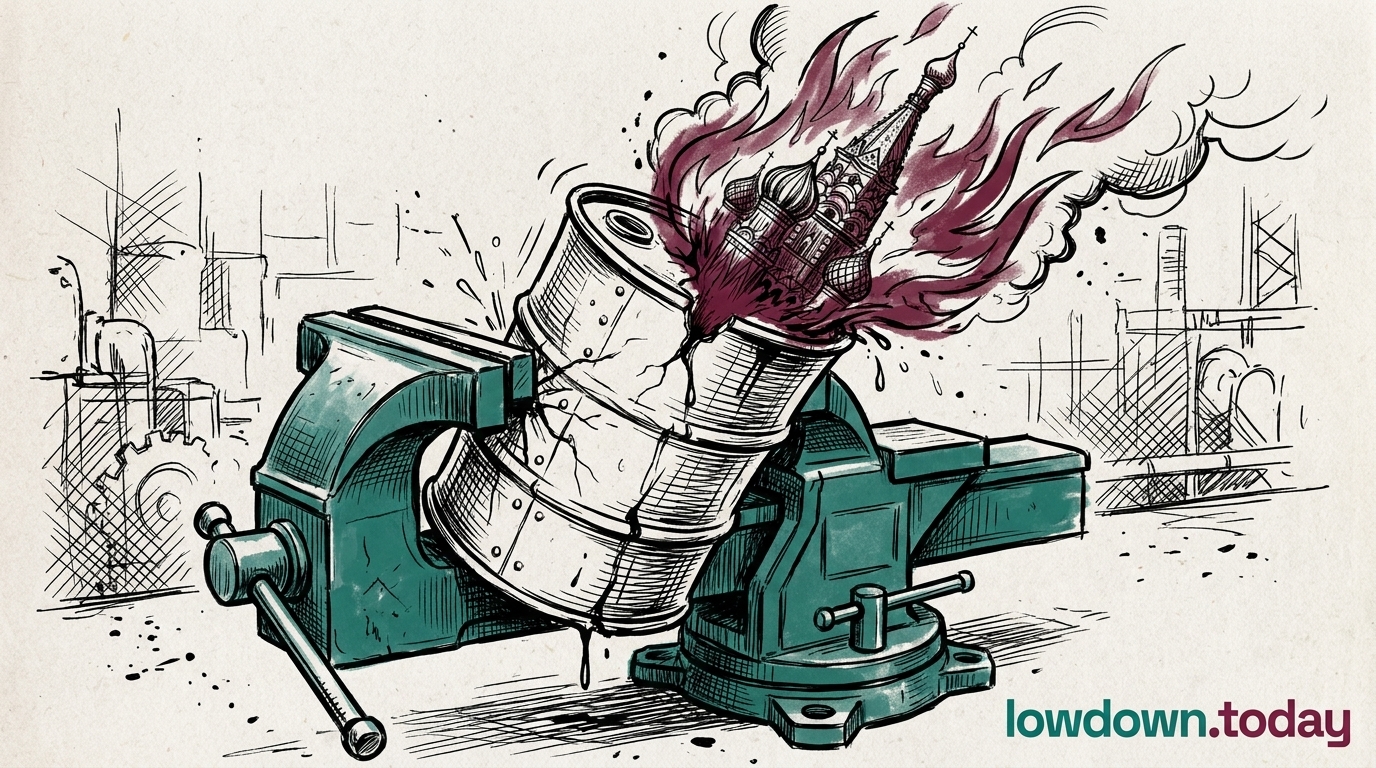
The EU adopted its 21st sanctions package on 23 July, freezing the $44 Russia oil cap for a full year and listing shadow-fleet support vessels for the first time.

ConflictDeveloping
Key takeaway

The year-long freeze keeps the Russian crude cap $14 below where the pricing formula would have drifted.

The European Union adopted its 21st sanctions package on 23 July by written procedure, one day before the one-week freeze of the $44 Russia oil price cap was due to lapse 1. The cap now holds for a full 12 months. It is the G7 and EU ceiling that bars Western shipping, insurance and finance from Russian crude sold above the line. An EU diplomat said the pricing formula would otherwise have let the ceiling drift toward $58, so the freeze holds roughly $14 of enforcement pressure on Russian barrels that the mechanism would have released.

The package lists around 250 entities, bars 32 Russian banks from cross-border transactions with EU banks, and adds more than 40 shadow-fleet vessels. For the first time the listings target ships that service the shadow fleet rather than the tankers alone, extending enforcement from the cargo to the support chain that keeps it moving. It cleared only after three failed COREPER votes on 13, 15 and 22 July , COREPER being the committee of member-state ambassadors that prepares Council decisions.

Greece dropped its veto after securing a renewable one-year exemption to keep carrying pre-2022 Russian liquefied natural gas contracts to third countries, with no new contracts allowed. Austria blocked fresh EU restrictions on Raiffeisen Bank's Russia operations. The Urals discount the cap targets has held Russian crude below Moscow's $59 budget floor through July , so the freeze arrives with the mechanism already biting on export revenue.


Deep Analysis

In plain English

The Russia oil price cap is a rule, agreed by the EU, G7 and allied countries, that blocks Western shipping and insurance firms from handling Russian crude sold above $44 a barrel. The idea is to let Russia keep exporting oil, so global supply does not collapse, while limiting how much money it earns per barrel. The EU's 21st sanctions package, adopted 23 July, keeps that $44 limit in place for another 12 months instead of letting it rise automatically. It also blacklists around 250 people and companies, bars 32 more Russian banks from cross-border transactions, and for the first time lists more than 40 support vessels, beyond the tankers themselves, that keep Russia's so-called shadow fleet running. This matters because EU sanctions need every member state to agree. The package only passed after Greece dropped its objection in exchange for an exemption letting it keep re-exporting Russian LNG for another year.

Deep Analysis
Root Causes

The price cap only works where G7 and EU firms control the insurance, shipping and finance a cargo needs, which is why shadow-fleet vessels with non-Western hull cover can carry Russian crude above $44 without breaching the mechanism as written. Freezing the cap at $44 for 12 months, rather than letting the automatic formula lift it toward $58, keeps that legal ceiling low even though enforcement against the shadow fleet remains the binding constraint.

The package cleared only after Coreper's third attempt in nine days, on 13, 15 and 22 July, because EU sanctions require unanimity and six states, Greece, Germany, France, Italy, Austria and Portugal, were each blocking it over unrelated national conditions rather than disputing the cap itself.

What could happen next?
  • Consequence

    The freeze denies Moscow a legal widening of the cap toward roughly $58 a barrel even though shadow-fleet insurance workarounds remain the larger enforcement gap.

First Reported In

Update #19 · Second chokepoint doubles Med freight

Kyiv Independent· 23 Jul 2026
Read original
Different Perspectives
Belgium
Belgium
Belgium blocked outright confiscation of the roughly EUR 210bn in frozen Russian assets held at Euroclear in December 2025, because Euroclear would carry the legal liability. Ukraine has since proposed moving custody to the EU instead.
European Commission
European Commission
The Commission said on 2 September that Ukraine has drawn EUR 3.2bn against an EUR 8.35bn annual target, and that a revenue-mobilisation law stuck in the Rada is one of twelve conditions for the next EUR 3.7bn payment.
Steve Witkoff and Jared Kushner
The US envoys met Putin in Moscow on 5 September and Zelenskyy in Kyiv on 6 September without an announced result from more than three hours of talks. Their mediation continues with no public outcome to show for this round.
Robert Brovdi
Robert Brovdi
Brovdi said on 12 September that his Unmanned Systems Forces struck 285 Russian tankers in ten weeks. His own monthly breakdown sums to 79, and he has given no account of the remaining 206.
Sergei Lavrov
Sergei Lavrov
Lavrov said on 12 September that Russia is ready to negotiate but will not suspend military operations while it does. He treats talking and fighting as compatible policies, ruling out a ceasefire as a precondition for further talks.
Belarus
Belarus
Minsk announced completion of its own 37th Separate Airborne Assault Brigade near Gomel, under plans dating to August 2025 rather than a response to any single frontline event this window, keeping its hedge of hosting the war without formally joining Russia's mobilisation drive.


