Skip to content
You can now search across every topic, entity and event.What's new
Russia-Ukraine War 2026
9JUN

Ukraine's strikes move to the Azov

2 min read
11:54UTC

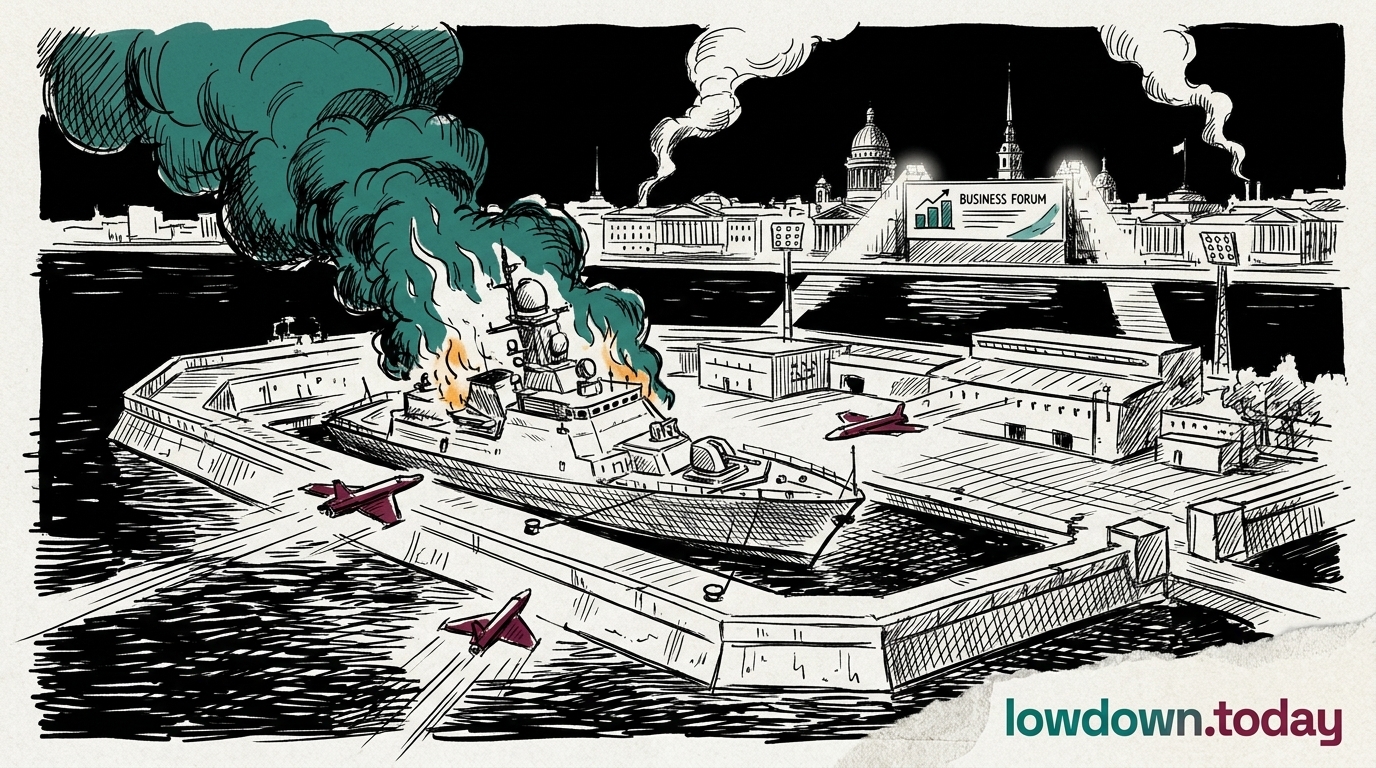
Ukraine's drones shifted from Russian refineries to fuel tankers in the Sea of Azov, cutting vessel traffic there by a possible 55% between 30 June and 11 July.

ConflictDeveloping
Key takeaway

Ukraine's strike campaign moved to Sea of Azov fuel tankers, cutting traffic there by a possible 55%.

Ukraine's long-range strike campaign shifted in the first fortnight of July from static refineries to the seaborne tankers carrying fuel across the Sea of Azov, the Institute for the Study of War (ISW) reported 1. Automatic identification system tracking from Starboard Maritime Intelligence, a commercial firm that monitors ship movements, recorded a possible 55% drop in Azov traffic between 30 June and 11 July 2.

Through June the campaign had reached deep inside Russia: the Kapotnya refinery near Moscow , the Tyumen plant two thousand kilometres from the border in Siberia , and airbase hangars at Saky on 1 July . Targeting the tankers changes the class of target from fixed installations to moving cargo, and it reaches the fuel at the point it leaves the country.

The tanker campaign works through logistics rather than firepower. Strike the vessels and the fuel cannot sail, so it backs up at the terminals the domestic market also draws on, pushing Russian pump prices higher 3. The diesel export ban exists in part to hold that backup inside Russia's borders.

Deep Analysis

In plain English

Ukraine has been bombing Russian oil refineries for months. Now it has widened the campaign to hit the ships that carry Russian fuel across the Sea of Azov, the inland sea between the two countries. A commercial tracking firm called Starboard Maritime Intelligence, which follows ship movements by radio signal, recorded roughly half as many vessels crossing the Azov between 30 June and 11 July as before. This matters because even fuel that survives the refinery still has to reach a buyer by ship. Targeting the tankers themselves, alongside the plants that make the fuel, closes off one more route Russia has been using to keep exports moving.

Deep Analysis
Root Causes

Refineries are fixed, defended, and can be patched or partially restarted; ocean-going tankers moving through the Sea of Azov's narrow approaches have far less air-defence cover and cannot be dispersed once under way, which makes them a softer target once Ukraine's strike range and targeting data allow it.

The economic incentive compounds this: the fuel crunch behind Russia's own diesel export ban tightens what refined product is even available to ship, so every remaining cargo becomes a higher-value target for the strike campaign to interdict.

Escalation

Direction: expanding target set from land-based refineries to seaborne logistics, a widening rather than a de-escalation of the strike campaign. Evidence: the 55% AIS traffic decline follows earlier June refinery strikes on Kapotnya and Tyumen, suggesting a deliberate broadening rather than a one-off incident.

What could happen next?
  • Consequence

    Vessel operators may increasingly go dark on AIS transponders to avoid becoming targets, which would make future traffic-decline figures harder to interpret as damage versus evasion.

First Reported In

Update #23 · Moscow rations diesel as US cover lapses

Institute for the Study of War / Critical Threats Project· 13 Jul 2026
Read original
Different Perspectives
IAEA (Rafael Grossi)
IAEA inspectors logged Zaporizhzhia's 22nd loss of off-site power, ten of them in the last three months, after a thunderstorm knocked out the plant's sole surviving backup line. Grossi reads the accelerating frequency, not any single outage, as the safety signal now that the plant's redundancy is exhausted.
United States (Treasury/OFAC)
Washington has let general licence 134C, its Russian crude waiver, lapse for 36 days with no successor, the longest gap of the war. Treasury has not said whether the non-renewal reflects deliberate policy or administrative delay, leaving buyers to price in compliance risk rather than wait for clarity.
Slovakia
Slovakia
Slovakia dropped its hold-out on the EU's 21st sanctions package only after winning a 2028 guarantee phasing out Russian gas, the exact pipeline dependency, roughly 80% of its crude supply, that gave it leverage. Bratislava's climbdown clears the package but leaves the same single-veto mechanism intact for the next round.
Russia (Kremlin and general staff)
General staff chief Gerasimov claimed Donetsk captures on 18 July that ISW says it cannot corroborate, extending a pattern ISW clocked at a 5:1 exaggeration ratio earlier this year. Moscow is conditioning its public for a possible autumn mobilisation after September's Duma elections rather than acknowledging the front has stalled.
Ukraine (Zelenskyy government)
Zelenskyy dismissed his commander-in-chief, defence minister and chief of general staff within eight days, replacing Syrskyi with Drapatyi and Hnatov with Skybiuk as protesters demanded Syrskyi go and Fedorov return. Kyiv frames the sweep as a bet on manoeuvre capacity ahead of a feared Russian autumn surge, not the disarray critics read into three changes in a week.
The United Kingdom
The United Kingdom
Starmer pledged £300 million in Kyiv on 16 July toward Ukraine's Gripen E squadron, adding to the PURL expansion Trump and Rutte had announced two days earlier. London is paying into a scheme built around a shortfall NATO's own published $4bn-plus pledge does not close against Zelenskyy's roughly $15bn stated need.