Skip to content
Briefings are running a touch slower this week while we rebuild the foundations.See roadmap
Russia-Ukraine War 2026
1JUN

CEPA scale check: 0.46% of Russian oil

3 min read
10:39UTC

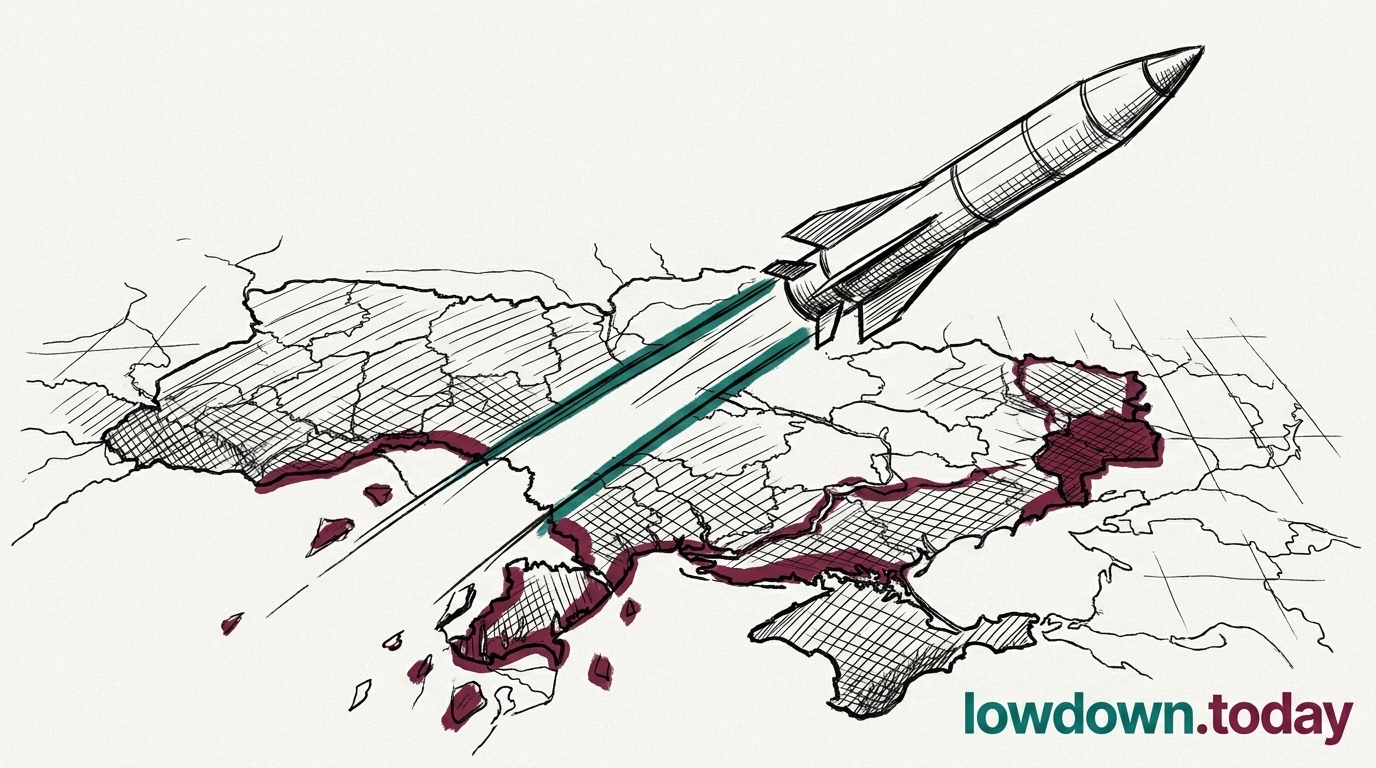
David Axe at CEPA, citing RUSI research, assessed Ukraine's 130 oil strikes in 2025 produced $863 million of damage against roughly $189 billion in annual Russian oil revenue.

ConflictDeveloping
Key takeaway

Ukraine's oil strike campaign delivers footage; the revenue figures sit on the wrong side of the scale.

David Axe at CEPA (Center for European Policy Analysis), citing RUSI research published this month, assessed that Ukraine's 130 refinery and port strikes in 2025 delivered only a 6% export reduction against 2024 1. Cumulative damage came to $863 million against roughly $189 billion in annual Russian oil revenue, or 0.46% of the base.

That is roughly the cost of three weeks of Patriot operations in the Middle East, set against a rounding error in Moscow's books. At that tempo, Ukraine would need over two centuries of strike operations to match a single year of Russian oil revenue. Ukrainian targeteers pick lightly-defended terminals for visible damage, leaving hardened core infrastructure intact. Footage does most of the work the revenue figures do not.

Two separate considerations compound the scale problem. Fire Point, the Ukrainian consortium manufacturing the Flamingo cruise missile , is reportedly under investigation by NABU (Ukraine's National Anti-Corruption Bureau). Only nine Flamingos have been fired in six months, against the hundreds that any serious strike campaign against hardened infrastructure would require. And the Iran war separated price from volume in a way the infrastructure campaign cannot control: Urals rode the Hormuz premium while Baltic throughput was recovering. When Kyiv asks for Patriots for ballistic defence while launching its own drones at pipelines Chevron part-owns, the two trade-offs sit on the same ledger.

Deep Analysis

In plain English

Ukraine has been hitting Russian oil refineries and export terminals in a campaign aimed at cutting the revenue that funds Russia's military. A new report from the Center for European Policy Analysis and RUSI found that 130 such strikes across 2025 reduced Russia's oil exports by only 6% and caused $863 million in total damage. Russia earns roughly $189 billion per year from oil. So the entire year of strikes damaged the equivalent of 0.46% of annual revenue. To put that in context, Russia earns back that amount in about 42 hours. The Iran war's oil price spike likely generated more revenue for Russia in a single week than Ukraine's entire 2025 strike campaign cost Russia in a year.

What could happen next?
  • Meaning

    The CEPA finding reframes the Baltic and Black Sea oil campaigns as primarily having operational-denial value, not economic attrition value; Ukraine's justification for the campaign must shift accordingly.

    Immediate · 0.78
  • Risk

    If the Fire Point/NABU investigation reveals systematic corruption in Ukraine's precision strike procurement, it will complicate Western partner willingness to fund further anti-infrastructure weapons deliveries.

    Short term · 0.62
  • Opportunity

    The 6% export-volume reduction, while small in revenue terms, represents real capacity constraints on specific refinery outputs (aviation fuel, diesel) that have strategic value beyond headline revenue figures.

    Medium term · 0.55
First Reported In

Update #12 · Three narrowings of US support for Kyiv

Center for European Policy Analysis· 11 Apr 2026
Read original
Causes and effects
This Event
CEPA scale check: 0.46% of Russian oil
Load-bearing counter-evidence against the narrative that Ukraine's strike campaign is constraining Russian oil revenue.
Different Perspectives
China
China
Beijing has not publicly commented on the dual Oreshnik launch. China's declared position of urging restraint and dialogue sits awkwardly alongside its continued economic ties with Russia; the weapons escalation tests whether Beijing's neutrality framing can survive a European IRBM normalisation event.
IAEA
IAEA
Director General Grossi condemned the ZNPP reactor-6 turbine building strike and stated "there should be no attack of any kind from or against the plant." The agency confirmed normal radiation levels but has not resolved attribution; Rosatom CEO Likachev warned the region is "one step closer to an incident."
Turkey
Turkey
Ankara hosted Istanbul Round 2 at Ciragan Palace on 2 June and secured a 1,200-for-1,200 prisoner exchange, consolidating Turkey as the war's sole diplomatic venue after Rubio confirmed US mediation has ended. Erdogan's leverage over both parties grows with each round.
European Union
European Union
EU Ambassador Mathernova answered Lavrov's evacuation demand with "We stay in Kyiv. We stay with Ukraine." The Verkhovna Rada approved the EUR 90bn EU loan on 28 May; the EUR 9.1bn first tranche, the EU's first explicit defence-procurement financing, arrives mid-June.
United States
United States
Rubio declared US mediation stagnated on 22 May and confirmed no talks were occurring, then received Lavrov's evacuation demand three days later without ordering embassy drawdown. Washington's leverage now runs through the GL 134C sanctions cliff on 17 June rather than any active diplomatic channel.
Ukraine
Ukraine
Zelenskyy called Russia's 2-3 day ceasefire counter-offer at Istanbul Round 2 "shortsighted" and submitted a full peace memorandum covering EU membership, international guarantees, phased sanctions relief and frozen-asset reparations. Kyiv's position is that a partial ceasefire freeze aids Russian reconstitution; only an all-domain 30-day pause is acceptable.
