Skip to content
Briefings are running a touch slower this week while we rebuild the foundations.See roadmap
Russia-Ukraine War 2026
22MAY

EU sovereignty law slips a third time

4 min read
10:57UTC

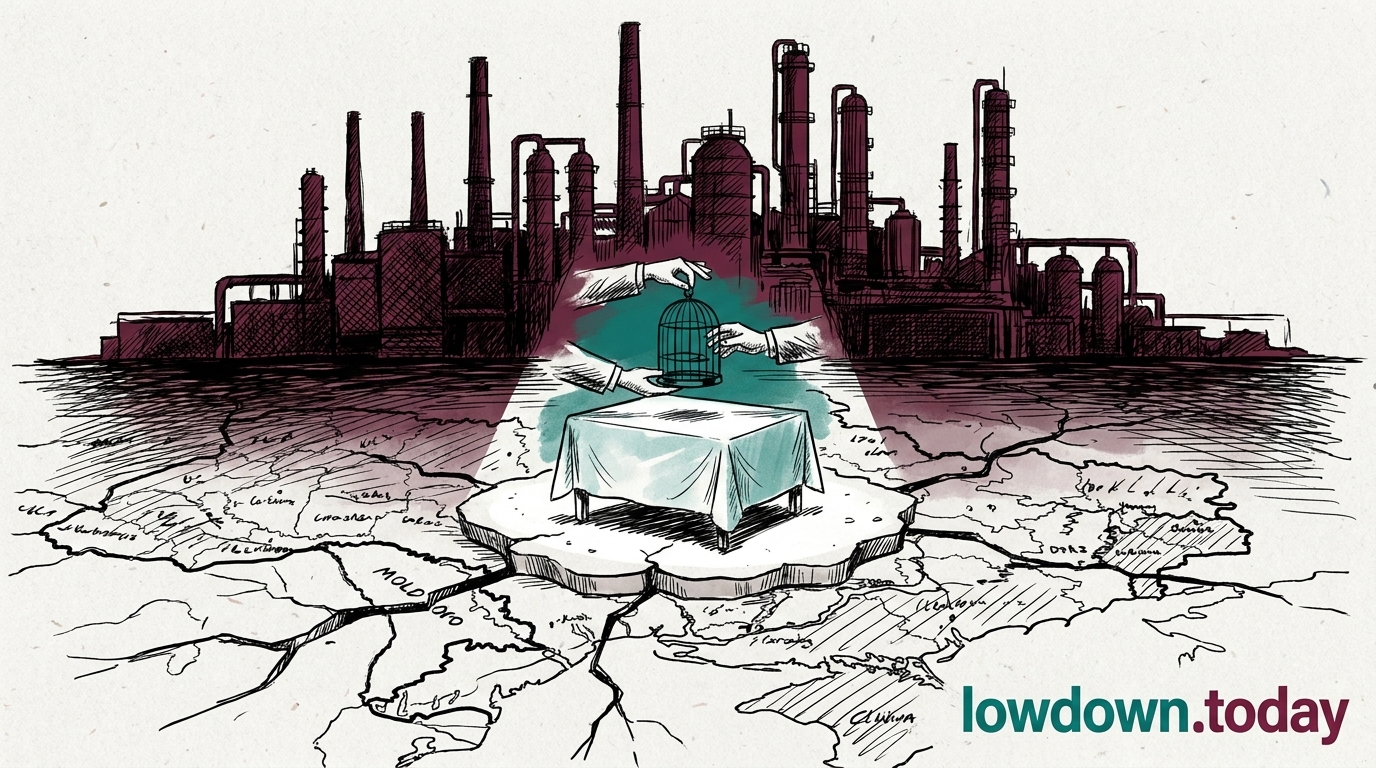
The Cloud and AI Development Act did not reach the College of Commissioners on Wednesday 27 May, the date Brussels itself had locked, and the US ambassador supplied the reason: a trade-framework red line.

ConflictDeveloping
Key takeaway

A package Brussels calendar-locked for today was pre-defeated diplomatically before it was ever formally proposed.

The Cloud and AI Development Act (CAIDA, the EU law that would bar US cloud giants from hosting sensitive public-sector data) did not reach the College of Commissioners on Wednesday 27 May 2026, the date the Commission itself had locked for adoption . The package slipped a third time, to a tentative 3 June, extending a sequence that now reads 25 March, 15 April, 27 May . Andrew Puzder, the US Ambassador to the EU, gave the proximate reason this time, and it was not industrial: he warned the package "crosses a red line" and is inconsistent with the EU-US trade framework 1. Politico, separately, reported the 400-page text was simply not ready 2.

For readers arriving cold: CAIDA is the centrepiece of the Tech Sovereignty Package, bundled with a revamped Chips Act II that would hand Brussels direct equity authority in semiconductor fabs. Alexandra Geese, a German Green MEP, put the trade link on the public record: the EU kept digital rules out of last August's framework, but Washington has kept pressing on the Digital Services Act (DSA, the EU's platform-accountability law) ever since 3.

For five updates the binding constraint on European sovereignty was an implementation gap: the right diagnosis, the right prescriptions, and an 11.2% delivery rate against the recommendations in Mario Draghi's 2024 competitiveness report . That constraint has changed character. Europe's problem is no longer only that it cannot build; it is that it cannot legislate sovereignty without tripping the trade framework, and the veto runs through Berlin. France favours the protectionist line. Germany, exposed to a threatened US tariff package on its automotive and luxury exports worth up to $200bn, does not 4.

The charitable reading deserves a hearing: reconciling procurement law, competition rules and international agreements across hundreds of pages is genuinely slow, and reading a US veto into a routine delay over-reaches. It does not survive the calendar. A third slip on a date the Commission locked, coinciding with a named ambassadorial red line and a documented Paris-Berlin split, means the package lacks the consensus to ship whatever the proximate cause. The instrument built to escape US dependence was pre-defeated diplomatically before a word of it reached the College.

Deep Analysis

In plain English

The European Commission wants to pass a law called CAIDA (the Cloud and AI Development Act) that would stop American tech giants like Microsoft, Amazon, and Google from handling sensitive government data in Europe. Think of it as a 'European data only' rule for public services. This was supposed to be approved on 27 May 2026, but it has now been delayed three times in a row. The latest holdup comes from two directions. First, the US ambassador to the EU publicly warned that the law would break trade rules agreed between Europe and America. Second, Germany is quietly reluctant because the United States has threatened up to $200 billion in tariffs on European cars, and Berlin does not want to provoke Washington further over a digital rule that does not directly affect the car industry.

Deep Analysis
Root Causes

Germany's automotive sector exported €84bn in vehicles and parts to the United States in 2024, representing approximately 27% of total German goods exports to the US. A $200bn threatened tariff package on EU automotive and luxury goods would fall disproportionately on German industry, not French or other member-state industry.

Berlin's CAIDA calculus is therefore not primarily about digital policy; it is about managing a trade-off between cloud procurement rules affecting German public-sector institutions and tariff exposure affecting the German private sector at roughly two orders of magnitude greater economic scale.

The Commission's public rationale for each successive slip has been procedural: finalising legal text, coordinating College positions. The structural cause is that CAIDA requires a qualified majority of member states, and Germany's silence functions as a blocking mechanism inside the College consensus model. Puzder's public intervention on 25 May crystallised what was already known internally: the US had communicated its position bilaterally before the ambassador went public.

What could happen next?
  • Risk

    A fourth slip beyond 3 June would push CAIDA past the summer recess, making October 2026 the earliest plausible adoption and extending US hyperscaler public-sector contract eligibility by another quarter.

    Short term · Assessed
  • Consequence

    Germany's automotive tariff calculus sets a precedent: any EU digital sovereignty instrument that conflicts with a US trade threat can be slowed by member-state export exposure, regardless of the instrument's merits.

    Medium term · Assessed
  • Precedent

    Puzder's public red-line warning, if unrebutted by the Commission, establishes that bilateral US pressure can visibly influence Commission adoption calendars on non-trade legislation.

    Long term · Assessed
First Reported In

Update #6 · Brussels slips sovereignty law a third time

BankInfoSecurity· 27 May 2026
Read original
Different Perspectives
North Korea / DPRK
North Korea / DPRK
ISW confirmed the first mounting of DPRK Type-75 MLRS on Russian autonomous UGVs near Kharkiv on 7 June, the latest step in a supply axis that escalated from shells in 2023 to troops in 2024. Pyongyang gains live battlefield data on its ordnance and on Russia's uncrewed-systems programme.
IAEA / Rafael Grossi
Grossi confirmed Chornobyl structural damage with nuclear material metres away and could not attribute the ZNPP 15-hour blackout during the agreed repair window. Six ceasefires brokered and broken at ZNPP, compounded by Rosatom's May attack on IAEA neutrality, have eroded his ability to enforce the windows he negotiates.
Emmanuel Macron / France
Macron co-signed the E3 framework whose line-of-contact baseline marks Europe's first formal acceptance that 1991 borders are not the opening position. France's role carries weight because Macron had previously proposed a European force for Ukraine, and the framework's multinational force point is the vehicle for that.
Keir Starmer / E3
Keir Starmer / E3
Starmer, Macron and Merz met Zelenskyy on 7 June and backed a five-point framework taking the line of contact as the talks baseline, conceding roughly one fifth of Ukraine in exchange for a multinational force and frozen assets. With US mediation ended, the NATO Ankara summit on 7-8 July is the next test.
Vladimir Putin / Kremlin
Putin used SPIEF to reject Zelenskyy's summit letter, citing 'elements of rudeness', and repeated the pre-agreed treaty precondition that has frozen every diplomatic round since May. The SPIEF platform's message of investor confidence was punctured by naval fires visible from St Petersburg, which Moscow declined to dispute in scale.
Ukraine / Unmanned Systems Forces
Commander Brovdi confirmed USF units tracked and set fire to Boikyi at Kronstadt, while Code 9.2 struck the Chonhar Bridge the following day. Ukraine is sequencing strikes for rear-area interdiction and political timing rather than ground gains, trading the Baltic Fleet's home base for the logistics squeeze Russia cannot absorb without rationing its own occupied territory.
