Skip to content
Briefings are running a touch slower this week while we rebuild the foundations.See roadmap
Russia-Ukraine War 2026
13MAY

Zelenskyy offers MBS drone skills

4 min read
20:00UTC

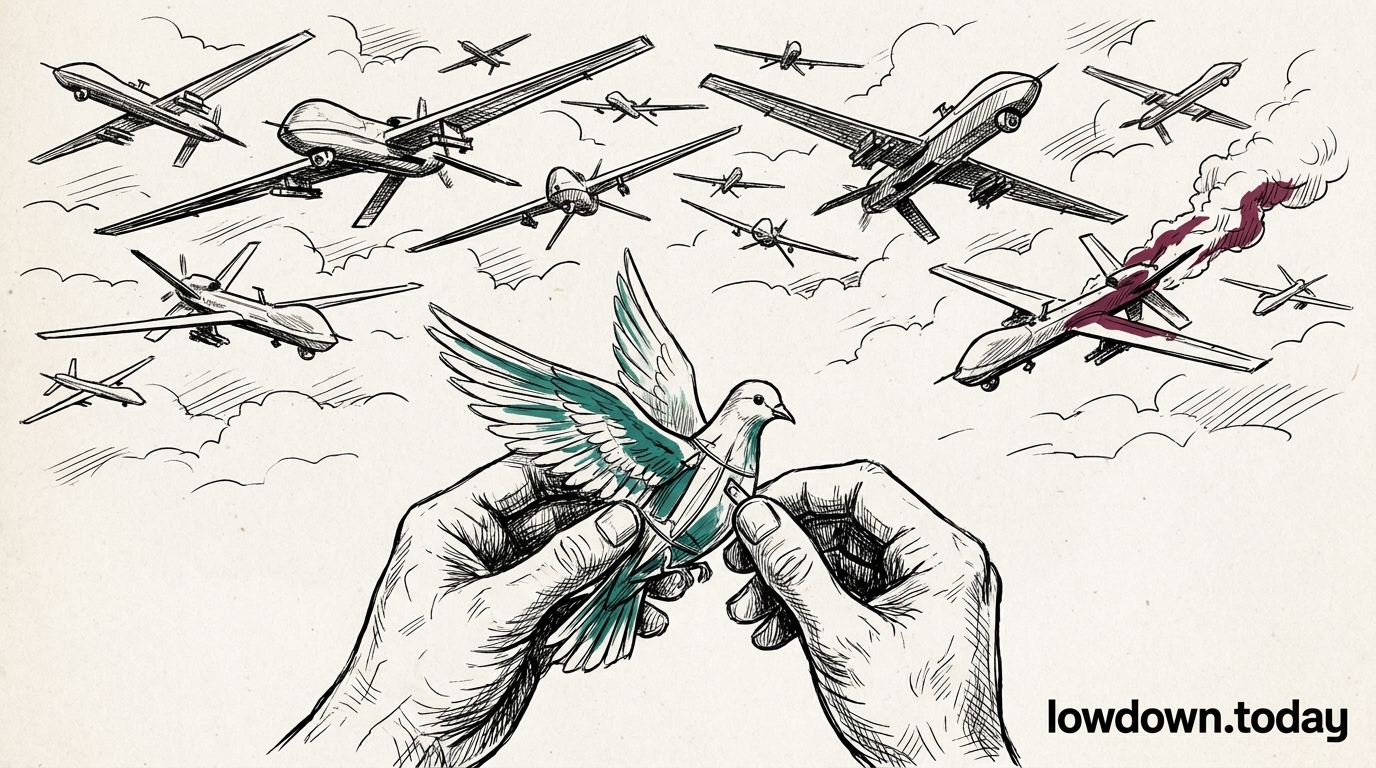
Two days after Trump's request, Zelenskyy pitched Saudi Arabia's crown prince on Ukraine's counter-drone expertise — and Bloomberg reported the asking price: ceasefire progress.

ConflictDeveloping
Key takeaway

Ukraine is converting wartime expertise into Gulf diplomatic capital, following Israel's post-1967 arms-diplomacy model.

On 7 March, Zelenskyy called Saudi Crown Prince Mohammed bin Salman and offered Ukraine's counter-drone expertise. "We know Shaheds. No other country in the world has this kind of experience," Zelenskyy told MBS 1. Bloomberg framed the exchange without ambiguity: Zelenskyy "offers help in return for truce" 2. The linkage between drone assistance and ceasefire progress was explicit — a transaction, not a goodwill gesture.

The economics favour Ukraine. Kyiv has developed low-cost interceptor drones at $1,000–$2,000 per unit 3, against $4–6 million for a single Patriot round and $12 million for a THAAD interceptor. Saudi Arabia has faced Houthi drone and missile attacks since the Yemen intervention began in 2015 and now confronts direct Iranian ballistic threats. It has immediate operational need for the capability Ukraine has refined under three years of fire. A wartime export ban currently blocks Ukrainian drone sales, but US and Gulf demand is building pressure to lift the restriction.

Ukraine entered 2026 seeking weapons, money, and security guarantees — the posture it has held since Russia's full-scale invasion. Within 48 hours of Trump's 5 March request, Zelenskyy had pitched the wealthiest Gulf state on a commodity neither the US nor European defence industry can supply at comparable cost or from comparable experience. The 2 March announcement that Ukraine would export counter-drone expertise to non-NATO states was the policy foundation; the MBS call was the first diplomatic application.

Whether this leverage converts depends on two decisions beyond Kyiv's control. First, Washington must lift the wartime export ban — a step that would signal US willingness to let Ukraine profit from the Iran war rather than merely absorb its side-effects. Second, MBS must weigh Ukraine's drone expertise against the oil-market coordination he maintains with Moscow through OPEC+. Saudi Arabia has avoided choosing sides in the Russia-Ukraine war since 2022, hosting negotiations while sustaining energy ties with both belligerents. Zelenskyy is betting that Iranian drones falling on Gulf territory change that arithmetic. The Russian oil revenues that had already fallen 65% year-on-year by January suggest Moscow's economic leverage over Riyadh is weaker than it was — but whether MBS sees it that way is a question only the next round of diplomacy will answer.

Deep Analysis

In plain English

Ukraine called Saudi Arabia's de facto ruler and offered something specific: the accumulated knowledge of how to shoot down Iranian Shahed drones, earned through three years of nightly interceptions. Saudi Arabia has itself been struck by Shahed variants and has strong reasons to want this expertise. In exchange, Ukraine is asking for help pushing a ceasefire with Russia — help that Saudi Arabia is positioned to provide, given its direct relationship with Trump and its influence over global oil markets that affect Russian revenues. Bloomberg described it plainly as 'help in return for a truce.' This is Ukraine repositioning from aid-receiver to capability-provider, using the Iran war as the catalyst for a new kind of diplomacy.

Deep Analysis
Synthesis

The MBS call is strategically layered beyond what the body surfaces. Saudi Arabia simultaneously holds leverage over Trump through their personal relationship and oil pricing, and over Russia through OPEC+ decisions that directly affect the oil revenues funding the war. Ukraine offering drone expertise to MBS is not merely a bilateral security transaction — it is an attempt to activate Saudi pressure on both ends of the Russia-US-Ukraine triangle at once. No other actor Ukraine could approach holds both levers simultaneously.

Root Causes

Ukraine's outreach to MBS reflects a calculated recognition that the US ceasefire track runs partly through Riyadh. Saudi Arabia's oil pricing decisions directly affect Russian fiscal revenues, and MBS has personal access to Trump that European leaders do not. Kyiv is constructing parallel pressure points on Moscow that do not depend on the frozen trilateral format — a hedge against that format's continued suspension.

What could happen next?
  • Opportunity

    If the export ban is lifted, Ukraine acquires a Gulf defence-market revenue stream and diplomatic network that persists beyond any eventual ceasefire.

    Medium term · Suggested
  • Risk

    Gulf states may absorb Ukrainian counter-drone doctrine without providing ceasefire pressure on Russia, extracting the expertise without the political reciprocity Kyiv needs.

    Short term · Suggested
  • Consequence

    Saudi mediation in the Ukraine conflict, if activated, would give Riyadh simultaneous leverage over Moscow and Washington — a structural position Riyadh would be incentivised to prolong.

    Short term · Assessed
  • Precedent

    A state actively at war monetising battlefield expertise for diplomatic outcomes establishes a new template for asymmetric conflict actors seeking influence beyond their military capacity.

    Long term · Assessed
First Reported In

Update #3 · Iran war halts talks, drains air defences

Al Jazeera· 9 Mar 2026
Read original
Causes and effects
Different Perspectives
NATO eastern flank (B9 + Nordics)
The B9+Nordic Bucharest joint statement on 13 May reaffirmed Ukraine's sovereignty within internationally recognised borders and backed NATO eastern flank reinforcement; the summit accepted Zelenskyy's bilateral drone deal proposal as a structural alternative to the stalled US export approval pathway, treating it as a European defence architecture question rather than aid delivery.
IAEA / Rafael Grossi
Grossi is still negotiating a sixth ZNPP repair ceasefire with no agreement after 50 days of 750 kV line disconnection; the 3 May ERCL drone strike that destroyed environmental monitoring equipment represents a qualitative escalation in infrastructure degradation that the IAEA has documented but cannot compel either party to halt.
Péter Magyar / Hungary
Magyar's incoming foreign minister pledged on 12 May that Hungary will stop abusing EU veto rights; the pledge is a statement of intent rather than a binding legal commitment, and Magyar's MEPs voted against the €90 billion loan as recently as April, while a planned referendum on Ukraine's EU accession preserves a downstream blocking lever.
EU Council and European Commission
The Magyar cabinet formation on 12 May removes the Hungary veto that had blocked the €9.1 billion first tranche since February; the Commission is now coordinating the three-document disbursement package for an early-June vote. The structural blocker is gone; the disbursement question is now scheduling, not politics.
Donald Trump / White House
Trump announced a 9-11 May three-day ceasefire with a 1,000-for-1,000 prisoner exchange attached, then called peace 'getting very close' on 11-13 May while Russia's 800-drone barrage was under way; his public framing adopted Russian diplomatic language without securing any Russian operational concession or verifying the exchange was agreed.
Vladimir Putin / Kremlin
Putin told reporters on 9 May the war is 'coming to an end' while Peskov confirmed on 13 May that territorial demands are unchanged and Russia requires full Ukrainian withdrawal from all four annexed regions; the verbal accommodation costs Moscow nothing and conditions any summit on a pre-finalised treaty Kyiv cannot accept.
