Skip to content
Briefings are running a touch slower this week while we rebuild the foundations.See roadmap
Russia-Ukraine War 2026
13MAY

IRGC: not a litre through Hormuz

3 min read
20:00UTC

The IRGC promised total closure of the world's most important oil chokepoint — but 11.7 million barrels of Iranian crude have already passed through to China.

ConflictDeveloping
Key takeaway

Iran declared total closure while exempting its own exports — selective coercion, not genuine blockade.

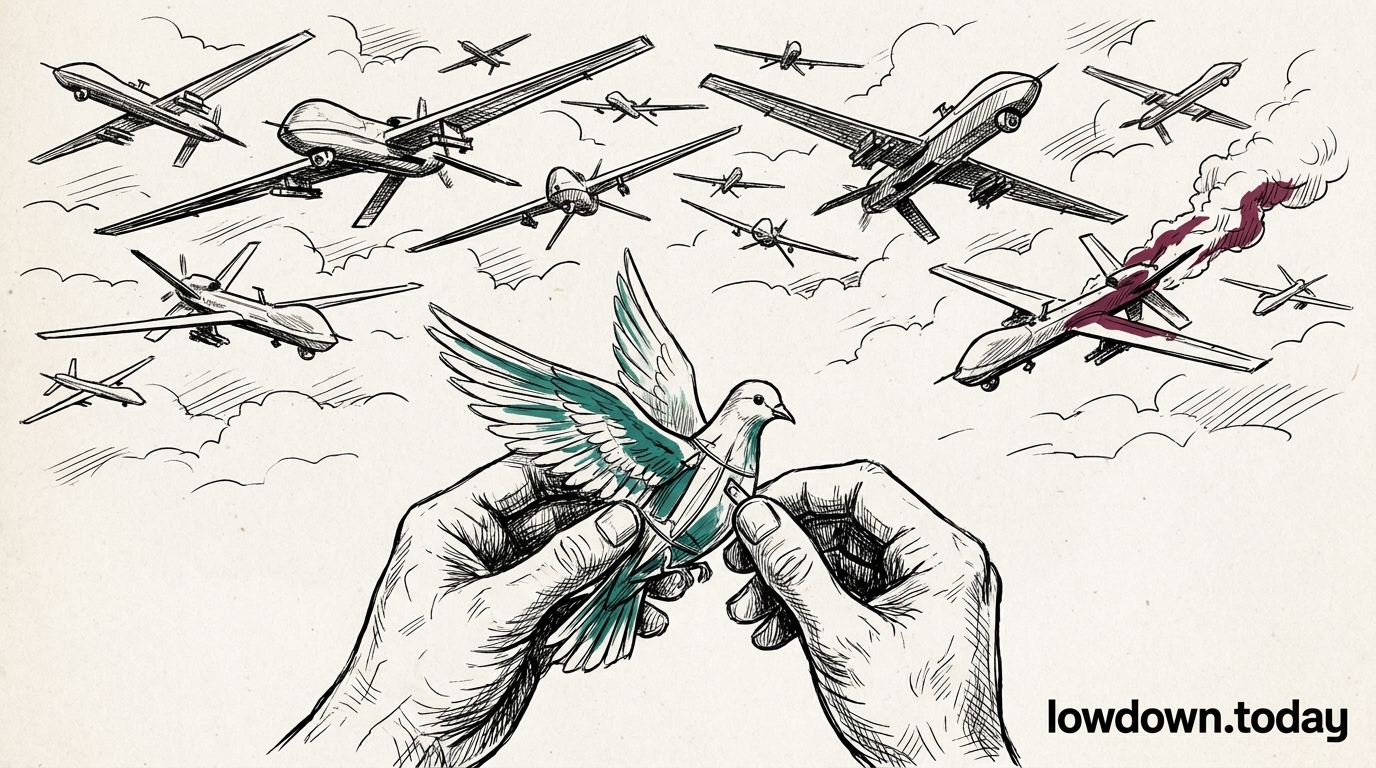
The IRGC declared on Wednesday that "not a litre of oil" would pass through the strait of Hormuz. This is the most absolute blockade language of the conflict, completing an escalation from IRGC operational warnings in the first days, through the Foreign Ministry's statement that tankers "must be very careful" — the first diplomatic-level Hormuz threat of the war — to a declaration of total closure.

The IRGC has backed the rhetoric with force. It struck the Marshall Islands-flagged tanker Louise P with a kamikaze drone, publicly naming the vessel and claiming it belonged to the US . It hit the Prima after the vessel ignored warnings about the transit ban . Both attacks were publicly claimed — the IRGC identified each ship, stated its rationale, and took responsibility. Under UNCLOS, attacking civilian merchant vessels is prohibited unless they directly assist military operations. No such claim was made for either vessel.

The declaration has a conspicuous exception: Iran's own crude continues to flow. Since 28 February, 11.7 million barrels of Iranian oil have transited the same strait, all bound for China. A blockade under international law requires impartial enforcement against all vessels. What the IRGC has constructed is not a blockade but a selective interdiction regime — one that punishes states aligned with the US-Israeli campaign while rewarding those providing diplomatic cover. The last time Iran systematically attacked commercial shipping in The Gulf was the 1980–88 Tanker War, which prompted the US to launch Operation Earnest Will, escorting reflagged Kuwaiti tankers under the American flag. No equivalent convoy operation has been announced.

The practical effect is already measurable. Tanker traffic through Hormuz has fallen 90% from pre-war levels. Every major protection and indemnity club cancelled War risk coverage effective 5 March. Kuwait declared force majeure on all oil exports . The declaration formalises what shipping companies had already priced in: the strait is open only to those Tehran permits through.

Deep Analysis

In plain English

The Strait of Hormuz is a narrow waterway — roughly 34 kilometres at its narrowest — through which approximately a third of the world's seaborne oil normally passes. Iran and Oman share its coastline. Iran has now announced that no oil will transit at all. But Iranian tankers have continued sailing through the same strait, carrying crude to China. This means the 'total blockade' is selective: Iran is weaponising control of the strait to punish adversaries while protecting its own revenue stream and rewarding its main diplomatic ally. It is economic warfare using a geographic chokepoint as the instrument — and the chokepoint stays open for the one party whose support Iran cannot afford to lose.

Deep Analysis
Synthesis

The selective blockade establishes a novel strategic template: a state actor weaponises a critical maritime chokepoint against adversaries while maintaining a protected revenue channel to a single patron, using that patron's diplomatic weight as political cover. No existing international legal or military framework contains a response mechanism designed for this specific configuration of selective transit denial.

Root Causes

Iran's sanctions-constrained economy is structurally dependent on Chinese oil purchases for nearly all export revenue. A genuine total closure would sever its primary income source. The 'not a litre' rhetoric is calibrated to maximise coercive pressure on adversaries while remaining structurally impossible to apply to China — the declaration's absolutism is affordable precisely because the exception is guaranteed.

Escalation

The absolute declaration creates a legal and political test the US has not yet acted on. Tolerating Iranian oil transits while enforcing closure against other nations concedes the two-tier order. Acting against Iranian-flagged vessels risks direct naval confrontation in waters Iran claims as territorial sea. The US has chosen inaction, which becomes harder to reverse as the pattern solidifies into a de facto norm.

What could happen next?
  • Risk

    US inaction on Iranian-flagged transits concedes the two-tier order; acting against them risks the first direct US-Iran naval exchange in the Persian Gulf since 1988.

    Immediate · Assessed
  • Meaning

    The gap between the 'not a litre' declaration and 11.7 million barrels flowing to China reveals Iranian escalatory constraints that adversaries can calibrate their responses against.

    Short term · Assessed
  • Precedent

    Iran's selective blockade doctrine may be studied as a replicable model for other actors controlling strategic chokepoints in future confrontations.

    Long term · Suggested
First Reported In

Update #32 · UN condemns Iran 13-0; ceasefire blocked

CNBC· 12 Mar 2026
Read original
Causes and effects
This Event
IRGC: not a litre through Hormuz
Iran escalated from diplomatic warnings to a declaration of total Hormuz closure — the strongest blockade language since the 1988 Tanker War. The declaration is selectively enforced: Iran's own crude transits freely to China while non-Chinese shipping faces interdiction, converting Hormuz from a waterway into a tool of economic coercion against US-aligned economies.
Different Perspectives
NATO eastern flank (B9 + Nordics)
The B9+Nordic Bucharest joint statement on 13 May reaffirmed Ukraine's sovereignty within internationally recognised borders and backed NATO eastern flank reinforcement; the summit accepted Zelenskyy's bilateral drone deal proposal as a structural alternative to the stalled US export approval pathway, treating it as a European defence architecture question rather than aid delivery.
IAEA / Rafael Grossi
Grossi is still negotiating a sixth ZNPP repair ceasefire with no agreement after 50 days of 750 kV line disconnection; the 3 May ERCL drone strike that destroyed environmental monitoring equipment represents a qualitative escalation in infrastructure degradation that the IAEA has documented but cannot compel either party to halt.
Péter Magyar / Hungary
Magyar's incoming foreign minister pledged on 12 May that Hungary will stop abusing EU veto rights; the pledge is a statement of intent rather than a binding legal commitment, and Magyar's MEPs voted against the €90 billion loan as recently as April, while a planned referendum on Ukraine's EU accession preserves a downstream blocking lever.
EU Council and European Commission
The Magyar cabinet formation on 12 May removes the Hungary veto that had blocked the €9.1 billion first tranche since February; the Commission is now coordinating the three-document disbursement package for an early-June vote. The structural blocker is gone; the disbursement question is now scheduling, not politics.
Donald Trump / White House
Trump announced a 9-11 May three-day ceasefire with a 1,000-for-1,000 prisoner exchange attached, then called peace 'getting very close' on 11-13 May while Russia's 800-drone barrage was under way; his public framing adopted Russian diplomatic language without securing any Russian operational concession or verifying the exchange was agreed.
Vladimir Putin / Kremlin
Putin told reporters on 9 May the war is 'coming to an end' while Peskov confirmed on 13 May that territorial demands are unchanged and Russia requires full Ukrainian withdrawal from all four annexed regions; the verbal accommodation costs Moscow nothing and conditions any summit on a pre-finalised treaty Kyiv cannot accept.
