Skip to content
Briefings are running a touch slower this week while we rebuild the foundations.See roadmap
Russia-Ukraine War 2026
5APR

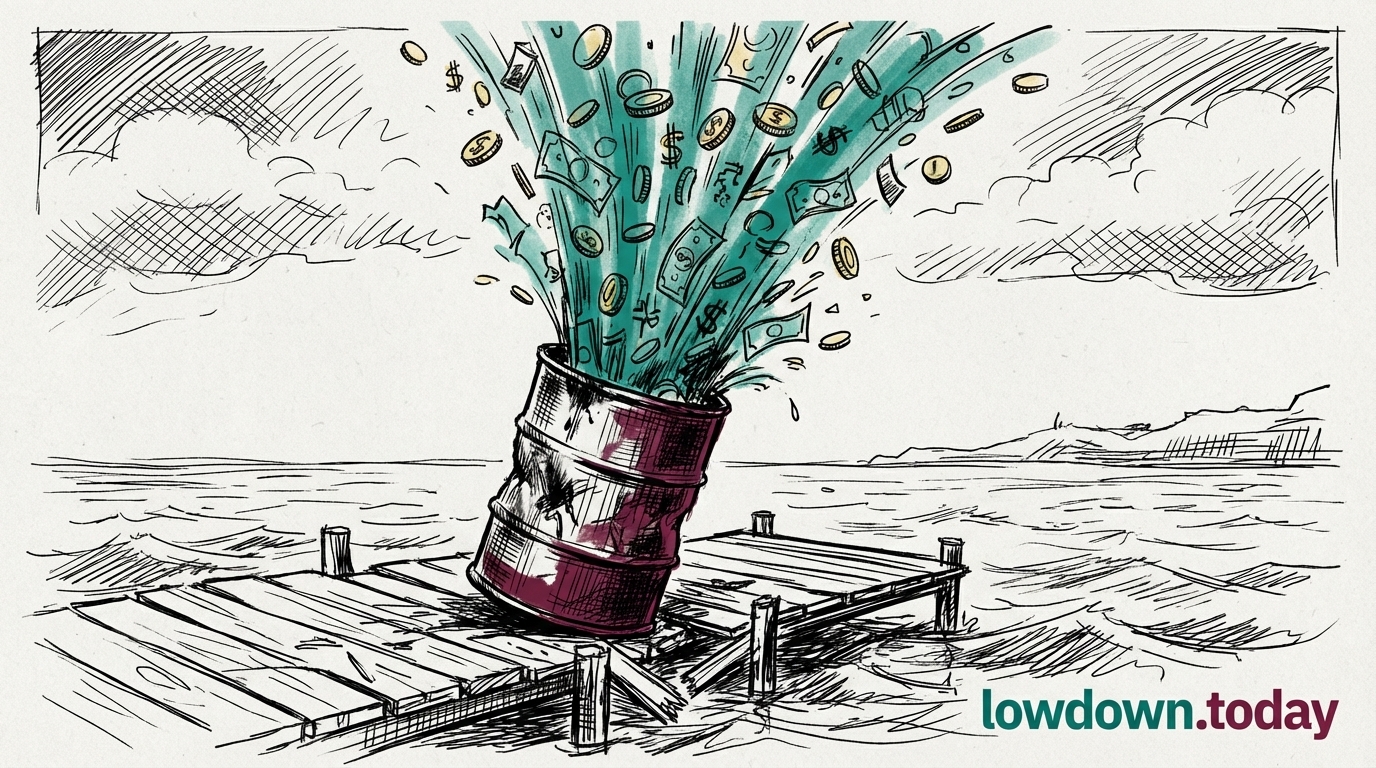
Brent's biggest single-day drop since 1991 Gulf War

2 min read
19:51UTC

Oil retired the war's escalation premium overnight; the structural Hormuz risk premium remains in the price.

ConflictDeveloping
Key takeaway

Markets retired the war's escalation premium overnight and kept the structural Hormuz risk premium intact.

Brent Crude opened London trading on 8 April between 15 and 16 per cent below its previous close, the largest one-day fall in oil since 1991. The price at $92 is still 37 per cent above the $67.41 pre-war baseline. The escalation tail (Brent towards $130 if the strait closed completely) has been retired. The structural floor (Brent above $90 because Iran is managing transits and not opening them) has not. Windward counted 20 daily transits through the strait as of 5 April, 14 outbound and 6 inbound, against a pre-war baseline of 138 daily, and the recovery to one-seventh of pre-war volume happened before the ceasefire driven by 11 flag states paying Iran's toll. The ceasefire ratifies a recovery trajectory that was already underway, not a return to pre-war operating conditions.

The IEA, IMF and World Bank had jointly described the conflict as one of the largest supply shortages in energy market history . Today's drop unwinds the part of that shortage that was speculative; the part that is structural is still in the price.


Deep Analysis

In plain English

Oil prices fell 15-16 per cent overnight on the ceasefire news, the biggest single-day drop since the first Gulf War in 1991. But Brent at $92 is still much higher than the $67 it was before the war started. That gap is the part of the price that traders think will stay even with a ceasefire, because Iran will keep deciding who passes through the Strait of Hormuz.

Deep Analysis
Synthesis

The price tells you what the ceasefire is and what it isn't.

Root Causes

Six weeks of supply disruption had built the escalation premium into the spot price. The ceasefire announcement removed the speculative component overnight.

Escalation

Markets are pricing de-escalation and structural impasse simultaneously.

What could happen next?
  • Consequence

    UK forecourt pump prices fall 5-8 per cent over the next fortnight; freight rates lag.

  • Risk

    If the ceasefire collapses, the speculative premium returns within hours.

First Reported In

Update #62 · Two victories, two different lists

Bloomberg· 8 Apr 2026
Read original
Different Perspectives
North Korea / DPRK
North Korea / DPRK
ISW confirmed the first mounting of DPRK Type-75 MLRS on Russian autonomous UGVs near Kharkiv on 7 June, the latest step in a supply axis that escalated from shells in 2023 to troops in 2024. Pyongyang gains live battlefield data on its ordnance and on Russia's uncrewed-systems programme.
IAEA / Rafael Grossi
Grossi confirmed Chornobyl structural damage with nuclear material metres away and could not attribute the ZNPP 15-hour blackout during the agreed repair window. Six ceasefires brokered and broken at ZNPP, compounded by Rosatom's May attack on IAEA neutrality, have eroded his ability to enforce the windows he negotiates.
Emmanuel Macron / France
Macron co-signed the E3 framework whose line-of-contact baseline marks Europe's first formal acceptance that 1991 borders are not the opening position. France's role carries weight because Macron had previously proposed a European force for Ukraine, and the framework's multinational force point is the vehicle for that.
Keir Starmer / E3
Keir Starmer / E3
Starmer, Macron and Merz met Zelenskyy on 7 June and backed a five-point framework taking the line of contact as the talks baseline, conceding roughly one fifth of Ukraine in exchange for a multinational force and frozen assets. With US mediation ended, the NATO Ankara summit on 7-8 July is the next test.
Vladimir Putin / Kremlin
Putin used SPIEF to reject Zelenskyy's summit letter, citing 'elements of rudeness', and repeated the pre-agreed treaty precondition that has frozen every diplomatic round since May. The SPIEF platform's message of investor confidence was punctured by naval fires visible from St Petersburg, which Moscow declined to dispute in scale.
Ukraine / Unmanned Systems Forces
Commander Brovdi confirmed USF units tracked and set fire to Boikyi at Kronstadt, while Code 9.2 struck the Chonhar Bridge the following day. Ukraine is sequencing strikes for rear-area interdiction and political timing rather than ground gains, trading the Baltic Fleet's home base for the logistics squeeze Russia cannot absorb without rationing its own occupied territory.



