Skip to content
You can now search across every topic, entity and event.What's new
Iran Conflict 2026
5APR

Global Energy Bodies Declare Historic Supply Shortage

3 min read
12:52UTC

The IEA, IMF, and World Bank issued a rare joint statement. They announced three coordinated actions and zero specific commitments.

ConflictAssessed
Key takeaway

Three global institutions confirmed the energy crisis but committed nothing specific to fix it.

The IEA, IMF, and World Bank issued a joint statement on 4 April calling the conflict "one of the largest supply shortages in global energy market history," with impact described as substantial, global, and highly asymmetric. 1 Three coordinated actions were announced: data sharing, targeted policy advice with concessional financing, and stakeholder mobilisation. No specific numerical commitments were made.

Emily Holland at War on the Rocks calculated that American households face $857 more in petrol costs if the Hormuz disruption continues through April. 2 Analysts warned $150 per barrel is possible if the strait stays closed another month. Brent crude had already risen to $109.24 after the 40-nation summit produced no steps . The joint statement puts institutional weight behind what oil markets have been pricing in for weeks, but it offers no mechanism to change the supply picture.

Deep Analysis

In plain English

Three of the most powerful economic organisations in the world, the International Energy Agency, the International Monetary Fund, and the World Bank, issued a joint statement calling this conflict the biggest disruption to energy supplies in the history of global markets. They announced they would share data, give advice, and bring people together to discuss the problem. They did not announce any specific action to fix it. One calculation estimates that American households will pay roughly $857 more for petrol if the shipping lane stays blocked through April. In the UK, fuel prices are already rising, with more to come if the lane does not reopen.

First Reported In

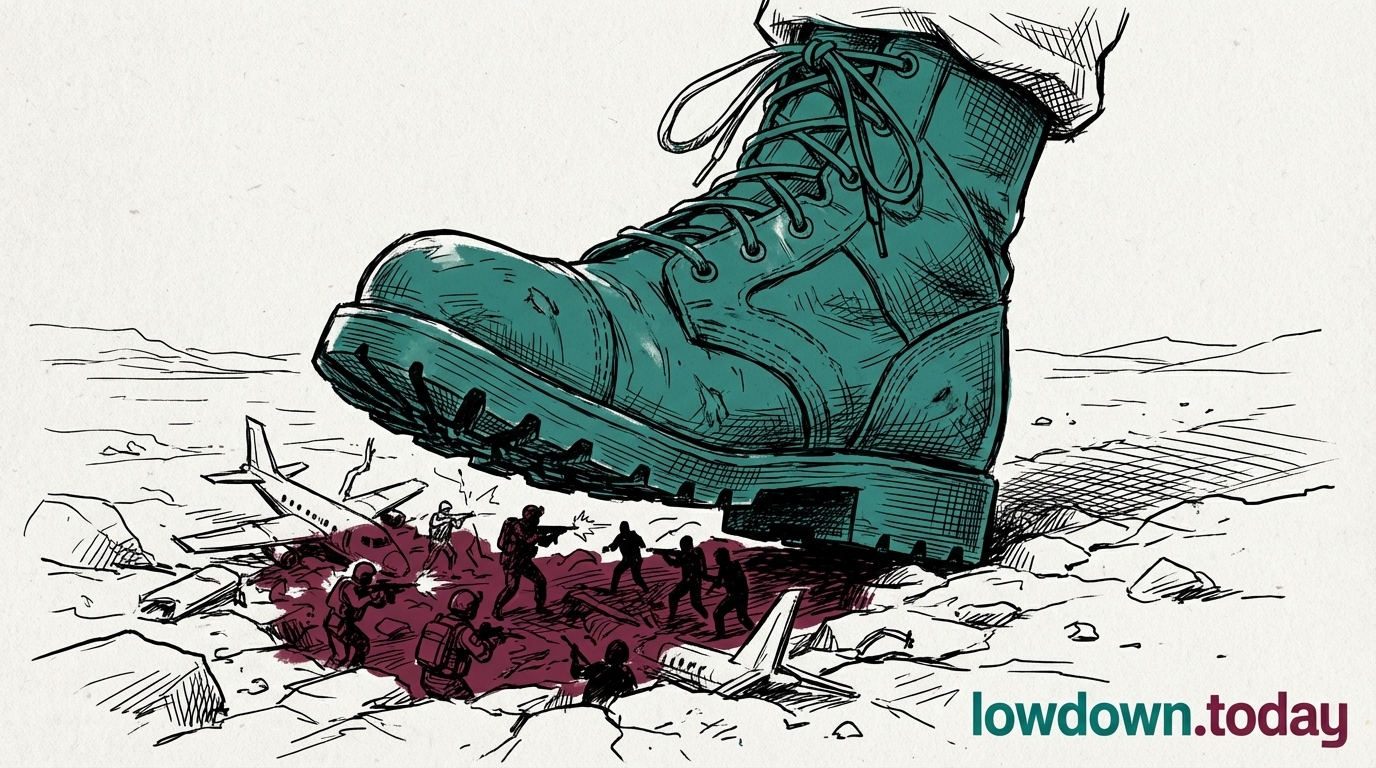
Update #59 · Day 37: A Ground War Inside Iran That Nobody Will Name

International Energy Agency· 5 Apr 2026
Read original
Different Perspectives
Oil market and P&I insurers
Brent cleared $87 intraday only once CENTCOM's blockade became physical rather than declared, even though P&I Clubs had already excluded Hormuz war risk a week earlier on 7 July: capital hedged ahead of enforcement, but prices moved only after it.
UAE reporting
UAE reporting
UAE reporting placed the Omani tanker deaths at one seafarer against the International Maritime Agency's count of two, the first time in this war that a Gulf state's casualty figures have diverged from an international monitor's.
Jordan
Jordan
Iranian strikes reached Jordan again on 14 July as part of the Gulf-wide retaliation for the Hormuz blockade, extending the conflict's geographic footprint to a state with no direct stake in the strait itself.
Bahrain
Bahrain
Bahrain sounded air-raid sirens on 14 July during Iran's Gulf-wide retaliation, the same day CENTCOM's blockade order and fourth night of strikes pushed the conflict's physical reach into the wider Gulf littoral.
Kuwait
Kuwait
Kuwait intercepted Iranian missiles and drones on 14 July as Tehran's blockade retaliation reached Gulf states beyond Iran's immediate shoreline, confirming Kuwaiti airspace now sits inside Iran's retaliatory envelope.
Oman
Oman
Oman absorbed the war's first tanker casualties in its own waters on 14 July, with two supertankers disabled and seafarers killed, putting the sultanate's shipping lanes directly in the path of the blockade fight for the first time.