Skip to content
You can now search across every topic, entity and event.What's new
Pandemics and Biosecurity
31JUL

Kenyan court halts US quarantine site

3 min read
10:28UTC

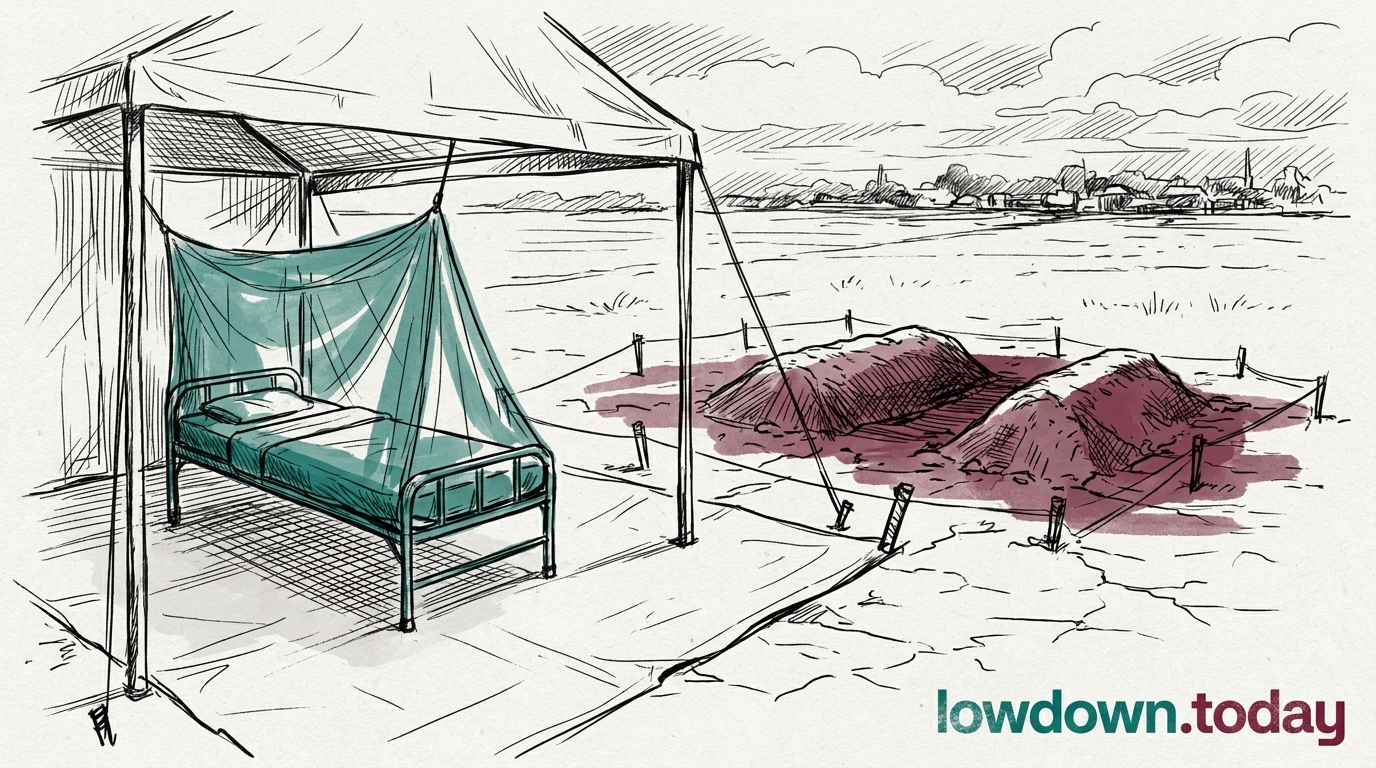
A Kenyan court suspended a US plan for a 50-bed quarantine facility at a Nairobi air force base on 29 May, and hundreds protested on 1 June. Days earlier, the US, Mexico and Canada announced Ebola screening for the World Cup.

ScienceDeveloping
Key takeaway

A Kenyan court blocked a US quarantine site in Nairobi as Washington pressed unilateral Ebola measures against WHO advice.

A Kenyan court suspended a United States plan to build a 50-bed quarantine facility for American nationals at a Nairobi air force base on Friday 29 May, and on Monday 1 June hundreds of Kenyans protested against the site 1. The facility was intended to hold US citizens exposed during the outbreak; the court froze the build before construction.

The ruling lands on a sequence of unilateral US moves. Washington's 21-day entry ban on nationals of DRC, Uganda and South Sudan, imposed on 18 May against WHO advice , lapses around Monday 8 June unless renewed. The International Health Regulations Emergency Committee, the WHO's legal framework governing member-state action during emergencies, had explicitly advised against travel restrictions, and the WHO repeated that opposition in DON605 2.

Separately, the United States, Mexico and Canada announced Ebola screening protocols on Thursday 28 May for the FIFA World Cup 2026 they jointly host this summer 3. These moves followed the standing 17 May emergency , not any fresh declaration. The posture lands on a thin federal bench: the US Ebola-response unit at USAID was disbanded earlier this year , and the same official holds the NIH and acting-CDC roles , so a blocked Nairobi site removes a fallback the US cannot quickly rebuild.

Deep Analysis

In plain English

When a serious disease outbreak happens, countries try to prevent it from spreading to their own territory by checking travellers at airports and, sometimes, by setting up places where people who may have been exposed can be separated from the general public while health authorities monitor them. The United States planned to build a 50-bed quarantine facility at an air force base in Nairobi, Kenya, for American nationals travelling from affected countries. On 29 May, a Kenyan court blocked the plan, and on 1 June hundreds of Kenyans protested against it. The Kenyan argument is that a foreign quarantine facility on a foreign military base is not subject to Kenyan courts or health standards. Separately, the US, Mexico and Canada announced that at the 2026 FIFA World Cup, people arriving from countries with active Ebola outbreaks would face health screening. The WHO advises against full travel bans but supports targeted screening at points of entry.

Deep Analysis
Root Causes

The underlying structural cause of the US-Kenya friction is the USAID operational vacuum created by the disbandment of the US global health security presence.

The standard modality for US public-health engagement in African partner countries ran through the CDC Global Disease Detection programme and USAID bilateral health attaché networks, which built the institutional relationships that would normally allow a quarantine-facility proposal to be negotiated quietly at an intergovernmental level before becoming a court case. Without that diplomatic-health infrastructure, the proposal surfaced publicly in a form that read as a unilateral imposition.

A second structural cause is the absence of a pre-agreed WHO-managed global quarantine-facility framework. The IHR calls for isolation capacity at points of entry but does not specify who builds or operates it, leaving each country to negotiate bilaterally. During the 2014 West Africa epidemic, the US CDC and USAID effectively served as the operational backbone for those bilateral arrangements; that role is now unfilled.

What could happen next?
  • Precedent

    The Kenyan court ruling creates a legal precedent restricting foreign governments from establishing quarantine infrastructure on military bases in African host countries without formal bilateral health agreements.

  • Risk

    The absence of a negotiated WHO-managed quarantine-facility framework means that the next high-risk traveller from DRC or Uganda who develops symptoms en route to a World Cup venue will fall through bilateral-protocol gaps.

First Reported In

Update #5 · Ebola money arrives, the cure does not

World Health Organization· 2 Jun 2026
Read original
Different Perspectives
Chinese health authorities
China reported three human H9N2 cases to WHO between 10 and 16 July: two four-year-olds recovered, a 44-year-old man remains in intensive care, the first severity signal in a cluster that has produced 173 cases and 2 deaths globally since 2015. The subtype is distinct from the H5N1 series this topic otherwise tracks.
US public health authorities
CIDRAP and Dr Andrew Racine, president of the American Academy of Pediatrics, call 2026's 2,318 confirmed measles cases by 24 July the worst year since 1991's 2,126. Zero deaths against three in 2025 and a 7% hospitalisation rate, down from 11%, show record case counts have not brought record severity.
CEPI
CEPI
CEPI put an rVSV-platform vaccine candidate specific to Bundibugyo ebolavirus into trial-production on 31 July, developed by Hilleman Laboratories with MSD manufacturing and IAVI's reference virus, funded up to $8.5m. Eleven weeks into the third-largest Ebola outbreak on record, this is the first species-matched candidate; the licensed vaccine covers only Zaire ebolavirus.
Médecins Sans Frontières
MSF reports sexual-violence care in Ituri is almost non-existent, with 7 of 14 health centres closed or relocated by fighting, as Panzi Hospital logs 646 new survivors in six months, an 85% rise. Withdrawn US funding for post-exposure prophylaxis has left clinics across three provinces without PEP kits for months, a crisis running alongside Ebola, not caused by it.
DRC health workers at Elikya Ebola Treatment Centre
Staff at DRC's Elikya Ebola Treatment Centre walked out on 25 July over unpaid wages, the second such action after Rwampara, while unconfirmed suspects occupy up to 64% of the country's isolation beds awaiting lab results. Workers are absorbing a response that has grown faster than its payroll and its labs.
Uganda's Ministry of Health
Uganda's ministry says it discharged its last confirmed patient on 16 June, completed every contact's 21-day follow-up, and declared the country Ebola-free on 28 July, exactly 42 days later. It names Hon. Dr Chris Baryomunsi, Minister of Health, as overseeing a 20-case, 2-death outbreak it now considers closed.