Skip to content
You can now search across every topic, entity and event.What's new
Pandemics and Biosecurity
31JUL

Two-thirds of Ebola deaths never reach a ward

3 min read
10:28UTC

Africa CDC's latest situation report puts two-thirds of this outbreak's deaths outside any treatment centre, with 264 beds standing empty in the epicentre while a neighbouring province runs at 134% of capacity. Uganda declared itself Ebola-free on 28 July, thirty days before the surveillance window WHO recorded, and three institutional records disagree about why. US measles has broken the 2025 record, with zero deaths so far.

Key takeaway

Bed capacity, lab throughput and unpaid wages, not virus behaviour, are driving Bundibugyo's rising death toll.

This briefing mapped
Humanitarian
Diplomatic
Regulatory

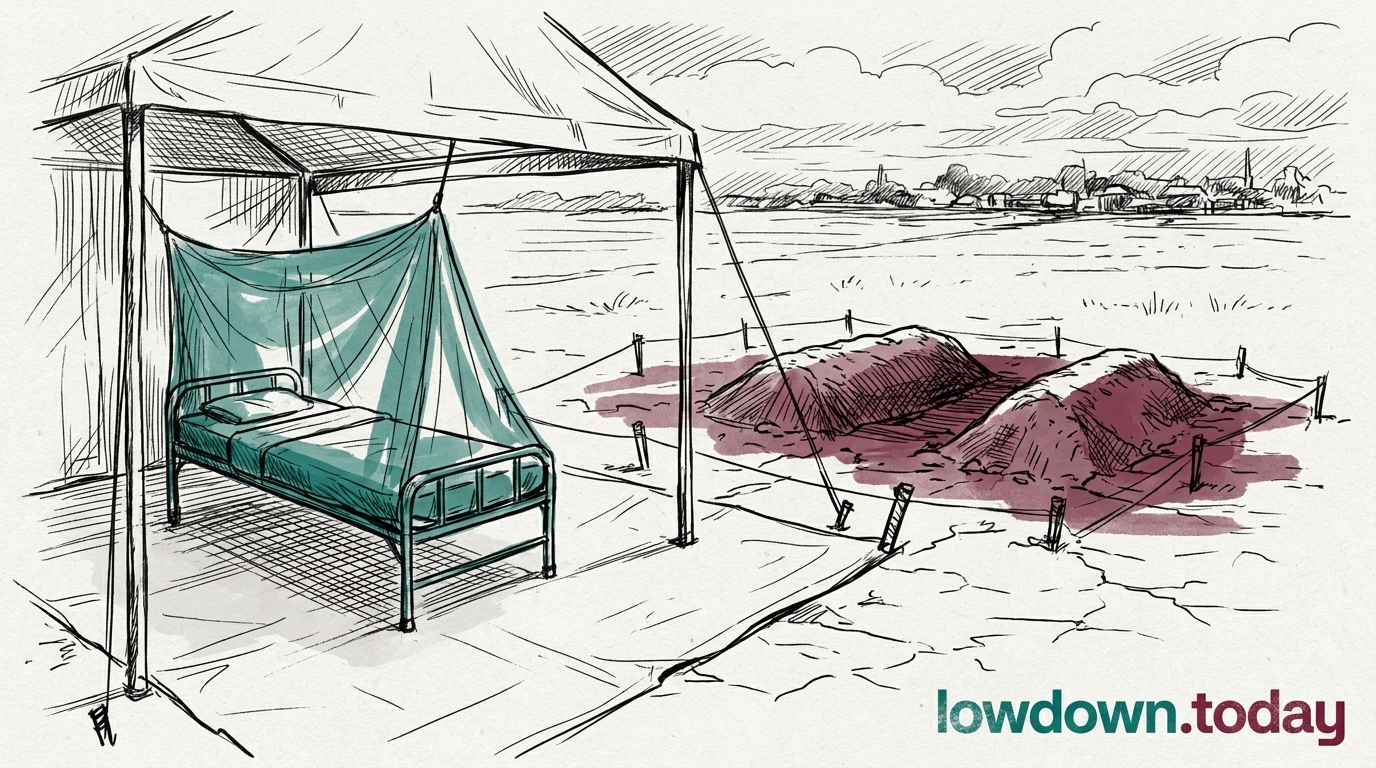
Africa CDC placed 683 of 1,033 reported Bundibugyo deaths in the community, outside any treatment or isolation centre. Two fatal cases in three never touch the care system.

Sources profile:This story draws on neutral-leaning sources

Africa CDC's latest report found two in three recorded Ebola deaths, 683 of 1,033, happened at home rather than in care. The case data runs through 27 July.

Most fatal cases never reach a treatment centre at all. Bodies are washed and buried by family at peak infectiousness, so each death is a likely spreading event. 

Sources:Africa CDC

Tshopo and South Kivu logged their first confirmed Bundibugyo cases, taking transmission to 48 of DR Congo's 140 affected-region health zones across five provinces.

Sources profile:This story draws on neutral-leaning sources

Bundibugyo Ebola has now reached 48 of 140 health zones across five DR Congo provinces. Tshopo and South Kivu recorded their first confirmed cases this window.

Tshopo's five cases carry an 80% death rate, but Africa CDC attributes that to a brand new area with no isolation beds yet, not a deadlier virus. 

Sources:Africa CDC

North Kivu ran its isolation wards at 134% of capacity on 27 July. Ituri, carrying nine times as many cases, had 264 beds free.

Sources profile:This story draws on neutral-leaning sources

Nord-Kivu's Ebola isolation wards ran as full as 136% for thirteen straight days, Africa CDC reported. Ituri, the epicentre with far more cases, had 264 empty beds instead.

The beds exist. They are simply in the wrong province, a mismatch the response cannot fix as fast as it counts new cases. 

Sources:Africa CDC

Staff at the Elikya Ebola Treatment Centre struck over unpaid wages on 25 July. Elikya is not Rwampara: this is the second centre lost to payroll failure in twelve days.

Sources profile:This story draws on neutral-leaning sources from Switzerland
Switzerland

Staff at the Elikya Ebola Treatment Centre in Ituri walked out over unpaid wages on 25 July, the second centre to strike in under two weeks after Rwampara.

Payroll delays are keeping donor money from reaching front-line workers. Each walkout cuts into the care capacity patients depend on. 

Patients still waiting on a laboratory result occupy between 55% and 64% of every Ebola isolation bed in DR Congo, Africa CDC found.

Sources profile:This story draws on neutral-leaning sources

Unconfirmed patients awaiting lab results fill 55 to 64% of every Ebola isolation bed in DR Congo, Africa CDC reported. That crowds out confirmed cases.

Suspects must be isolated before results arrive, whether they test positive or not. Testing now consumes the very capacity it should protect. 

Sources:Africa CDC

Africa CDC put Bundibugyo case fatality at 44.1% on 27 July, up from about 39.7% a week earlier, and attributes the rise to later presentation and saturated treatment sites.

Sources profile:This story draws on neutral-leaning sources

Bundibugyo Ebola's case-fatality rate crossed 40%, rising from about 39.7% on 20 July to 44.1% on 27 July. Africa CDC reported the figures.

Africa CDC blames later patient presentation and overloaded treatment sites, not a more dangerous virus. The same bed and testing bottlenecks straining the response explain the rise. 

Sources:Africa CDC

Health minister Chris Baryomunsi declared Uganda's outbreak over in Kampala on 28 July, thirty days before the surveillance window WHO recorded as running to 27 August.

Sources profile:This story draws on neutral-leaning sources

Uganda's health minister, Dr Chris Baryomunsi, declared the country Ebola-free on 28 July. That came thirty days before the World Health Organization's own 42-day countdown was due to close on 27 August.

Uganda's ministry, the WHO and Africa CDC each give a different account of why the early closure was allowed. This briefing reports the conflict without picking a side. 

Panzi Hospital recorded an 85% rise in sexual-violence survivors over the first half of 2026, in figures released on 30 July, while MSF reports care in Ituri has all but vanished.

Sources profile:This story draws on neutral-leaning sources from Switzerland
Switzerland

Panzi Hospital in South Kivu recorded 646 new sexual-violence survivors between January and June, an 85% rise on last year. The figures were released 30 July.

The surge is driven by the same conflict displacing people, not by the Ebola outbreak. Both crises now strain the same overstretched clinics. 

The United States confirmed 2,318 measles cases by 24 July, beating the 2,289 logged across all of 2025, with no deaths recorded so far this year.

Sources profile:This story draws on neutral-leaning sources

The US confirmed 2,318 measles cases by 24 July, passing 2025's full-year record of 2,289. Utah and Virginia lead the state counts.

CIDRAP counts zero deaths in 2026, against three last year, and a lower hospitalisation rate than 2025 despite the record case total. 

Sources:CIDRAP

WHO reported three human H9N2 avian influenza infections in China between 10 and 16 July. Two four-year-olds recovered; a 44-year-old man remains in intensive care.

Sources profile:This story draws on neutral-leaning sources

The World Health Organization reported three new human H9N2 bird-flu cases in China between 10 and 16 July. All three had live-poultry contact.

H9N2 is a milder, separate subtype from H5N1. Its quiet spread in poultry makes it a genetic donor that can feed more dangerous flu strains. 

Sources:CIDRAP

CEPI announced on 31 July that a vaccine candidate matched to Bundibugyo ebolavirus has entered production for clinical trials, with up to $8.5m behind it.

Sources profile:This story draws on neutral-leaning sources
Sources:Actualite.cd

Uganda and DR Congo closed their common frontier to non-essential travel for four weeks, screening 4,772 travellers at 32 entry points and building capacity on the Congolese side.

Sources profile:This story draws on neutral-leaning sources

Uganda and DR Congo closed their shared border to non-essential travel for four weeks. They screened 4,772 travellers at 32 entry points.

Uganda also helped build two mobile labs and an 80-bed treatment unit just inside DRC. That puts new capacity closer to where cases are occurring. 

Sources:Africa CDC
Closing comments

Africa CDC's Rt estimate of 1.08-1.15 in its 27 July 2026 sitrep, and its 342-431 case seven-day projection, point to continued growth, not a plateau. The specific mechanism to watch is an undetected case crossing from DRC into Uganda: 15 of Uganda's 20 cases arrived from Congo, and a single unnoticed crossing after 28 July 2026 would reopen an outbreak Kampala has just declared closed. The second mechanism is capacity, not incidence: if Africa CDC's flagged hotspots at Nizi and Nia-Nia pull cases toward North Kivu's already-overloaded wards rather than Ituri's 264 spare beds, case-fatality keeps climbing on saturation alone, independent of any change in the virus.

Different Perspectives
Africa CDC
Africa CDC
Africa CDC's sitrep 71 puts 66% of Bundibugyo deaths outside any care centre and flags Nizi and Nia-Nia as emerging hotspots, alongside a 342-431 case seven-day projection. Its own five-region coordination network cannot move beds between provinces, which is why it is publishing the mismatch rather than fixing it directly.
World Health Organization
WHO's DON613 dates Uganda's last discharge to 16 July, opening a 42-day countdown to 27 August, while Uganda's own ministry declared the outbreak over on 28 July. WHO has commended Uganda's response generally but has not co-signed the declaration or named a Country Representative on it.
Uganda's Ministry of Health
Uganda's ministry says it discharged its last confirmed patient on 16 June, completed every contact's 21-day follow-up, and declared the country Ebola-free on 28 July, exactly 42 days later. It names Hon. Dr Chris Baryomunsi, Minister of Health, as overseeing a 20-case, 2-death outbreak it now considers closed.
DRC health workers at Elikya Ebola Treatment Centre
Staff at DRC's Elikya Ebola Treatment Centre walked out on 25 July over unpaid wages, the second such action after Rwampara, while unconfirmed suspects occupy up to 64% of the country's isolation beds awaiting lab results. Workers are absorbing a response that has grown faster than its payroll and its labs.
Médecins Sans Frontières
MSF reports sexual-violence care in Ituri is almost non-existent, with 7 of 14 health centres closed or relocated by fighting, as Panzi Hospital logs 646 new survivors in six months, an 85% rise. Withdrawn US funding for post-exposure prophylaxis has left clinics across three provinces without PEP kits for months, a crisis running alongside Ebola, not caused by it.
CEPI
CEPI
CEPI put an rVSV-platform vaccine candidate specific to Bundibugyo ebolavirus into trial-production on 31 July, developed by Hilleman Laboratories with MSD manufacturing and IAVI's reference virus, funded up to $8.5m. Eleven weeks into the third-largest Ebola outbreak on record, this is the first species-matched candidate; the licensed vaccine covers only Zaire ebolavirus.