Skip to content
You can now search across every topic, entity and event.What's new
Pandemics and Biosecurity
31JUL

Ebola beds sit empty in the epicentre

2 min read
10:28UTC

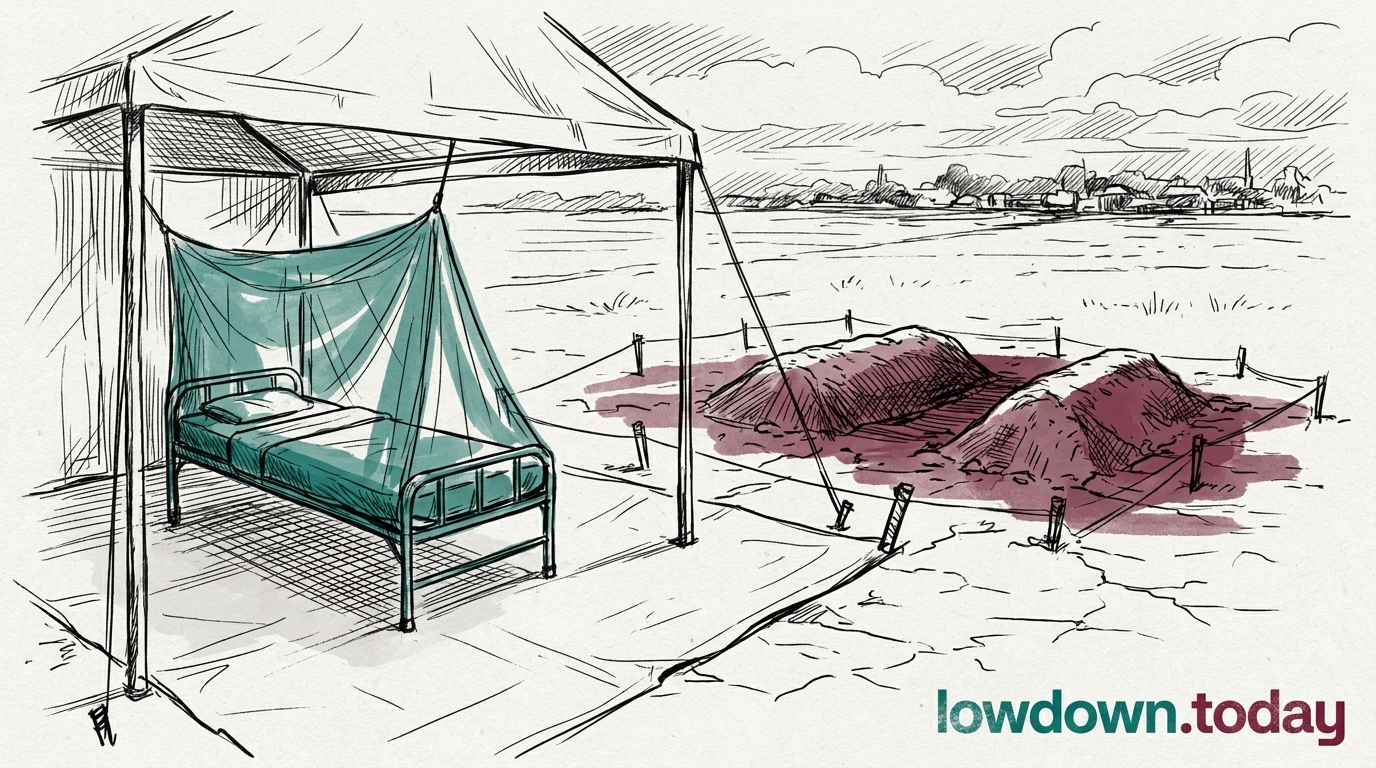
North Kivu ran its isolation wards at 134% of capacity on 27 July. Ituri, carrying nine times as many cases, had 264 beds free.

ScienceDeveloping
Key takeaway

Capacity exists in the wrong province: 264 spare Ituri beds against wards at 134% in North Kivu.

North Kivu held Ebola patients at 134% of its isolation-bed capacity on 27 July, the thirteenth consecutive day the province ran between 119% and 136%, according to Africa CDC's latest situation report on Bundibugyo virus disease 1. Ituri, the province at the outbreak's centre and carrying nine times North Kivu's caseload, sat at 67% occupancy with 264 beds standing empty.

Both provinces lie in eastern DR Congo and both have Ebola treatment centres, so the mismatch is not a question of whether capacity exists. It is a question of where it was built and how a patient gets from one to the other. The road between Bunia in Ituri and the affected North Kivu health zones is unpaved for long stretches and passes through territory contested by armed groups; moving a suspected Ebola case along it costs a day, a vehicle, an escort and a decontamination team. A bed a day's drive away does not help a patient bleeding today.

That geography explains part of a number Lowdown reported a fortnight ago, when DRC's isolation rate slipped to 39%, well below the 70% threshold Africa CDC treats as the fork between containment and sustained community spread . A national average conceals a distribution. One province turning patients away while another runs a third of its ward empty produces exactly that kind of average, and no amount of additional construction fixes it. Closing the gap means one of two expensive things: convoying patients west into Ituri's empty wards, or stripping those wards and rebuilding the capacity beside the North Kivu health zones now overflowing.


Deep Analysis

In plain English

Think of isolation beds as hospital beds set aside specifically for Ebola patients, kept separate so the disease cannot spread to other patients or staff. Right now, one province, Nord-Kivu, has more sick people needing these beds than it has beds, running at up to 136% capacity, meaning some patients are being treated in overflow conditions. Meanwhile the province next door, Ituri, which actually has far more Ebola cases overall, has 264 empty isolation beds sitting unused. The beds exist. They are just in the wrong place, and moving either the beds or the patients takes time the outbreak is not giving the response.

Deep Analysis
Root Causes

Isolation-bed capacity in an outbreak response is typically built where the earliest confirmed cases cluster, because that is where the evidence points first. Planners built the original bed programme around Ituri, the outbreak's initial epicentre. Case-fatality and transmission dynamics change faster than construction and staffing timelines, so by the time Nord-Kivu's caseload justified more beds, the physical infrastructure could not be relocated as quickly as patients could.

A second cause is that isolation beds are not fungible in the way generic hospital beds are: they require negative-pressure or cohorted wards, trained infection-control staff and a supply chain for personal protective equipment, none of which move at the speed of a case count.

What could happen next?
  • Consequence

    Sustained over-capacity in Nord-Kivu raises the risk of nosocomial transmission among patients and staff in that province specifically, independent of the outbreak's overall trajectory.

  • Opportunity

    Reallocating a portion of Ituri's 264 spare beds to Nord-Kivu, or routing new Nord-Kivu patients to Ituri facilities, would relieve the overflow without requiring new construction.

First Reported In

Update #12 · Two-thirds of Ebola deaths never reach a ward

Africa CDC· 31 Jul 2026
Read original
Different Perspectives
Chinese health authorities
China reported three human H9N2 cases to WHO between 10 and 16 July: two four-year-olds recovered, a 44-year-old man remains in intensive care, the first severity signal in a cluster that has produced 173 cases and 2 deaths globally since 2015. The subtype is distinct from the H5N1 series this topic otherwise tracks.
US public health authorities
CIDRAP and Dr Andrew Racine, president of the American Academy of Pediatrics, call 2026's 2,318 confirmed measles cases by 24 July the worst year since 1991's 2,126. Zero deaths against three in 2025 and a 7% hospitalisation rate, down from 11%, show record case counts have not brought record severity.
CEPI
CEPI
CEPI put an rVSV-platform vaccine candidate specific to Bundibugyo ebolavirus into trial-production on 31 July, developed by Hilleman Laboratories with MSD manufacturing and IAVI's reference virus, funded up to $8.5m. Eleven weeks into the third-largest Ebola outbreak on record, this is the first species-matched candidate; the licensed vaccine covers only Zaire ebolavirus.
Médecins Sans Frontières
MSF reports sexual-violence care in Ituri is almost non-existent, with 7 of 14 health centres closed or relocated by fighting, as Panzi Hospital logs 646 new survivors in six months, an 85% rise. Withdrawn US funding for post-exposure prophylaxis has left clinics across three provinces without PEP kits for months, a crisis running alongside Ebola, not caused by it.
DRC health workers at Elikya Ebola Treatment Centre
Staff at DRC's Elikya Ebola Treatment Centre walked out on 25 July over unpaid wages, the second such action after Rwampara, while unconfirmed suspects occupy up to 64% of the country's isolation beds awaiting lab results. Workers are absorbing a response that has grown faster than its payroll and its labs.
Uganda's Ministry of Health
Uganda's ministry says it discharged its last confirmed patient on 16 June, completed every contact's 21-day follow-up, and declared the country Ebola-free on 28 July, exactly 42 days later. It names Hon. Dr Chris Baryomunsi, Minister of Health, as overseeing a 20-case, 2-death outbreak it now considers closed.