Skip to content
Briefings are running a touch slower this week while we rebuild the foundations.See roadmap
Iran Conflict 2026
16MAY

China seeks private Hormuz deal

4 min read
12:41UTC

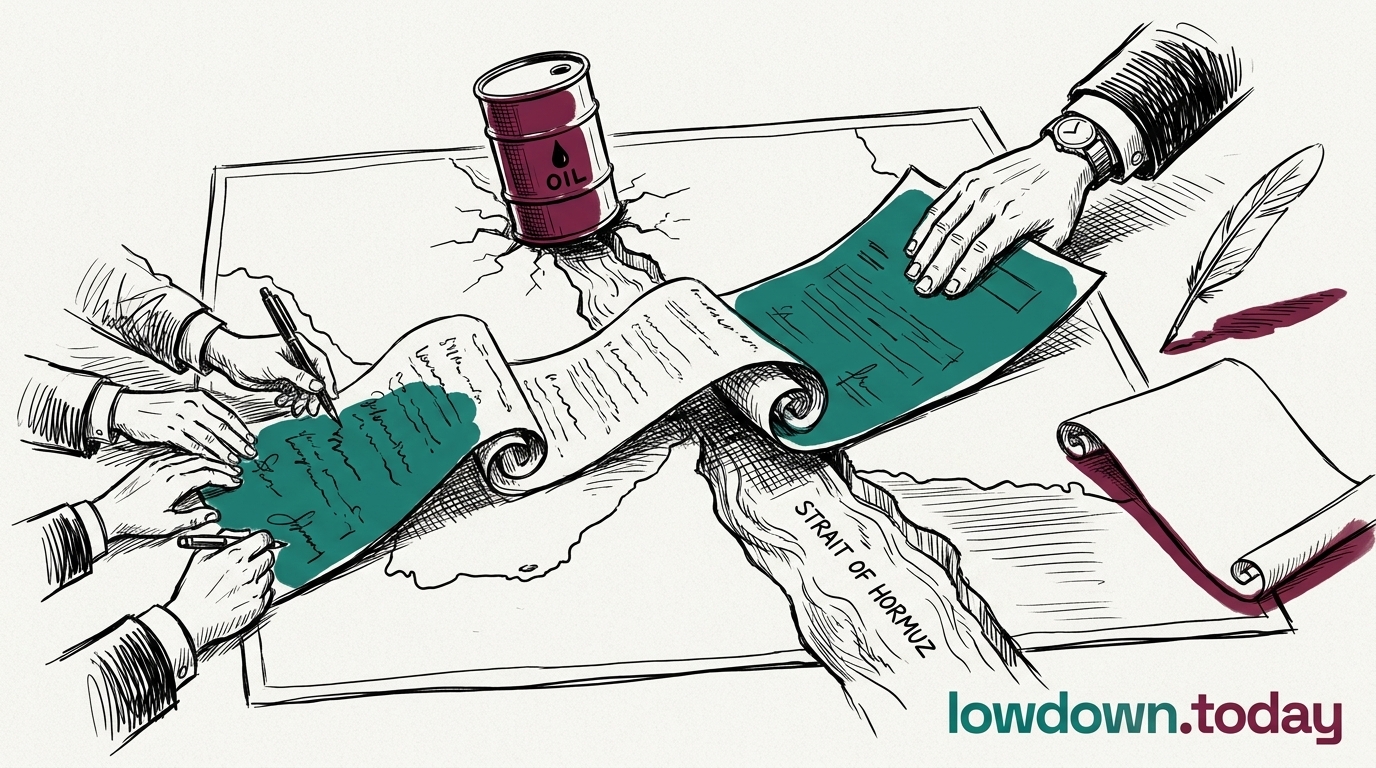
Beijing is negotiating bilateral safe passage for Chinese-flagged vessels through the strait, splitting global oil markets in two — 60% of Gulf crude flows east on Chinese terms while Western-bound shipments stay blocked.

ConflictDeveloping
Key takeaway

China is converting Iran's chokepoint control into a structural commercial advantage over Western energy buyers without any military involvement — monetising the conflict as a geo-economic instrument at zero military cost.

China is in direct negotiations with Iran to create a safe passage arrangement for Chinese-owned vessels through the strait of Hormuz, according to The Jerusalem Post and Iran International. Iran's strait closure announcement reportedly omitted Chinese-flagged vessels from explicit targeting. If the arrangement holds, roughly 60% of Gulf oil — the share that flows to Asian buyers — could resume transit at prices and terms Beijing sets. The 40% bound for Western refineries stays locked behind more than 150 vessels at anchor in the Gulf of Oman and Arabian Sea , with every major Protection & Indemnity club having cancelled war risk cover.

The shift from rhetoric to commerce happened fast. Days ago, Bloomberg reported that China entered direct talks with Tehran pressing Iran specifically not to attack oil tankers, gas carriers, or Qatari LNG export facilities — a move described then as a qualitative change from general calls for restraint to targeted infrastructure protection. The Hormuz lane goes further. It is not a request to spare assets; it is a bilateral regime in which Chinese credentials become a transit permit through waters the US Fifth Fleet has patrolled since 1995. China's Special Envoy Zhai Jun was already en route to the region ; this negotiation gives him a deliverable that neither the Egypt-Turkey-Oman mediation bid nor Washington's stalled diplomacy can match.

The leverage is structural, not incidental. China is Iran's largest remaining oil customer. In the years when US secondary sanctions constrained Iranian crude sales, Chinese state refineries — particularly the independent "teapot" refineries in Shandong province — continued purchasing through ship-to-ship transfers and labelling arrangements that Washington could not or chose not to enforce. Tehran needs China's market to survive the war's economic damage; China needs Gulf energy to fuel an economy still recovering from its property sector contraction. The arrangement satisfies both while imposing costs exclusively on Europe, the United States, and their allies.

The geopolitical consequence extends beyond oil pricing. If a two-tier Hormuz becomes operational, China gains a permanent card in any future negotiation — over sanctions enforcement, over Iran's nuclear programme, over the terms of a ceasefire. Beijing is not mediating this war. It is building an economic architecture around it, one in which the strait's openness depends on Chinese diplomatic relationships rather than American naval power. For Gulf producers weighing which relationships guarantee market access, the signal is difficult to misread.

Deep Analysis

In plain English

Iran declared the Strait of Hormuz — a narrow waterway through which roughly a fifth of the world's oil passes — closed to shipping. China has now privately negotiated an exception for ships it owns or flags. This means Chinese companies can keep receiving Gulf oil at potentially discounted prices while European and American buyers are blocked. China gets energy security; Iran gets income from its most important trading partner that helps sustain the war economically; Western consumers face higher energy prices. No Chinese soldier or warship is involved.

Deep Analysis
Synthesis

Iron Maiden's AIS credential broadcast — advertising Chinese ownership to avoid targeting — establishes a market mechanism for a new form of commercial flag protection. If this precedent holds, it creates demand from other neutral-country operators to register vessels under Chinese ownership structures, or for China to extend the protected lane to vessels carrying Chinese cargo regardless of flag, potentially transforming a narrow bilateral exemption into a Chinese-administered transit corridor that encompasses a far larger share of Gulf traffic.

Root Causes

China's leverage derives directly from a decade of US sanctions policy that inadvertently channelled Iran's trade relationships almost exclusively toward Beijing — by 2024, China accounted for roughly 90% of Iran's oil exports under sanctions. The two-tier arrangement is the strategic payoff of that dependency: Washington's own sanctions architecture created the bilateral relationship China is now converting into commercial advantage at Western expense.

Escalation

The Chinese exemption reduces Iran's incentive to negotiate a Strait reopening by providing sufficient commercial revenue to make continued closure economically viable. This is a structural de-escalation inhibitor: it removes the economic self-harm dynamic that would otherwise pressure Iran toward a negotiated resolution of the maritime dimension, even if kinetic activity elsewhere de-escalates.

What could happen next?
  • Consequence

    A sustained Western-bound Hormuz blockade creates a structural energy price differential between Asian and Western markets, compounding European industrial competitiveness disadvantages already opened by the 2022 Russian gas shock.

    Short term · Assessed
  • Precedent

    A formalised state-level exemption from a maritime closure for a single flag or ownership category would be the first codification of preferential transit access in a major international strait since UNCLOS entered into force — a template replicable in any future conflict involving a chokepoint state.

    Long term · Assessed
  • Risk

    Other vessel operators may falsely broadcast Chinese ownership credentials to claim transit protection, degrading the arrangement's integrity and potentially prompting China to demand formalised enforcement — creating a Chinese-administered transit authority within the Strait as a de facto institutional outcome.

    Medium term · Suggested
  • Risk

    Iran's economic sustainability under Chinese exemption reduces internal pressure to negotiate a Strait reopening, structurally prolonging the maritime blockade and Western energy disruption beyond what Iran could sustain without Chinese trade revenue.

    Medium term · Assessed
First Reported In

Update #23 · Iran loses half its navy; China eyes Hormuz

Jerusalem Post· 6 Mar 2026
Read original
Different Perspectives
India (BRICS meeting host, grey-market beneficiary)
New Delhi hosted the BRICS foreign ministers' meeting on 14 May that Araghchi attended under the Minab168 designation, giving India a front-row seat to Iran's diplomatic positioning. India's state refiners have been absorbing discounted Iranian crude through grey-market routing since April; Brent at $109.30 means every barrel sourced outside the formal market generates a structural saving.
Hengaw / Kurdish human rights monitors
Hengaw's daily reports from Iran's Kurdish provinces remain the sole independent cross-check on Iran's judicial activity during the conflict. Two executions across Qom and Karaj Central prisons on 15 May and five Kurdish detentions on 15-16 May indicate the wartime judicial pipeline is operating independently of military tempo.
Pakistan (mediator and bilateral partner)
Islamabad spent its diplomatic capital as the US-Iran MOU carrier to secure LNG passage for two Qatari vessels through a bilateral Pakistan-Iran agreement, spending its mediation credit for direct economic gain. China's public endorsement of Pakistan's mediatory role on 13 May is the structural reward.
China and BRICS bloc
Beijing endorsed Pakistan's mediatory role on 13 May, one day after the BRICS foreign ministers' meeting in New Delhi. Chinese state banks are processing PGSA yuan toll payments; China has not commented on its vessels' continued Hormuz passage, but benefits structurally from a non-dollar toll system it did not design.
Iraq (bilateral passage partner)
Baghdad negotiated a 2-million-barrel VLCC transit without paying PGSA yuan tolls, offering political alignment in lieu of cash. Iraq's position inside Iran's adjacent bloc makes it the natural first bilateral partner and a template for how Tehran structures passage deals with states that cannot afford Western coalition membership.
Bahrain and Qatar (Gulf signatories)
Both signed the Western coalition paper while hosting US Fifth Fleet and CENTCOM's Al Udeid base, respectively. Qatar occupies the sharpest contradiction: it is on coalition paper while simultaneously receiving LNG passage through the bilateral Iran-Pakistan track, a position Doha has tacitly accepted from both sides.