Skip to content
Briefings are running a touch slower this week while we rebuild the foundations.See roadmap
Iran Conflict 2026
10MAY

Iran tanker tests Cooper blockade claim

3 min read
14:22UTC

CENTCOM's commander said US forces had completely halted Iran's sea trade. A sanctioned Iranian supertanker headed for Imam Khomeini Port the same day.

ConflictDeveloping
Key takeaway

A self-written CENTCOM order with carve-outs cannot produce the total blockade Cooper described.

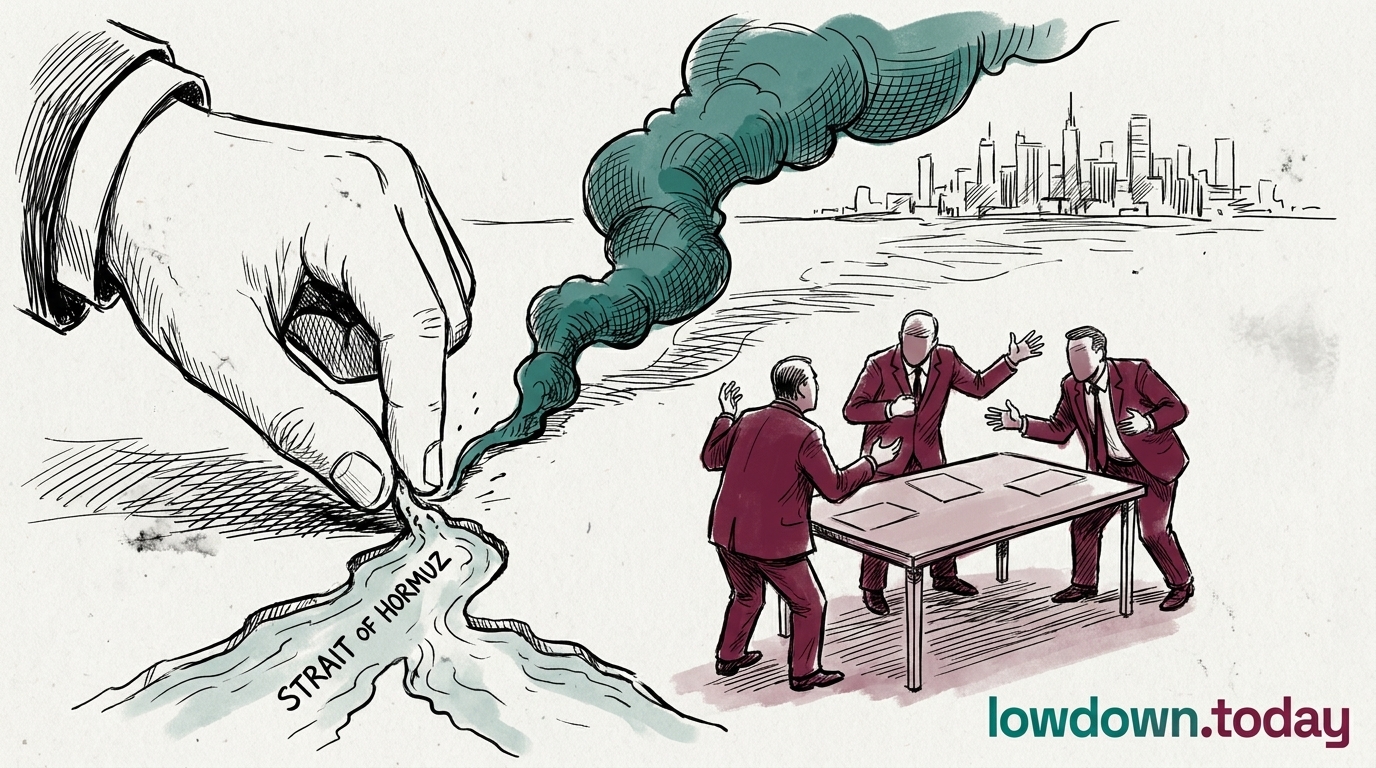
Admiral Brad Cooper, the US Central Command (CENTCOM) commander, told reporters on 15 April that US forces had "completely halted economic trade going into and out of Iran by sea". Kpler vessel-tracking data for 14 and 15 April logged 8 to 9 ships crossing the Strait of Hormuz, roughly 6 per cent of the pre-war 135-transit daily baseline . The same day, a sanctioned Iranian supertanker reportedly transited the strait toward Imam Khomeini Port per Fars News Agency, the first reported direct Iranian-flagged challenge. The Malta-flagged Agios Fanourios I entered The Gulf on its second transit attempt.

CENTCOM is the US combatant command responsible for the Middle East theatre, operating the blockade under an order it wrote itself rather than a presidentially signed instrument. The blockade that Cooper described as complete is, by written order, confined to vessels engaging with Iranian ports ; the toll-interdiction provision Trump posted on Truth Social on 12 April was omitted from the operational order entirely . Cooper's "complete" claim is therefore a verbal maximum stretched across a written minimum.

The sanctioned Iranian supertanker attempt tests the gap directly. Previous sanctioned transits, the Chinese-owned Rich Starry and Elpis on day one, crossed under the non-Iranian-port carve-out . An Iranian-flagged vessel heading to Imam Khomeini cannot hide behind that carve-out, which makes 15 April's attempt the first collision between the announcement and the order. Whether the vessel completed transit, was turned back, or was boarded is the test case that will determine whether CENTCOM's narrow written mandate holds against political pressure to match Cooper's rhetoric.

Independent verification is not available. Planet Labs, the commercial satellite imagery company, continues to withhold Iran imagery at US government request, a policy made indefinite on 5 April and retroactive to 9 March. The satellite blackout is now in its 38th day, and Hormuz traffic data relies on vessel-tracking signals vessels can themselves disable. Without overhead imagery, Cooper's 100 per cent claim stands against Kpler's 6 per cent count with no third public dataset to arbitrate.

Deep Analysis

In plain English

The US military is running a naval blockade of the Strait of Hormuz, the shipping lane between Iran and the Arabian Peninsula. The commander of US forces in the region, Admiral Brad Cooper, said on 15 April that the blockade had completely stopped all shipping into and out of Iran. A commercial vessel-tracking company called Kpler, which monitors ship movements using publicly available data, recorded 8 to 9 ships still crossing the strait on the same two days. That is about 6 per cent of normal traffic, which is a major disruption but not a complete halt. On the same day, an Iranian-owned tanker apparently under US sanctions also tried to transit the strait toward an Iranian port, which is exactly what the blockade is supposed to stop. The gap between what the commander said and what the tracking data shows is significant because it determines whether the blockade is as tight as claimed, and whether Iran can test its limits successfully.

Deep Analysis
Root Causes

Cooper's 100 per cent claim against Kpler's 6 per cent data reflects a structural gap in the blockade architecture. CENTCOM's operational order covers only vessels entering or departing Iranian ports. Vessels transiting through the Strait without Iranian port calls are not interdicted.

The Iranian supertanker heading toward Imam Khomeini Port is precisely the case the order is designed to cover, but the gap between Trump's Truth Social announcement of a complete blockade and the narrower operational mandate creates a verification problem: CENTCOM cannot claim 100 per cent effectiveness and simultaneously justify letting 8-9 vessels transit daily.

Planet Labs' continued imagery suppression at US government request is structurally related. A blockade whose effectiveness can be independently verified by commercial satellite imagery is a blockade whose gaps can also be verified. The suppression removes the most accessible independent check on both CENTCOM's claims and Iranian transit attempts.

Escalation

The sanctioned Iranian supertanker transit attempt on 15 April is a controlled provocation: Tehran is testing whether CENTCOM will enforce against an Iranian-flagged vessel when there is no clear operational order covering the specific case. A successful transit would establish a precedent, and the pattern of CENTCOM narrowing Trump's announcements suggests the enforcement gap may be tolerated rather than closed. This is the day-to-day operational test of the blockade's actual reach.

What could happen next?
  • Risk

    A successful Iranian-flagged transit under the blockade would undermine Cooper's 100 per cent claim publicly and signal to other flag states that the operational order's gaps are exploitable.

    Immediate · 0.7
  • Consequence

    Planet Labs' continued suppression of commercial satellite imagery means independent verification of CENTCOM's blockade claims will not be available for the duration of the conflict.

    Short term · 0.9
  • Risk

    If CENTCOM widens its operational order to close the carve-out for non-Iranian-port traffic, the Chinese and Indian sanctioned tankers currently transiting freely face interdiction, escalating the conflict to a direct confrontation with major-power commercial interests.

    Medium term · 0.65
First Reported In

Update #70 · Europe signs what America won't

USNI News· 16 Apr 2026
Read original
Different Perspectives
International human rights monitors (NetBlocks, IHR, Hengaw)
NetBlocks recorded 1,704 cumulative hours of near-total internet blackout for roughly 90 million Iranians on Day 74, while IHR documented ongoing executions under emergency provisions. These organisations are the only active monitoring windows into a civilian population cut off from the global internet for 71 consecutive days.
UK / France coalition
The Royal Navy confirmed HMS Dragon's Hormuz deployment on its own website on 11 May, converting a press-reported presence into declared force posture; UK and French defence ministers hosted a coalition meeting the same day. Britain and France are now the only named contributors to a Hormuz escort mission all five allies Trump originally asked had declined.
Saudi Aramco / Gulf producers
Saudi Aramco CEO Amin Nasser warned on 11 May that a Hormuz closure could remove 100 million barrels of weekly supply from global markets (roughly 15 million barrels per day for a week), a figure that dwarfs any OPEC+ swing capacity. The warning functions as both a price-floor signal and a public pressure on Washington to protect transit.
Beijing / Chinese Government
China has not publicly acknowledged the four Hong Kong-registered entities designated on 11 May or extended MOFCOM's Blocking Rules cover to HK-domiciled firms. Xi Jinping hosts Trump on 14–15 May having already de-risked state-bank balance sheets via NFRA's quiet loan halt, entering the summit partially compliant before any negotiation.
Tehran / Iranian Government
Foreign Minister Araghchi described Iran's 10-point counter-proposal as 'reasonable and responsible' via spokesman Baqaei on 11 May, and widened the mediator pool by meeting Turkish, Egyptian, and Dutch counterparts in a single day. Tehran is buying procedural runway while Trump's verbal rejection went unmatched by any written US counter.
Trump White House
Trump White House
Trump called the ceasefire 'on massive life support' and dismissed Iran's 10-point counter-proposal as 'a piece of garbage' on 11 May, while departing for Beijing two days later with no signed Iran instrument to show Congress. The verbal maximum and the paper void coexist: the administration is running a legal pressure campaign through Treasury while the president free-lances the rhetoric.