Skip to content
Briefings are running a touch slower this week while we rebuild the foundations.See roadmap
Iran Conflict 2026
1MAY

Paris and London convene forty nations

4 min read
10:38UTC

Lowdown Newsroom

ConflictDeveloping
Key takeaway

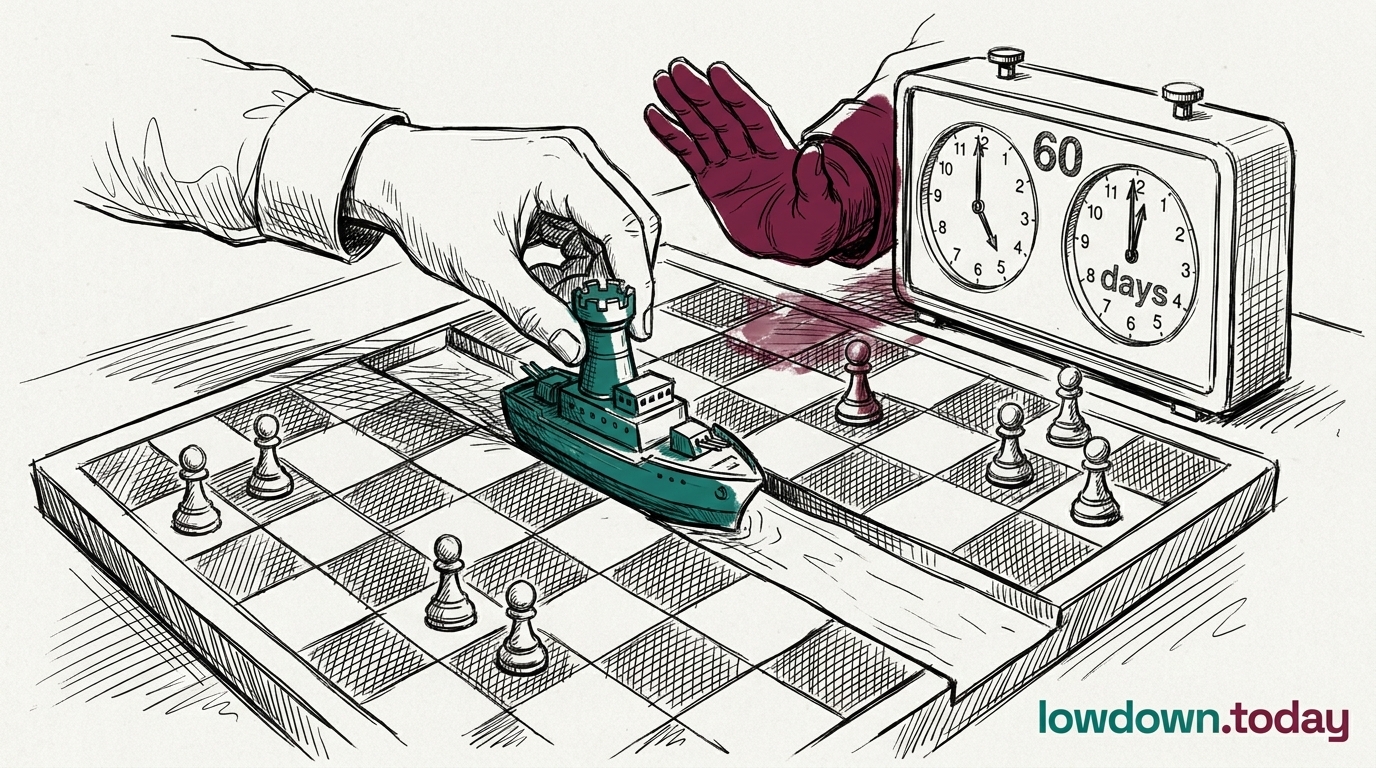
Europe is drafting the Hormuz framework Washington never put on paper.

Emmanuel Macron and Keir Starmer will chair a leaders' video conference on Friday of nations willing to contribute to 'a purely defensive multilateral mission' to restore freedom of navigation in the Strait of Hormuz once security conditions permit. The Elysée announcement, published on Tuesday, confirmed senior diplomats would hold a preparatory call on Thursday and that over forty nations were expected to participate. The conference is the operational successor to the earlier UK-convened Hormuz coordination meeting .

The difference is what is being drafted. At the earlier meeting the coalition agreed to coordinate. On Friday it plans to design a physical mission, command structure, and rules of engagement for a post-war passage framework. In international maritime law, the first credible multilateral framework tends to hold. Subsequent proposals negotiate against it rather than replacing it. Europe's advantage is written documents where the United States has only posts.

The US blockade has been running for several days on a social-media post and a self-generated CENTCOM operational order. The instrument-free record the White House's own presidential-actions page confirmed this week is what gives Paris and London space to hold the pen. With no American presidential text on record, any framework published on Friday becomes the document any post-war passage arrangement must reference. The Anglo-French summit is not framed as a challenge to Washington; it does not need to be. Roughly eighty per cent of the named nations host US bases, which complicates formal opposition to the blockade, but does not prevent them signing a post-war framework the United States has not written.

Deep Analysis

In plain English

France and the UK have invited more than 40 countries to a video conference on Friday to plan what happens at the Strait of Hormuz after the war ends. The Strait is a 33-kilometre-wide waterway between Iran and the Arabian peninsula, and about 20 per cent of the world's oil normally passes through it. Right now the US is running a blockade there; but it has never written down the formal rules on paper. The idea is: if no one writes the rules, whoever writes them first gets to set the terms. Europe is trying to be that writer. The conference would design a security mission; which countries contribute ships, what those ships are allowed to do, and under what legal authority. If it succeeds, the post-war Hormuz rules will have been written in Paris and London, not Washington.

Deep Analysis
Root Causes

The summit's genesis is the US instrument gap . Europe cannot negotiate a post-war passage regime against a text that does not exist. The blockade, the ceasefire, and the toll list are all Truth Social posts; no signed American instrument describes what a post-war Hormuz looks like from Washington's perspective.

The 2 April UK-led coordination meeting established that Europe had the political will but not the framework. The 17 April summit converts political will into a draft mission document; command structure, rules of engagement, force contributions; before the ceasefire window closes on 22 April. Europe is not challenging Washington; it is filling a governance vacuum Washington has not moved to fill.

What could happen next?
  • Consequence

    If the summit produces operational rules of engagement, Europe holds the pen on post-war Hormuz governance regardless of US diplomatic position

    Short term · 0.7
  • Risk

    Italy's parallel bilateral Gulf trip and France's simultaneous flag-state protest erode the claim that Europe speaks with a unified voice, weakening the framework's negotiating weight

    Immediate · 0.8
  • Opportunity

    A UNCLOS-compatible multilateral mandate gives Tehran a non-US framework to negotiate passage terms against, potentially breaking the Islamabad deadlock by providing an alternative interlocutor

    Medium term · 0.65
First Reported In

Update #69 · Cooper joins the instrument gap

Al-Monitor (Elysée)· 15 Apr 2026
Read original
Different Perspectives
Oil markets
Oil markets
Brent fell $1.05 to $106.0 on summit Day 1 but remains $5-7 above the post-ceasefire equilibrium analysts modelled in March; the market is pricing a holding pattern, not a breakthrough. OilPrice.com and Aramco CEO Nasser converge on buffer-exhaustion before Hormuz reopens if the blockade extends past mid-June.
Iranian dissidents and human rights monitors
Hengaw documented a five-prison simultaneous execution cluster on 13 May, with Gorgan appearing for the first time in the wartime register. Espionage charges framed as Israel-linked moharebeh now extend across Mashhad, Karaj, and Gorgan, using the war as judicial cover for protest-era detainees.
BRICS / Global South
Araghchi's Delhi appearance positioned Iran as a victim of US aggression before non-Western foreign ministers, with Deputy FM Bagheri Kani calling on BRICS to act against US aggression. India, as the largest non-Chinese user of Iranian-routed crude, faces pressure to balance bloc solidarity against its own shipping and sanctions exposure.
China
China
Beijing accepted the Nvidia chip clearance on summit Day 1 and gave Rubio verbal acknowledgement of Iran as an Asian stability concern, having already put Pakistan on paper as the mediatory channel on 13 May (ID:3253), deflecting the US ask for direct Chinese action without refusing it.
Iran (government and civilian diplomatic track)
Araghchi denied any Hormuz obstruction at BRICS Delhi on 14 May while Iran's SNSC had finalised a Hormuz security plan the day before. Israel Hayom's single-sourced 15-year freeze offer gives Tehran a deployable figure in non-Western forums regardless of corroboration; the state attributed 3,468 wartime deaths with no independent verification.
United States (Trump administration and Senate moderates)
Trump signed a chip clearance for 10 Chinese firms on summit Day 1 and zero Iran instruments across 76 days; Rubio and Vance made verbal Iran asks without paper. Murkowski voted yes on the 49-50 war-powers resolution after Hegseth told the Senate that Article 2 makes an AUMF unnecessary.