Skip to content
Briefings are running a touch slower this week while we rebuild the foundations.See roadmap
Iran Conflict 2026
1MAY

Islamabad talks end with no deal reached

2 min read
10:38UTC

Vance departs after two days of negotiations with no agreement, no joint text, and no next meeting.

ConflictDeveloping
Key takeaway

The ceasefire's negotiation window is running out with nothing behind it.

JD Vance left Islamabad on 12 April after two days of talks at the Serena Hotel, having presented what he called a "final and best offer" . Iran refused to commit to forgoing nuclear weapons. No joint statement was issued, no written agreement produced, and no date set for a next round.

The talks opened on 11 April as proximity negotiations, with Pakistani officials shuttling between the two delegations, before shifting to direct sessions. Both sides exchanged written proposals for the first time, but the paper produced no convergence. Vance told reporters the breakdown was "bad news for Iran much more than for the US."

Three structural deadlocks killed the text: Iran's refusal to forswear nuclear weapons, its refusal to hand over its enriched uranium, and its demand for Hormuz toll-collection authority. Each one alone would have blocked an agreement. Together they left no negotiating space.

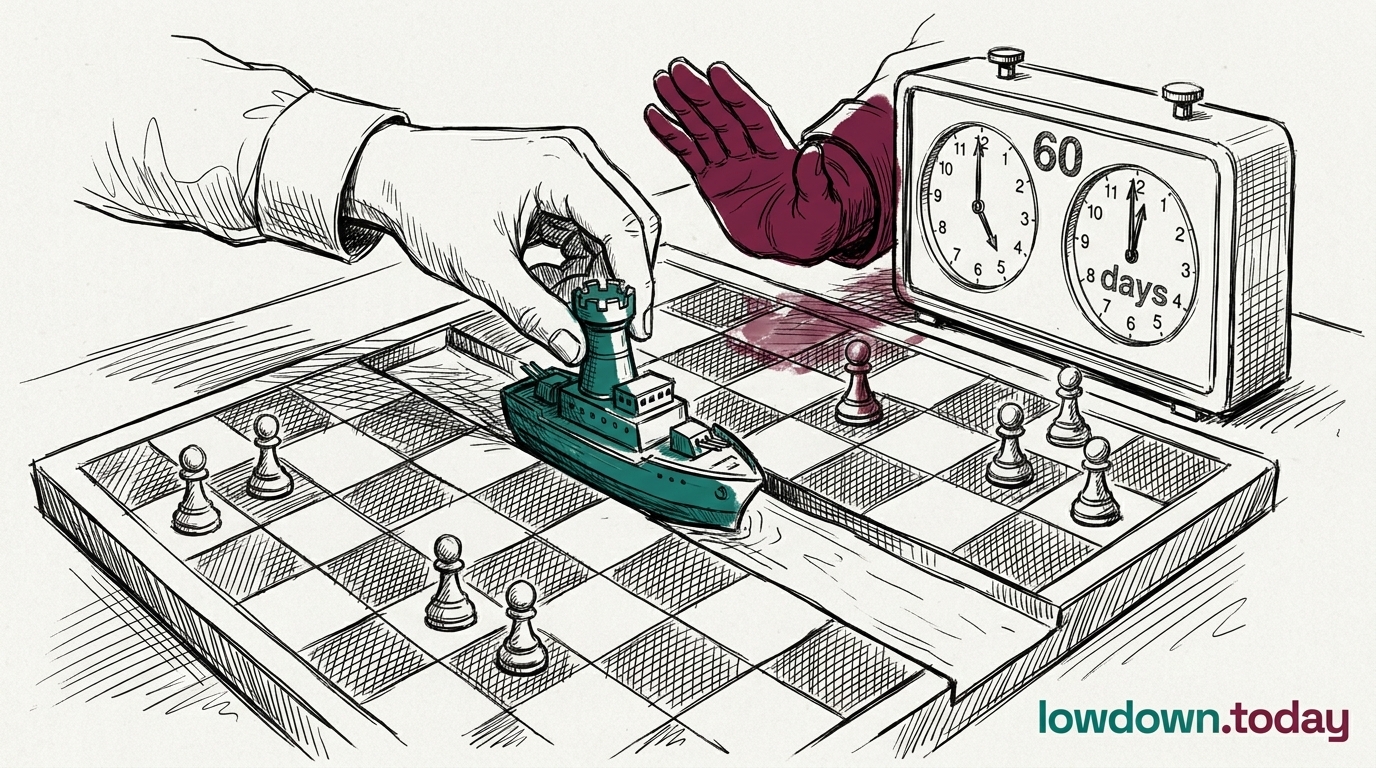
The ceasefire, announced on 7 April, included a negotiation window of two weeks or slightly longer. That window now has no framework, no next venue, and no interlocutor claiming authority to extend it. OFAC's General License U, covered in detail in the sanctions event below, expires in seven days with no Treasury renewal signal issued. The ceasefire itself expires at the end of the month. Two deadlines, zero framework.

Deep Analysis

In plain English

Imagine two people trying to sell a house. One says 'I'll only buy if you accept that I own it outright, no mortgage.' The other says 'I'll only sell if you agree I can rent the downstairs flat forever.' They can't even start writing a contract. That is what happened in Islamabad. The US said Iran must give up its nuclear programme permanently. Iran said the right to nuclear enrichment is non-negotiable. Those two positions cannot be put in the same document. So after 21 hours of talking through intermediaries, the American delegation left. The ceasefire, the agreement to stop shooting, is still technically in place, but it runs out in about ten days. There is now no plan for what happens after that.

Deep Analysis
Root Causes

The proximity format itself was structurally insufficient: Pakistani officials walking paper messages between delegations cannot bridge a gap that requires both sides to move simultaneously on enrichment and Hormuz without losing domestic standing.

The US delegation's composition (Vance, Witkoff, Kushner) prioritised political loyalty over Iran nuclear expertise. The Arms Control Association assessed this explicitly in March 2026, noting negotiators arrived without the technical depth that the 2015 JCPOA team brought.

Iran's parliamentary delegation composition was itself a domestic signal: sending Ghalibaf alongside Araghchi meant the hardliner bloc had a seat at the table and a veto over any text that moved on enrichment.

What could happen next?
  • Consequence

    With no next round scheduled and Vance framing his offer as 'final', the US has publicly exhausted its concession space before the 22 April ceasefire expiry, removing the diplomatic path for the remaining ten days.

    Immediate · High
  • Risk

    Iran's state media framing ('US overreach', 'ball in America's court') gives Tehran a pre-built domestic narrative for resuming hostilities that places blame externally, reducing the domestic political cost of walking away.

    Short term · High
  • Precedent

    If the ceasefire collapses without a framework, it establishes that the first direct US-Iran talks since 1979 produced no transferable architecture, making any future negotiation start from scratch rather than building on Islamabad.

    Long term · Medium
First Reported In

Update #66 · Islamabad collapses: 10 days to expiry

Al Jazeera· 12 Apr 2026
Read original
Different Perspectives
Oil markets
Oil markets
Brent fell $1.05 to $106.0 on summit Day 1 but remains $5-7 above the post-ceasefire equilibrium analysts modelled in March; the market is pricing a holding pattern, not a breakthrough. OilPrice.com and Aramco CEO Nasser converge on buffer-exhaustion before Hormuz reopens if the blockade extends past mid-June.
Iranian dissidents and human rights monitors
Hengaw documented a five-prison simultaneous execution cluster on 13 May, with Gorgan appearing for the first time in the wartime register. Espionage charges framed as Israel-linked moharebeh now extend across Mashhad, Karaj, and Gorgan, using the war as judicial cover for protest-era detainees.
BRICS / Global South
Araghchi's Delhi appearance positioned Iran as a victim of US aggression before non-Western foreign ministers, with Deputy FM Bagheri Kani calling on BRICS to act against US aggression. India, as the largest non-Chinese user of Iranian-routed crude, faces pressure to balance bloc solidarity against its own shipping and sanctions exposure.
China
China
Beijing accepted the Nvidia chip clearance on summit Day 1 and gave Rubio verbal acknowledgement of Iran as an Asian stability concern, having already put Pakistan on paper as the mediatory channel on 13 May (ID:3253), deflecting the US ask for direct Chinese action without refusing it.
Iran (government and civilian diplomatic track)
Araghchi denied any Hormuz obstruction at BRICS Delhi on 14 May while Iran's SNSC had finalised a Hormuz security plan the day before. Israel Hayom's single-sourced 15-year freeze offer gives Tehran a deployable figure in non-Western forums regardless of corroboration; the state attributed 3,468 wartime deaths with no independent verification.
United States (Trump administration and Senate moderates)
Trump signed a chip clearance for 10 Chinese firms on summit Day 1 and zero Iran instruments across 76 days; Rubio and Vance made verbal Iran asks without paper. Murkowski voted yes on the 49-50 war-powers resolution after Hegseth told the Senate that Article 2 makes an AUMF unnecessary.