Skip to content
Briefings are running a touch slower this week while we rebuild the foundations.See roadmap
Iran Conflict 2026
23MAR

IRGC Military Council Captures Iranian State

2 min read
05:40UTC

A military council of senior Revolutionary Guard officers now controls all access to the Supreme Leader. The elected president cannot govern.

ConflictDeveloping
Key takeaway

Iran's civilian government is a shell; the IRGC decides, but nobody can reach them.

Iran's IRGC established a military council of senior officers on 1 April that seized control of all information flow and access to Supreme Leader Mojtaba Khamenei, who has not appeared in public for 34 days 1. President Pezeshkian is in complete political deadlock: he cannot appoint ministers, cannot secure a meeting with the Supreme Leader, and watches the IRGC appoint replacements for officials killed in airstrikes. The constitution reserves that function for the executive.

All messages from Mojtaba Khamenei are delivered via a state television anchor reading from a still photograph. A Russian envoy confirmed he remains in Iran. FM Araghchi stated on 1 April that Khamenei is in 'good health' and may appear soon. No appearance followed. State media applied the 'janbaz' title to him , a designation reserved for disabled veterans of the 1980-88 Iran-Iraq War, never before used for a sitting supreme leader.

Any ceasefire negotiated with Pezeshkian's government is constitutionally meaningless without IRGC sign-off, and no Western state has a channel to the IRGC. The Islamabad Four talks (Turkey, Saudi Arabia, Egypt, Pakistan) ended without a communique partly because nobody could confirm who speaks with genuine authority for Iran . That question is now answered: the Guards do. But nobody has the Guards' phone number.

Deep Analysis

In plain English

Iran has an elected president and a Supreme Leader. The Supreme Leader is supposed to be the ultimate authority. But Mojtaba Khamenei has not been seen publicly for 34 days, and Iran's Revolutionary Guard (IRGC) has stepped in to fill that vacuum. The practical result: Iran's elected president cannot make appointments, cannot access the leader, and watches the military doing his job. If the US wants to negotiate a ceasefire, it would need to talk to the IRGC. No Western government has a phone number for them.

Deep Analysis
Root Causes

Mojtaba Khamenei's physical incapacitation created a power vacuum the constitution does not address. Article 110 of Iran's constitution assigns supreme command of the armed forces to the Supreme Leader; with that position functionally empty, the IRGC commands itself.

The IRGC has been expanding its economic and political footprint since the 2009 Green Movement suppression. Wartime conditions accelerated what was a decade-long structural shift: by Day 34 the Guards control an estimated 30-40% of Iran's formal economy and most of its informal financial networks.

The absence of a formal succession process means there is no constitutional mechanism to restore civilian authority while military operations continue. The IRGC has no incentive to relinquish control it did not formally seize.

What could happen next?
  • Consequence

    Any ceasefire signed by Pezeshkian's government is constitutionally void without explicit IRGC endorsement, which no current Western channel can secure.

  • Risk

    IRGC self-direction without civilian oversight increases probability of unilateral escalatory decisions that bypass any remaining political constraints.

First Reported In

Update #55 · The Last Door Closes

Business Today (relaying Iran International)· 2 Apr 2026
Read original
Different Perspectives
IAEA
IAEA
Director General Rafael Grossi appeared in person at the UNSC on 19 May and warned that a direct hit on an operating reactor 'could result in very high release of radioactivity'. The session produced a condemnation record but no resolution, and the Barakah perimeter was already struck on 17 May.
Hengaw (Kurdish rights monitor)
Hengaw documented three judicial executions and the detention of Kurdish writer Majid Karimi in Tehran on 19 May, establishing Khorasan Razavi province as the newest geography in Iran's wartime judicial record. The organisation's Norway-based operation continues to surface a domestic repression track running in parallel with every diplomatic and military development.
India
India
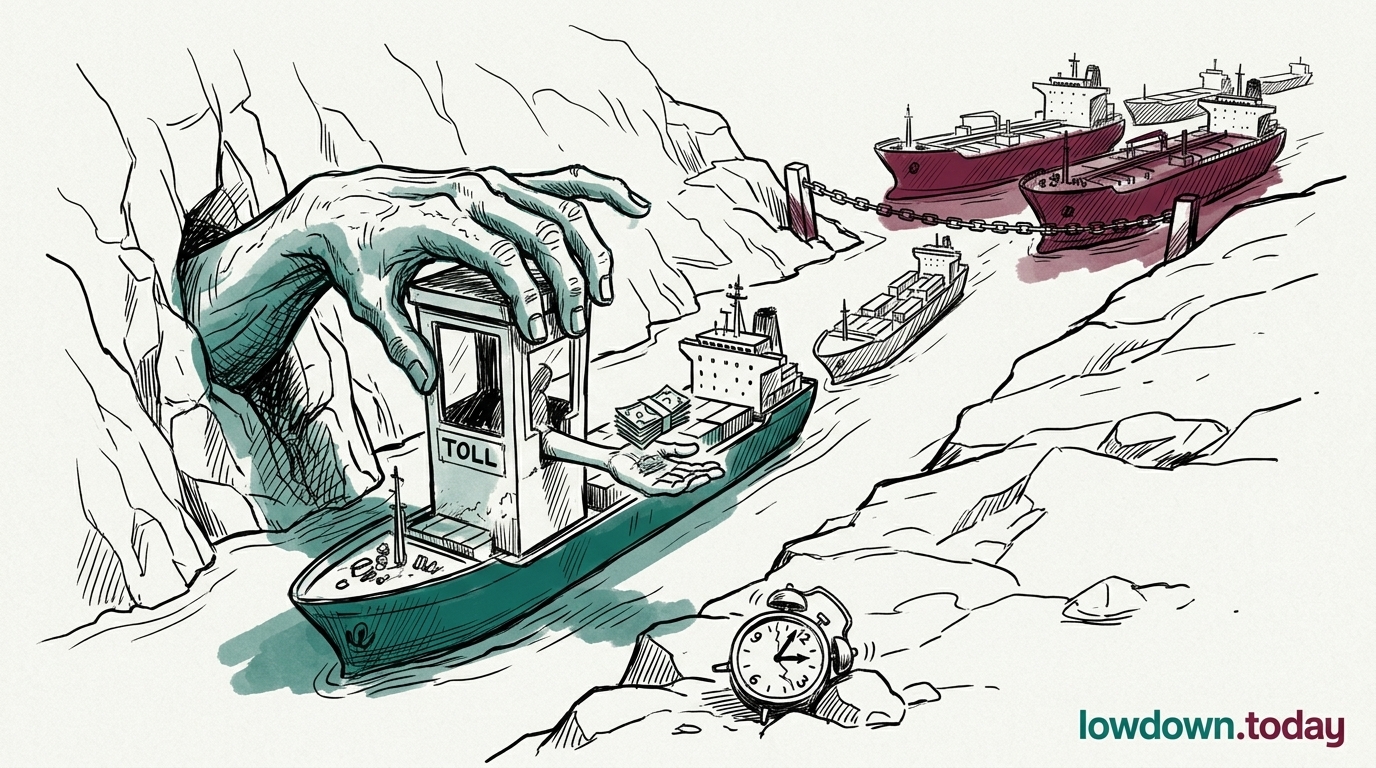
Six India-flagged vessels conducted a coordinated cluster transit under PGSA bilateral assurances during the 17 May window, paying no yuan tolls. New Delhi's inclusion in Iran's state-to-state passage track insulates Indian energy supply without requiring endorsement of the PGSA's yuan-toll architecture or alignment with the US coalition.
Pakistan
Pakistan
Pakistan is the only functioning diplomatic bridge between Tehran and Washington. Its role is relay, not mediation in the settlement sense: it conveyed Iran's 10-point counter-MOU in early May, relayed the US rejection, and is now passing 'corrective points' in the third documented exchange of this sub-cycle without either side working from a shared text.
UK and France (Northwood coalition)
Twenty-six coalition members have published no rules of engagement eight days after the Bahrain joint statement; Lloyd's underwriters have conditioned war-risk reopening on written ROE from either Iran or the coalition. Italian and French mine-countermeasures deployments are operating on the in-water clearance task CENTCOM Admiral Brad Cooper's 90% mine-stockpile claim does not address.
Saudi Arabia
Saudi Arabia
Riyadh has not publicly commented on the Barakah strike or the 50-47 discharge vote. Saudi output feeds the IEA's $106 base case; the $5 Brent premium above that model reflects institutional uncertainty no Gulf producer can compress through supply adjustment alone.