Skip to content
You can now search across every topic, entity and event.What's new
Iran Conflict 2026
23AUG

Iran bills the world for Hormuz oil

2 min read
19:02UTC

Esmaeil Baqaei said any future administration of the Strait of Hormuz must include payment for environmental damage to Iran's coastline, which he put in the trillions of dollars.

ConflictDeveloping
Key takeaway

Tehran reframed its Hormuz demand as environmental damages, which no maritime rule blocks.

Iran's foreign ministry spokesman Esmaeil Baqaei said on Thursday 13 August that any future administration of the strait of Hormuz must include payment for environmental damage, putting the cumulative harm to Iran's coastal areas in the trillions of dollars 1. Oil had washed onto Qeshm Island, off Iran's southern coast, the day before. "Every party that benefits from commercial shipping through the strait of Hormuz carries both a legal and a moral obligation to remediate the environmental harm inflicted upon The Persian Gulf and the Sea of Oman," he said. He named no ship, no flag and no government.

Three days earlier the same spokesman ruled transit fees out of the Oman talks and named four working areas, one of them environmental protection . That sequence matters because a charge for passage runs straight into the transit-passage right that every maritime state cites against Iran, the objection that has sunk each fee proposal since the spring.

A remediation claim carries no such problem. Framed as damage owed rather than a price paid, it needs no ceasefire, no counterparty signature and no naval success to stay alive, and it can be tabled at any point a waterway arrangement is drafted. The trillions figure is Baqaei's own characterisation, offered without a party to bill or a period to bill for, and it is worth nothing as a valuation. The shape of the claim will outlive the war that produced it.

Deep Analysis

In plain English

Oil washed up on Iran's Qeshm Island in mid-August, and Iran's foreign ministry spokesman, Esmaeil Baqaei, responded by saying any future arrangement over who controls the Strait of Hormuz must include payment for environmental damage running into trillions of dollars. He did not say who should pay. Separately, the oil causing the pollution has been traced to a tanker called the Caroline Bezengi, which was carrying Russian crude and is under international sanctions for helping Russia dodge them. Iran has not publicly named Russia or that tanker's owners as responsible, even though the evidence points there, likely because Russia has been supplying Iran through the war and Tehran has reasons not to embarrass an ally in public.

Deep Analysis
Root Causes

Iran's reluctance to name a payer sits against a wartime dependency it cannot easily set aside: Russia's Caspian shipping corridor into Bandar Anzali has supplied Iran throughout the conflict, a route Israel and Ukraine have each struck this year.

That dependency gives Tehran a live strategic reason not to publicly blame a Sovcomflot-linked vessel for polluting its own coastline.

What could happen next?
  • Consequence

    Framing environmental compensation as a precondition for any future Hormuz administration arrangement adds a new, uncosted demand layered onto Iran's existing six political conditions (ID:5645) for reopening the strait.

  • Meaning

    Naming no payer lets Iran raise the political cost of any Hormuz settlement without committing to a legal claim against any specific state or company, including its own wartime supplier.

First Reported In

Update #170 · The ships Iran does not control are leaving Hormuz

Press TV· 14 Aug 2026
Read original
Different Perspectives
Hizballah
Hizballah
Has not commented on the US Treasury's 20 August designation of ten people, including named couriers, over a cash network Treasury says moved money to it from the IRGC-Qods Force. ACLED recorded a sharp rise in attacks around it the same day.
Kuwait
Kuwait
Kuwait's Chief of the General Staff, Lieutenant General Khaled al-Shriaan, co-chaired the 16th US-Kuwait Joint Military Commission at the Pentagon on 21 August. Kuwait has not published what was agreed; only a summary of the meeting's existence and attendees is sourced.
Qatar
Qatar
Has not commented publicly on the $4.5bn KC-46A tanker Foreign Military Sale notification the State Department approved on 20 August. The notification opens a sale process; Doha has not confirmed whether it will proceed to a signed transfer.
Mohammad Bagher Ghalibaf
Told a Baghdad business meeting on 20 August that Iran will not endure a hungry population regardless of its military strength, against 87.9% point-to-point inflation and 128.1% food inflation for Tir. His fellow Majlis Economic Committee member Samsami separately warned a petrol price rise would ignite unrest.
US Navy
US Navy
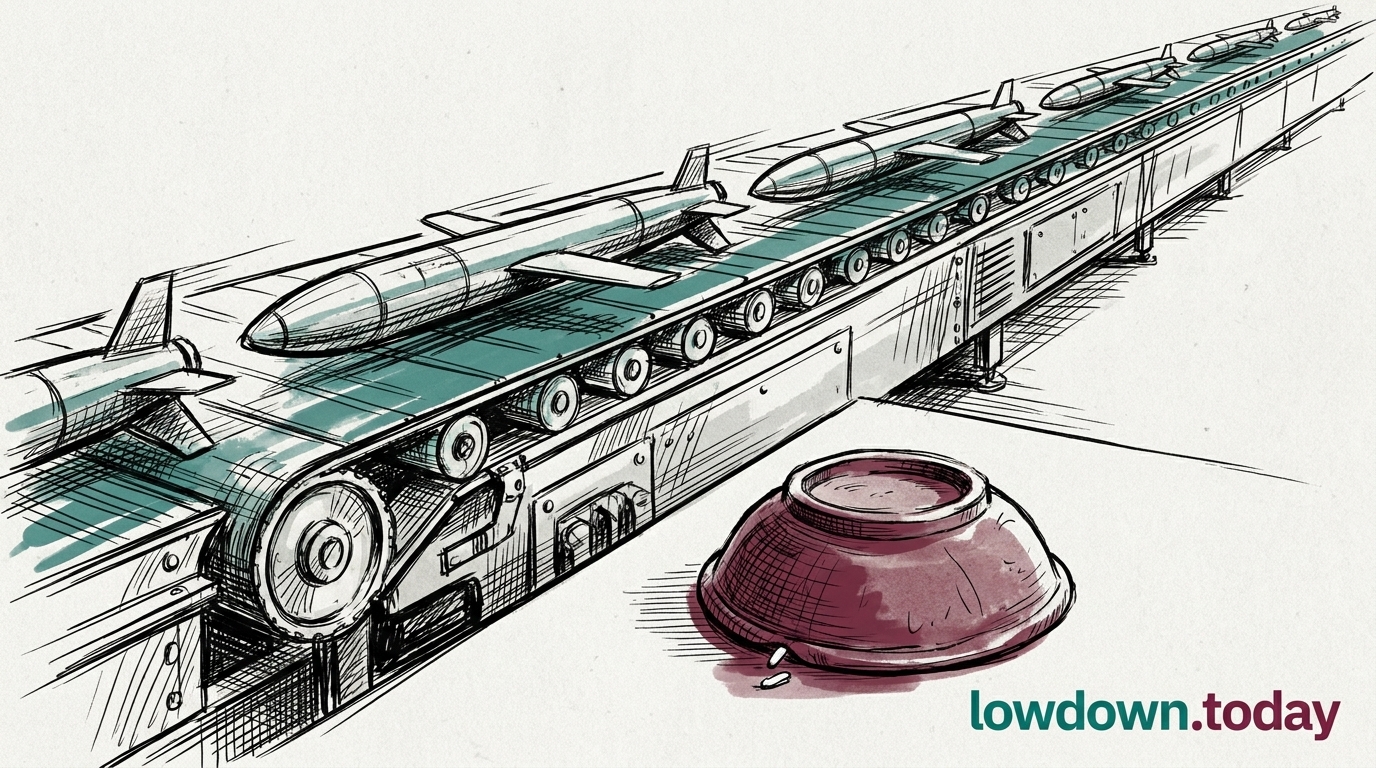
Signed a $22.9bn, seven-year contract with Raytheon on 17 August to raise Tomahawk output from about 60 a year to more than 1,000. The Acting Navy Secretary, quoted via an X post, framed it as the "Arsenal of Freedom" initiative; it replaces the 850 missiles fired by 1 April in about ten months at the new rate.
UK Maritime Trade Operations
UKMTO logged six armed men boarding a tanker 136 nautical miles east of Al Mukalla on 20 August and redirecting it toward Somalia. A vessel steered toward the Somali coast reads as an attempted seizure, a distinct hazard from the stand-off strikes the same lane has seen before.