Skip to content
You can now search across every topic, entity and event.What's new
Iran Conflict 2026
23AUG

Hegseth threatens Iran strikes in Singapore

2 min read
19:02UTC

US Defence Secretary Pete Hegseth told the Shangri-La Dialogue on Saturday 30 May the US was 'more than capable' of resuming Iran strikes, tying Hormuz to Taiwan; China sent only scholars for the second year running.

ConflictDeveloping
Key takeaway

Washington ran diplomacy and military threat in parallel at Singapore; China stayed out of the Iran conversation.

Pete Hegseth, the US defence secretary, told the Shangri-La Dialogue in Singapore on Saturday 30 May that the United States was "more than capable" of resuming strikes on Iran and that its munition stocks were "more than suited" to it 1. The Shangri-La Dialogue is Asia's premier annual security summit, where defence ministers across the Indo-Pacific gather each year.

Hegseth tied Hormuz to Taiwan as linked Indo-Pacific concerns and said Trump was "being patient". His speech ran while Trump held the Situation Room meeting in Washington, and the timing read as a coordinated diplomacy-or-force message to allies.

China sent only scholars to the dialogue for the second year running, with no defence minister, and its delegation addressed multilateralism and Taiwan without mentioning Iran 2. Beijing chose a visible non-alignment signal at the moment Washington named it the pacing threat and threatened renewed Iran strikes in the same hall.

That posture is consistent with Trump barring China as a custodian for Iran's enriched uranium on Wednesday 27 May , and with Chinese internet hardware now capping Iran's connectivity . Beijing keeps its economic leverage over Iran while declining the diplomatic exposure of defending it.

Deep Analysis

In plain English

The Shangri-La Dialogue is an annual security summit in Singapore where defence ministers from across Asia and beyond discuss military threats and alliances. It is one of the most watched forums for reading US intentions in Asia. US Defence Secretary Hegseth said the US could restart bombing Iran and had the weapons to do it. This was deliberate: Trump was holding his Situation Room meeting in Washington at the same time, so the two messages arrived simultaneously. Washington wanted allies and enemies alike to hear both: 'we are negotiating, but we can also bomb.' China sent only academics, not its defence minister, for the second year in a row. That means Beijing chose not to engage with Hegseth's framing directly. China imports roughly half its oil through the Strait of Hormuz, so it has a significant stake in how this ends, but it is signalling it will not take a public position on the Iran conflict.

Deep Analysis
Root Causes

China's Shangri-La downgrade since 2025 tracks the Trump administration's designation of Beijing as the 'pacing threat', which has made senior attendance politically costly: a defence minister at the forum must respond to questions, and any response on Iran or Taiwan becomes attributed policy. Scholars can probe and listen without generating attributed positions.

The Iran-specific silence reflects China's bilateral leverage calculation. Beijing holds transit agreements with Tehran and has deployed internet infrastructure in Iran. Public Shangri-La statements on Iran would require China to choose between its relationship with Tehran and its desire to avoid secondary US sanctions, a choice Beijing refuses to make publicly.

What could happen next?
  • Consequence

    China's deliberate Iran silence at Shangri-La confirms that Washington cannot use Beijing as a pressure vector on Tehran through multilateral forums; any Chinese influence must operate through bilateral channels.

  • Risk

    Hegseth's Taiwan-Hormuz linkage, if adopted as US doctrine, raises the cost for China of any future Hormuz transit deal that bypasses CENTCOM's blockade.

First Reported In

Update #113 · Trump signs nothing as a Hellfire hits a hull

Al Jazeera· 31 May 2026
Read original
Different Perspectives
Hizballah
Hizballah
Has not commented on the US Treasury's 20 August designation of ten people, including named couriers, over a cash network Treasury says moved money to it from the IRGC-Qods Force. ACLED recorded a sharp rise in attacks around it the same day.
Kuwait
Kuwait
Kuwait's Chief of the General Staff, Lieutenant General Khaled al-Shriaan, co-chaired the 16th US-Kuwait Joint Military Commission at the Pentagon on 21 August. Kuwait has not published what was agreed; only a summary of the meeting's existence and attendees is sourced.
Qatar
Qatar
Has not commented publicly on the $4.5bn KC-46A tanker Foreign Military Sale notification the State Department approved on 20 August. The notification opens a sale process; Doha has not confirmed whether it will proceed to a signed transfer.
Mohammad Bagher Ghalibaf
Told a Baghdad business meeting on 20 August that Iran will not endure a hungry population regardless of its military strength, against 87.9% point-to-point inflation and 128.1% food inflation for Tir. His fellow Majlis Economic Committee member Samsami separately warned a petrol price rise would ignite unrest.
US Navy
US Navy
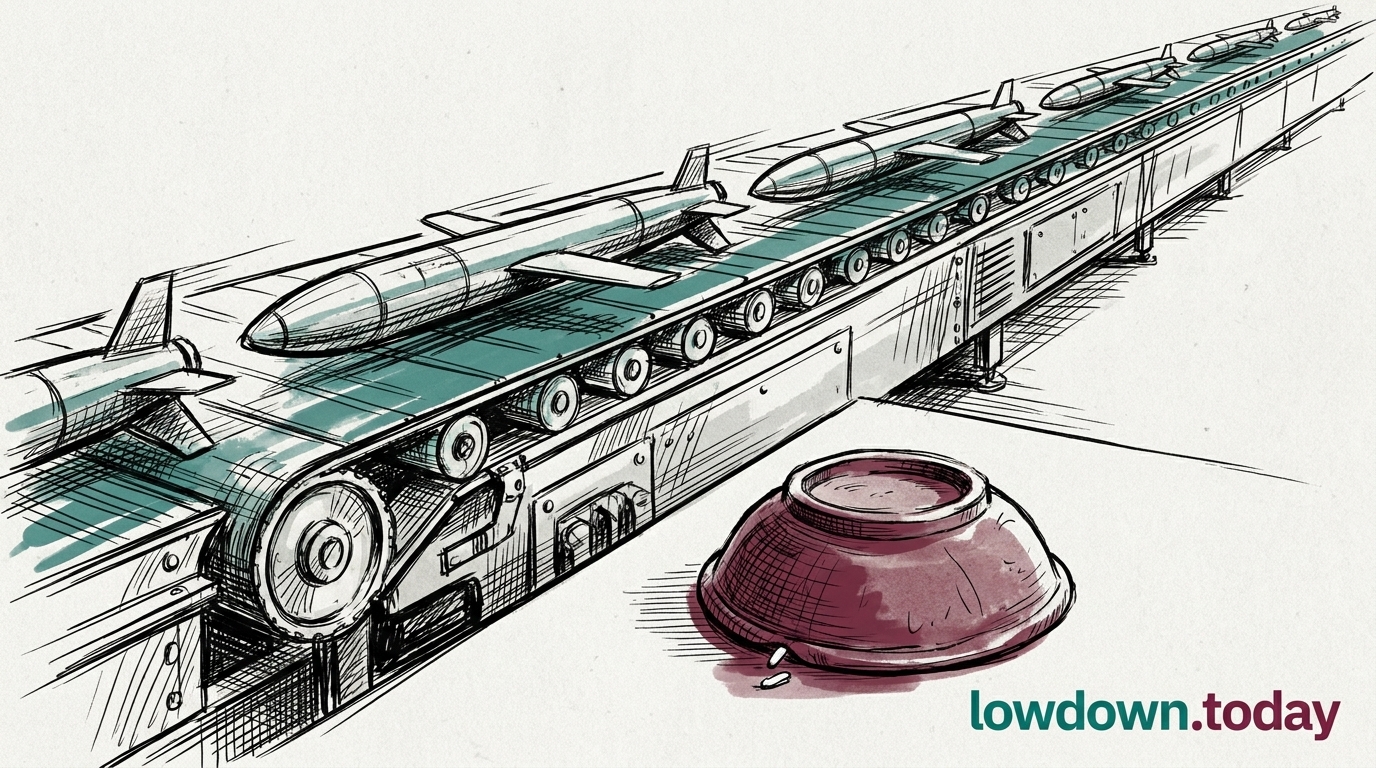
Signed a $22.9bn, seven-year contract with Raytheon on 17 August to raise Tomahawk output from about 60 a year to more than 1,000. The Acting Navy Secretary, quoted via an X post, framed it as the "Arsenal of Freedom" initiative; it replaces the 850 missiles fired by 1 April in about ten months at the new rate.
UK Maritime Trade Operations
UKMTO logged six armed men boarding a tanker 136 nautical miles east of Al Mukalla on 20 August and redirecting it toward Somalia. A vessel steered toward the Somali coast reads as an attempted seizure, a distinct hazard from the stand-off strikes the same lane has seen before.