Skip to content
You can now search across every topic, entity and event.What's new
Iran Conflict 2026
20AUG

Mokhber calls Hormuz an atomic-bomb equivalent

3 min read
16:36UTC

Three named senior Iranian officials reframed Hormuz on Saturday 9 May as the country's nuclear-equivalent strategic deterrent. Mohammad Mokhber, senior adviser to the Supreme Leader, said the line on the record.

ConflictDeveloping
Key takeaway

Tehran has put a doctrinal floor under Hormuz that the current MOU cannot clear.

Mohammad Mokhber, senior adviser to Supreme Leader Mojtaba Khamenei, told Al Jazeera on Saturday 9 May that Iran's control of the Strait of Hormuz is "a capability on the level of an atomic bomb, because when you have a capability that can affect the entire global economy with a single decision, that is an enormous capability" 1. First Vice President Mohammad Reza Aref described Hormuz management on the same broadcast as the direct counter to US sanctions and oil-sale restrictions. Foreign Ministry spokesperson Esmaeil Baqaei dismissed the missed Saturday reply window for the US proposal: "We do our own work, we don't pay attention to deadlines or timing" 2.

Mokhber served as acting president for ten weeks after Ebrahim Raisi's death in 2024 and remains the senior adviser closest to the Khamenei office. When he names Hormuz a nuclear-equivalent on the public record, the statement carries Supreme Leader proximity, not parliamentary noise. The verification void Tehran created by letting the proposal window lapse is now stated as doctrine, not procedural delay.

The MOU asks Tehran to surrender the 200kg of 60%-enriched uranium last seen entering an Isfahan tunnel in June 2025, for monitoring by an architecture that does not yet name its monitors. On already-public IAEA (International Atomic Energy Agency) calculations, that stockpile, if further enriched to weapons grade, translates to enough fissile material for several warheads. If Hormuz is now the equivalent leverage, the verification trade asks Tehran to give up its surviving deterrent in exchange for monitoring an enrichment programme the opening strikes physically destroyed. Iran lost an estimated $25bn in war damage and roughly two years of enrichment capacity in those strikes; doctrine is being adjusted to match what survived.

MOFCOM used the same encoding move with its early-May order pinning the five named Chinese refineries : announce a structural rule, and every subsequent counterparty move is bounded by it. Tehran's announcement does the same job. The 2015 JCPOA collapsed in part because Washington underestimated how Iran encoded leverage; this is the encoding being made explicit on the record.

Deep Analysis

In plain English

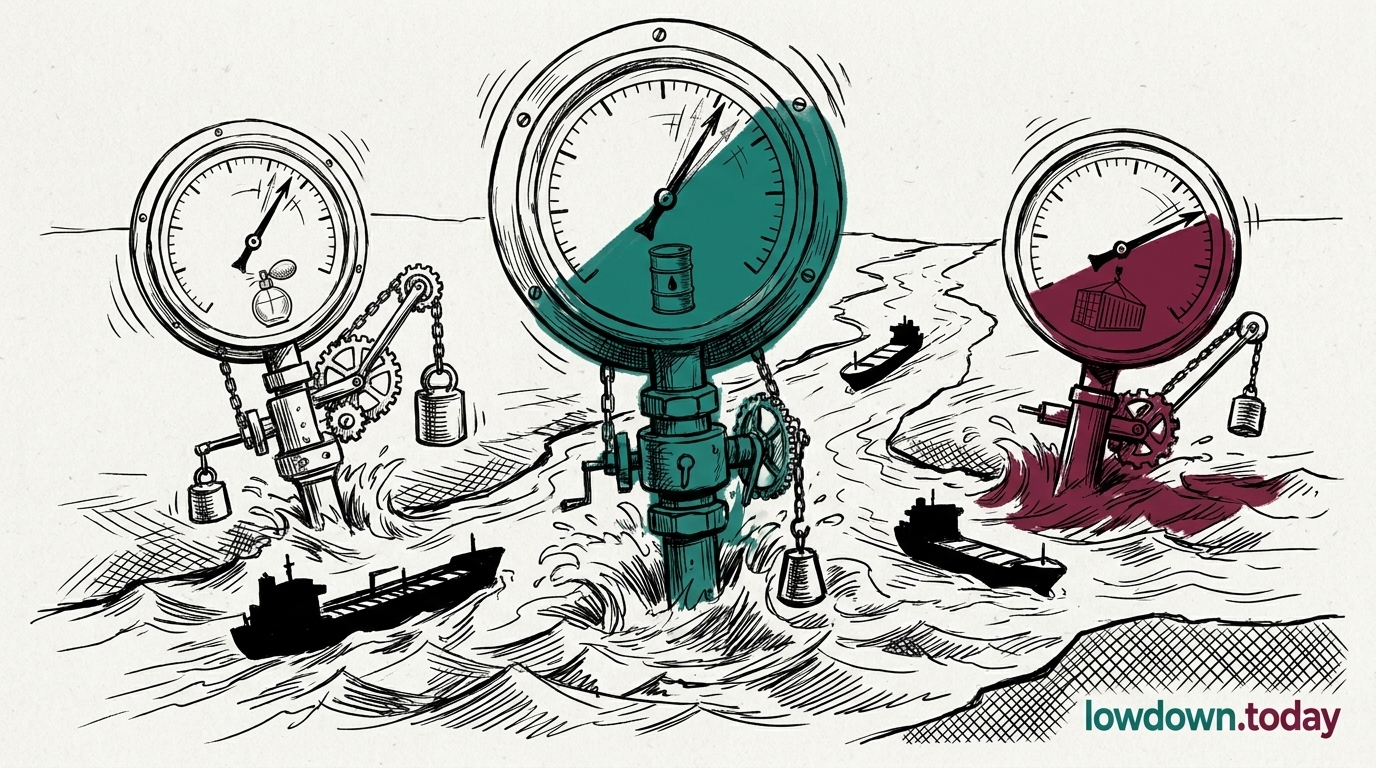
Iran's top officials are now openly saying that their control of the Strait of Hormuz delivers as much strategic power as a nuclear weapon. Before the conflict, Iran's nuclear programme was the card Tehran held to deter attacks and extract concessions in negotiations. Now the IRGC has closed the world's most important oil shipping lane, costing the global economy billions every day without firing a single missile at a US target. Mokhber's statement on 9 May says Iran will not give that up. The US peace deal asks Iran to reopen the strait within 30 days. Accepting it would mean surrendering the one asset Mokhber's own government has just called irreplaceable.

Deep Analysis
Root Causes

Iran's nuclear deterrent ambiguity collapsed on two fronts simultaneously. The IAEA has been locked out of all nuclear facilities since the 11 April 2026 Majlis vote suspending cooperation, destroying Tehran's ability to use calibrated enrichment revelations as leverage. Separately, the 28 February strikes destroyed the senior military command that had managed the nuclear programme's political signalling function for two decades.

The strategic substitution Mokhber describes was structurally available to Iran since the PGSA came into force on 5 May: chokepoint control over 20% of global oil produces an immediate, measurable, global economic effect that Brent's $101 floor confirms. That effect was previously the aspiration underpinning Iran's nuclear deterrent theory. Mokhber is naming what the IRGC has already operationalised, not announcing a new policy.

The 7 May MOU asks Iran to phase out Hormuz control over 30 days. Mokhber's 9 May statement reframes that ask: trading a stated nuclear-equivalent capability for the MOU's sanctions-relief terms is equivalent to asking a nuclear state to disarm for economic incentives. The domestic-political cost in Tehran exceeds the material gain on offer.

First Reported In

Update #93 · Tanker hits Doha while Qatar mediates

Al Jazeera· 10 May 2026
Read original
Different Perspectives
UK Maritime Trade Operations
UKMTO logged six armed men boarding a tanker 136 nautical miles east of Al Mukalla on 20 August and redirecting it toward Somalia. A vessel steered toward the Somali coast reads as an attempted seizure, a distinct hazard from the stand-off strikes the same lane has seen before.
Mohammad Bagher Ghalibaf
Iran's Majlis speaker received Iraq's Hormuz carve-out request in Baghdad on 19 August, a request that treats passage as Tehran's to grant. Ghalibaf's authority over that grant sits alongside the Revolutionary Guard's separate transit rules, which have moved independently of Iran's foreign ministry before.
Haibat al-Halbousi
Haibat al-Halbousi
Iraq's parliament speaker asked Iran for special consideration on Iraqi Hormuz oil exports during Ghalibaf's 19 August Baghdad visit. Iraq presses the request from a weak position: Iran's central bank is simultaneously demanding Baghdad release Iranian reserves parked in Iraqi accounts.
Federal Department of Economic Affairs, Education and Research
Switzerland's economics ministry updated the Article 21 forms governing lawful Iran money transfers on 19 August, with only the revised forms accepted from 26 August. Bern operates one of the few remaining legal Iran payment channels and has just set a hard cutover on its control point.
Motegi Toshimitsu
Motegi Toshimitsu
Japan's foreign minister said in Muscat on 20 August that Tokyo wants closer coordination with Oman on safe Hormuz and Bab el-Mandeb passage. Japan has no naval presence of its own in the strait, so it is routing the ask through the state negotiating with Iran instead.
Badr bin Hamad Al Busaidi
Oman's foreign minister joined Japan's in Muscat on 20 August to call for intensified coordination on Hormuz and Bab el-Mandeb navigation. Oman also runs the mediation track with Tehran, so the appeal travels through the same channel as the negotiation.