Skip to content
You can now search across every topic, entity and event.What's new
Iran Conflict 2026
23JUL

Brent's kinetic premium settles at $6.81

3 min read
19:27UTC

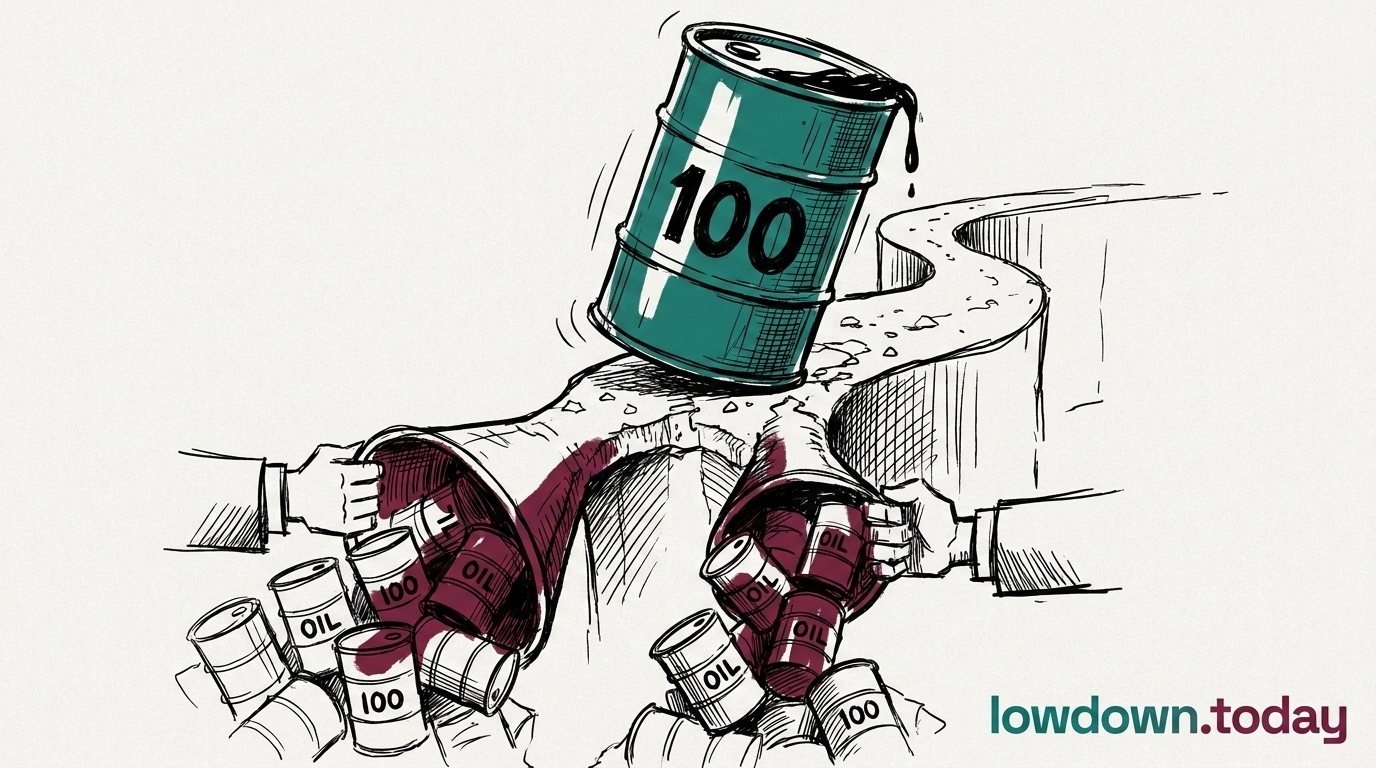
Brent crude surged 6 per cent intraday to $114.44 on 4 May as Project Freedom's kinetic exchange unfolded, then the Trump pause walked it back to $109.87, with $108.51 by 6 May leaving a $6.81 net kinetic premium above Monday's open.

ConflictDeveloping
Key takeaway

Six dollars eighty-one of kinetic premium remained priced after the pause. Goldman's lower bound held.

Brent Crude settled at $101.70 on Monday 4 May before the IRGC opened fire on Project Freedom, then surged nearly 6 per cent to $114.44 intraday as the kinetic exchange unfolded and Fujairah was struck 1. The Trump pause on Tuesday 5 May reversed most of that move; Brent settled at $109.87. By Wednesday 6 May the price drifted to $108.51 2. Net change from Monday's opening settlement: +$6.81. The market priced the kinetic exchange at $12 per barrel; the verbal pause walked back only $5 of it.

A $6.81 move on Brent translates to roughly 1 to 2 pence per litre at British pumps within four to six weeks if the premium holds. The price action confirms the deeds-versus-words asymmetry the briefing has tracked since the UAE walkout from OPEC on Friday 1 May . Kinetic action moves the curve fast; verbal action partially walks it back. Goldman Sachs and Lloyd's P&I clubs had estimated a single Project Freedom escort contact would recover $15 to $20 per barrel; the outcome landed near the lower bound, suggesting the market reads the pause as a credible attempt at de-escalation rather than a tactical retreat.

OPEC+ added 206 thousand barrels per day for June into a market already absorbing the loss of Iranian export capacity and the closure of Hormuz transit, exposing the asymmetry in the underlying supply curve. The cartel's decision to add barrels into a bullish kinetic backdrop, days before the UAE walkout, established the supply-side ceiling against which the kinetic premium is now pricing.

Deep Analysis

In plain English

When the US Navy fought its way through the Strait of Hormuz on 4 May, oil prices spiked nearly 6% in a single day, reaching over $114 per barrel. The next day, when Trump said he was pausing the operation, prices fell back to around $108-109. Oil prices swing because traders are betting on whether ships will be able to get through the strait. If they can, oil flows freely and prices fall. If they cannot, the world gets less oil and prices rise. The net result after three days of drama: oil is still about $6.80 per barrel more expensive than it was on Monday morning, before the fighting started. That works out to roughly 2-3 pence more per litre of petrol at British filling stations.

Deep Analysis
Root Causes

Brent rose $12 in hours but fell only $6 over two days, reflecting the structural thinness of the Brent spot market in conflict conditions: the P&I war-risk cover suspensions that have been in place since mid-April have reduced the number of vessels actively pricing cargoes in the ICE market, concentrating price discovery in a smaller pool of speculative and hedging positions. A thin market amplifies moves in both directions.

OPEC+'s June production increase of 206,000 barrels per day, agreed the week prior, provided a partial supply buffer; but the UAE's 1 May OPEC exit removed the institutional constraint that kept its 5 million barrels per day within quota discipline, creating a two-layer price uncertainty: kinetic risk premium compounding a cartel coordination breakdown.

What could happen next?
  • Consequence

    The partial price reversal on the Trump pause reduces pressure on OPEC+ to accelerate production increases, as the net kinetic premium of $6.81 falls below the $10-12 threshold Saudi Arabia considers its intervention trigger.

  • Risk

    Any resumption of Project Freedom convoy transits will re-test the $114 intraday level with reduced friction, as the market has now established a price pathway and the algorithms will execute faster.

First Reported In

Update #89 · Truxtun gets through; Trump pulls back

Al Jazeera· 6 May 2026
Read original
Different Perspectives
India
India
India buys more Saudi crude than any other country and has 2.5 million nationals working in the kingdom, so a $100 Brent and a live strike on Saudi tankers reach New Delhi through both fuel bills and remittance risk. Neither channel has an alternative route the way Saudi Arabia's own pipeline does.
Qatar
Qatar
Qatar co-authored the four-mediator ten-day ceasefire proposal alongside Egypt, Pakistan and Oman, centred on resuming Hormuz navigation, while separately pursuing its dated compensation claim against Iran at the UN Security Council filed on 21 July. Doha is mediating and litigating in the same week.
Israel
Israel
Israeli intelligence, reported by the Wall Street Journal, assesses Iran moved thousands of centrifuges and part of its roughly 440kg enriched-uranium stock into Pickaxe Mountain after the June 2025 strikes on its three main nuclear sites. Some of the US refuelling aircraft now deploying to the region are bound for Israeli bases and Ramon Airport.
Houthis
Houthis
Yahya Saree announced the missile and drone strikes on the Encelia and Layla on 22 July as enforcement of the embargo his forces had declared by radio warning alone two days earlier. Six vessels already turned back on the broadcast; the strike shows Houthi forces will use weapons once warnings stop working.
Saudi Arabia
Saudi Arabia
Saudi Arabia's state news agency confirmed only a fire on the Encelia's bow, with the crew safe; the Layla strike remains unconfirmed by Riyadh. The kingdom built its Petroline pipeline specifically to bypass Hormuz through the Red Sea, so the tanker fire lands on the route Riyadh had already spent billions escaping.
United States
United States
Washington is weighing both ten-day proposals but wants a longer truce than either offers, and moved F-16 and F-35 jets plus refuelling aircraft into the region while it decides. That deployment, not Trump's Pickaxe Mountain remarks, is the measurable US action, buying options for the day talks fail rather than betting on them.