Skip to content
You can now search across every topic, entity and event.What's new
Iran Conflict 2026
23JUL

Brent breaks $100 as insurers hold

4 min read
19:27UTC

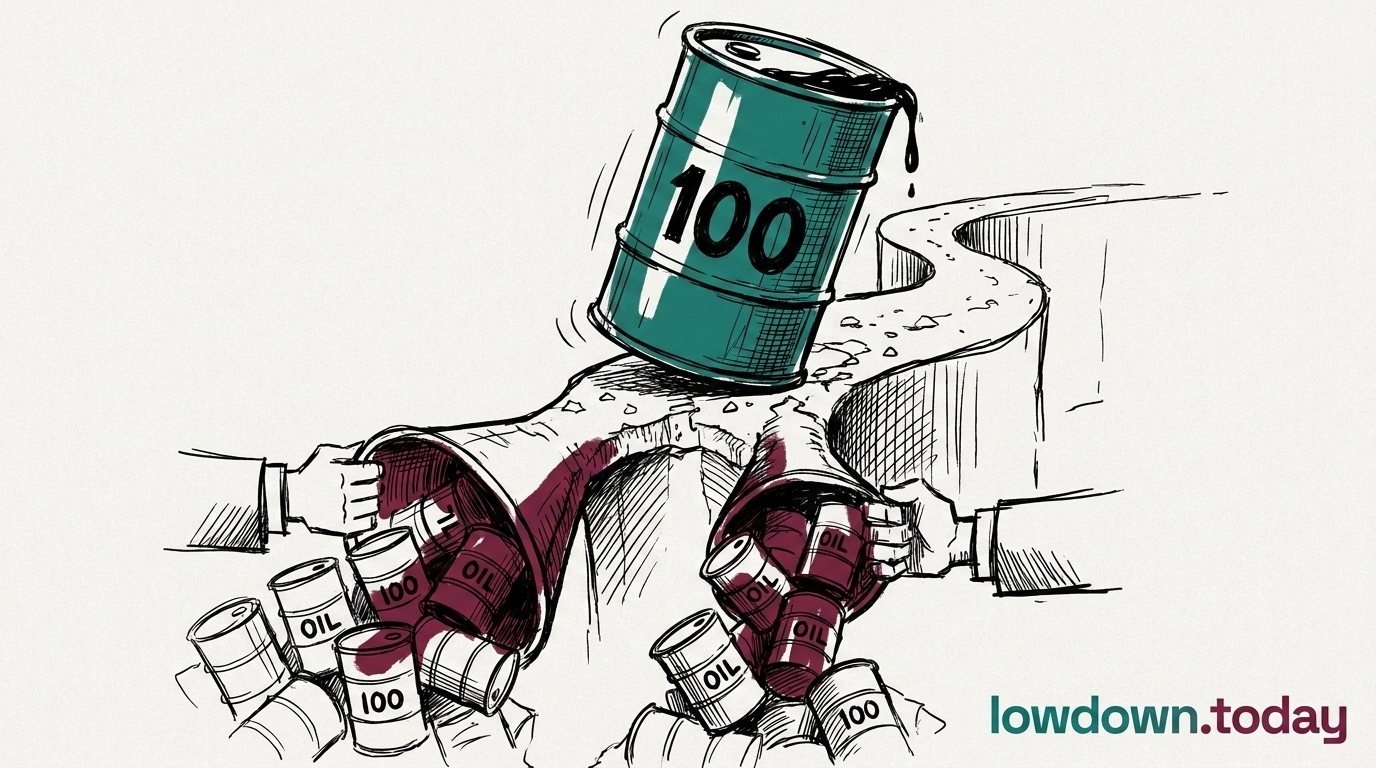
Brent crude fell 5% below $100 on Monday on ceasefire hopes, but Lloyd's left its Hormuz war-risk designation untouched. Cheaper oil on the screens; unchanged cost to move a tanker.

ConflictDeveloping
Key takeaway

Falling oil reflects deal-hope; flat insurance reflects deal-doubt, and insurance pays out when ships burn.

Brent Crude fell roughly 5% on Monday 25 May to about $98.96, dipping to $98.12 intraday, its first sub-$100 print since early May and a fall of some $13 from the $112.10 conflict high reached on 19 May 1. West Texas Intermediate (WTI), the US benchmark, slid toward $92 in the same session. Oil traders read the day as a ceasefire drawing near.

The insurance market read it the other way. Lloyd's of London, the centuries-old London marine market that sets war-risk cover for shipping, left its Strait of Hormuz designation in place, with premiums stuck at $10-14m a voyage. A fall in crude that holds would, in time, ease pump and freight costs the war pushed up. Nothing in the cargo lanes has changed yet, and the cost of moving a tanker through the strait has not moved with the screens.

The two markets diverge because they answer different questions. Oil futures clear daily on sentiment, and Goldman Sachs and Morgan Stanley flagged the structural insurance premium beneath this split in mid-May . War-risk underwriters price the probability of a hull loss, not the probability of a press release, so the Lloyd's Joint War Committee will not relist Hormuz on a verbal understanding. At $99, Brent sits about $7 below the International Energy Agency (IEA) $106 Hormuz-closure baseline, the level the agency models for a shut strait, implying the futures market has now priced a substantial chance the strait reopens soon.

Traders should treat the move with some caution. A 5% drop on a thin US holiday session, the biggest single-day fall since the post-ceasefire relief on 22 April , can be ordinary profit-taking as much as a verdict on the talks. One session reads as the weaker signal next to the Brent-Lloyd's split, which is the durable one, because insurance is the market that pays out when ships burn, and it has not flinched.

Deep Analysis

In plain English

Oil prices fell below $100 a barrel on Monday for the first time in weeks. Markets were pricing in optimism that a deal might end the war in the Persian Gulf and reopen the Strait of Hormuz, the narrow passage through which about 20% of the world's oil travels. But Lloyd's of London, which insures the ships that carry that oil, kept its war-risk rates unchanged at $10-14 million per voyage. Insurance markets move more slowly than financial markets, because insurers face real losses if they get it wrong. The gap between the two tells you something: traders are betting on a deal, but the people who actually have to pay out if a tanker is hit are not yet convinced.

Deep Analysis
Root Causes

Lloyd's war-risk designation at Hormuz depends on the Joint War Committee's (JWC) listed-area classification, which requires a formal resolution before removal. The JWC's protocol requires either a UN Security Council resolution certifying the end of hostilities, or a bilateral government certification letter, before an area can be de-listed.

UNSC Resolution 2817 condemned but did not certify anything; no bilateral letter from the US or Iran has been deposited with Lloyd's. Until one of those instruments lands, syndicates cannot underwrite at standard rates without breaching their reinsurance treaty terms.

The futures market, by contrast, trades probability. Brent's 5% fall represents the market pricing roughly a 35-45% probability of a near-term deal, per Goldman's 25 May note, not a resolved outcome. The two markets answer different questions, which is why they can diverge by $13 simultaneously.

Escalation

Directionally de-escalatory on futures markets, but structurally unchanged on physical shipping. The Lloyd's hold is the more reliable indicator of near-term kinetic risk.

What could happen next?
  • Risk

    If deal talks break down after Brent has already priced a 35-45% deal probability, a sharp reversal toward $112 or beyond is the immediate market consequence.

    Immediate · Assessed
  • Consequence

    Lloyd's war-risk designation will remain in force until a signed, deposited instrument reaches the Joint War Committee, regardless of what verbal agreements are announced.

    Short term · Assessed
  • Opportunity

    Asian refiners holding spot-market capacity could lock in sub-$100 Brent cargoes at today's price on a 30-day delivery basis if they judge deal probability above 50%.

    Immediate · Suggested
First Reported In

Update #107 · Two markets, two prices on one Iran deal

Fortune· 25 May 2026
Read original
Different Perspectives
India
India
India buys more Saudi crude than any other country and has 2.5 million nationals working in the kingdom, so a $100 Brent and a live strike on Saudi tankers reach New Delhi through both fuel bills and remittance risk. Neither channel has an alternative route the way Saudi Arabia's own pipeline does.
Qatar
Qatar
Qatar co-authored the four-mediator ten-day ceasefire proposal alongside Egypt, Pakistan and Oman, centred on resuming Hormuz navigation, while separately pursuing its dated compensation claim against Iran at the UN Security Council filed on 21 July. Doha is mediating and litigating in the same week.
Israel
Israel
Israeli intelligence, reported by the Wall Street Journal, assesses Iran moved thousands of centrifuges and part of its roughly 440kg enriched-uranium stock into Pickaxe Mountain after the June 2025 strikes on its three main nuclear sites. Some of the US refuelling aircraft now deploying to the region are bound for Israeli bases and Ramon Airport.
Houthis
Houthis
Yahya Saree announced the missile and drone strikes on the Encelia and Layla on 22 July as enforcement of the embargo his forces had declared by radio warning alone two days earlier. Six vessels already turned back on the broadcast; the strike shows Houthi forces will use weapons once warnings stop working.
Saudi Arabia
Saudi Arabia
Saudi Arabia's state news agency confirmed only a fire on the Encelia's bow, with the crew safe; the Layla strike remains unconfirmed by Riyadh. The kingdom built its Petroline pipeline specifically to bypass Hormuz through the Red Sea, so the tanker fire lands on the route Riyadh had already spent billions escaping.
United States
United States
Washington is weighing both ten-day proposals but wants a longer truce than either offers, and moved F-16 and F-35 jets plus refuelling aircraft into the region while it decides. That deployment, not Trump's Pickaxe Mountain remarks, is the measurable US action, buying options for the day talks fail rather than betting on them.