Skip to content
Welcome, thoughtbot's Giant Robots listeners!Start here
Iran Conflict 2026
25JUN

GL X lapses 21 August; Iran starts transit fees

4 min read
14:30UTC

General License X expires on 21 August, the Persian Gulf Strait Authority starts charging Hormuz fees around 17 August, and Iran's dollar-free payment corridor finishes Stage 3 the same month.

ConflictAssessed
Key takeaway

Iran's relief window is the exact window it uses to make sanctions optional.

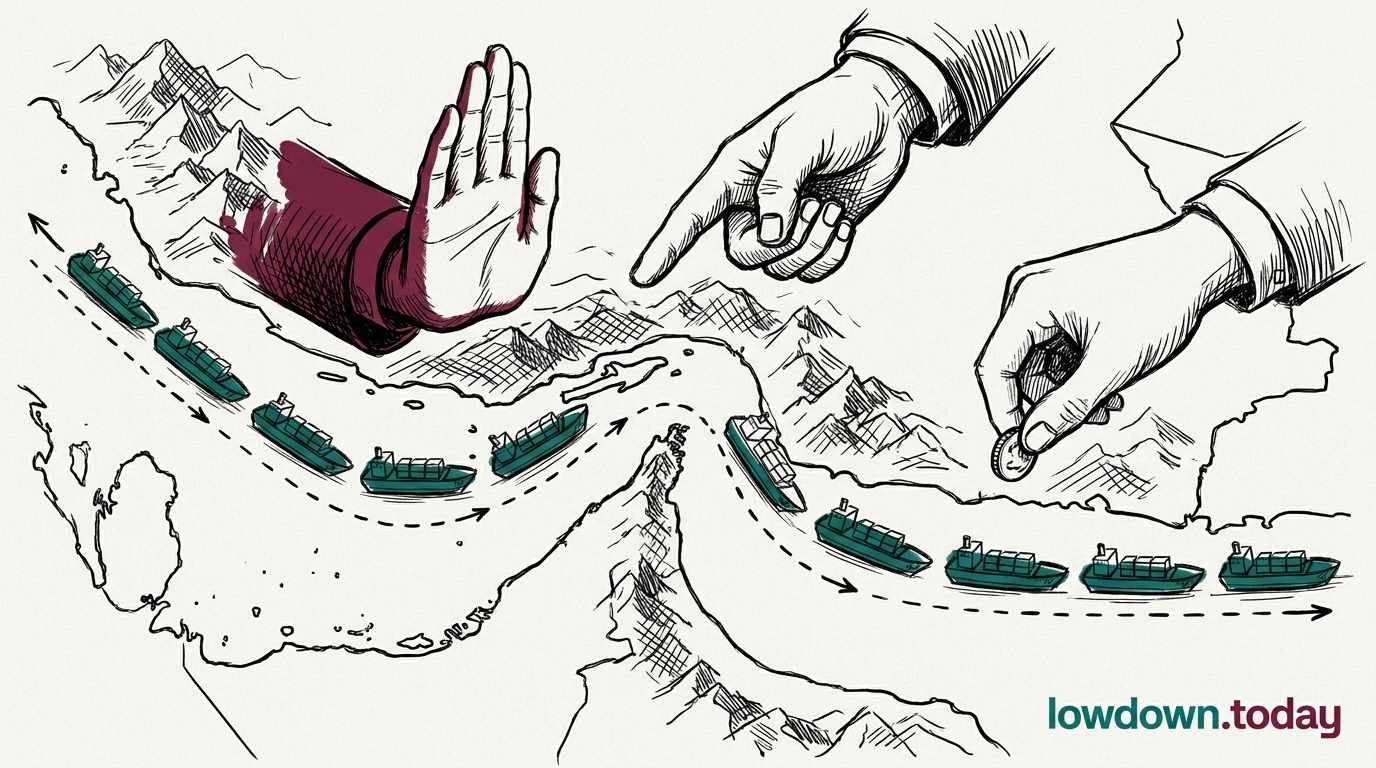
General License X expires on 21 August 2026, four days after the Persian Gulf Strait Authority (PGSA) begins charging Hormuz transit fees around 17 August. The PGSA is the IRGC body that controls strait access. A third clock lands in the same week: Shetab-Mir, Iran's dollar-independent payment corridor built with Moscow, is set to finish its third integration stage around August. Three deadlines set by three different actors fall within four days of each other.

Read the sequence as a mechanism. The 60-day relief window is precisely the window in which Iran completes the infrastructure that makes the next round of sanctions survivable. If the nuclear sub-talks fail by mid-August, the licence expires, the oil sanctions GL X just lifted snap back automatically, the PGSA starts billing every transit as IRGC revenue, and Iran's payment rails are live just as the dollar squeeze returns.

Two of these clocks are not this desk's to read. The freight and fee economics of a fee-charged, dark-corridor Hormuz belong to the European oil desk. So does the parallel sanctions track: Shetab-Mir is an Iran-Russia build, and GL X's amendment of the Russia-related General License 134 ties this licence to Moscow's sanctions story, which the Russia-ukraine desk owns. Lowdown reads the convergence for what it does to the deal's credibility. The MOU's 60-day nuclear window was meant to be a deadline for Iran; tied to a payment-rails completion date, it becomes a deadline for Washington's leverage instead.

Deep Analysis

In plain English

Three different deadlines all land in the third week of August, and each one matters. First, the US oil-sanctions permission slip expires on 21 August. Second, Iran's Revolutionary Guard has set around 17 August as when ships crossing the strait of Hormuz must start paying mandatory transit fees. Third, Iran is finishing the last stage of a joint payment system with Russia, called Shetab-Mir, that lets them move money without using US dollars at all. The striking thing is the timing: the 60-day period Washington gave Iran to sell oil is almost exactly the period Iran needs to finish building the financial plumbing that makes future US sanctions less painful. Whether that overlap is coincidence or calculation is disputed, but the effect is the same.

Deep Analysis
Root Causes

The three-clock convergence in August reflects Iran's deliberate use of the ceasefire's diplomatic bandwidth to advance its infrastructure while the other side's attention is on the nuclear and Lebanon files.

The PGSA fee schedule, reserved from around 17 August, was publicly announced by the IRGC on 20 June, two days before GL X was issued. Iran did not suspend or delay the PGSA timeline when GL X arrived, confirming that the fee structure and the oil-relief licence are parallel, not competing, tracks. Iran earns from the PGSA whether or not GL X continues; GL X earns Iran an additional revenue stream without displacing it.

Shetab-Mir's Stage 3 timeline, confirmed by Central Bank Governor Hemmati in Moscow on 16 June, predates GL X by six days. The payment infrastructure was already on a fixed August schedule that GL X did not accelerate or change. Washington issued the relief instrument without conditioning it on a pause or extension of Shetab-Mir integration, meaning the 60-day window simultaneously provides dollar revenue today and dollar-independent infrastructure for tomorrow.

What could happen next?
  • Risk

    The 60-day window gives Iran time to complete Shetab-Mir Stage 3, making a GL X snap-back on 21 August less economically damaging to Tehran than the original sanctions regime.

    Short term · Assessed
  • Consequence

    PGSA mandatory fees beginning around 17 August convert a military-controlled transit point into a permanent IRGC revenue instrument, regardless of what happens to GL X or nuclear talks.

    Medium term · Reported
  • Meaning

    The three-clock convergence signals that Iran is treating the 60-day window as infrastructure time, not compliance time, which changes the incentive structure for any GL X renewal negotiation.

    Immediate · Assessed
First Reported In

Update #136 · Trump's first Iran paper is an oil licence

OFAC/US Treasury· 23 Jun 2026
Read original →
Different Perspectives
Office for Budget Responsibility
The OBR's 28 October forecast assumed $82 oil for 2026 and 2027, from market prices for the ten working days to 19 August, and blamed dearer wholesale energy on the war without naming Iran. It expects CPI inflation close to 4% in early 2027 even at that price.
Hengaw, Kurdish rights group
Hengaw reported the 3 November hangings of Amirhossein Maleki and Amirhossein Ebrahimi in Isfahan, saying Ebrahimi was tortured into confessing and that nine of 12 people sentenced to death in the case have now been hanged. Iran's judiciary holds that the defendants killed members of the security forces.
FINTRAC, Canada's financial intelligence unit
FINTRAC worked with the US Treasury on the 6 November designation of eight money services businesses in British Columbia, Ontario and Quebec. Treasury says the businesses still operate, some under new names, so closing them falls to Ottawa.
Abdul Qadir al-Dakhil, Governor of Nineveh
Al-Dakhil cancelled three Mosul International Airport contracts on 7 November over alleged links to armed groups, after meeting Prime Minister Ali al-Zaidi in Baghdad. He named no group or company, and said the contracts will go to international companies.
Kuwait
Kuwait
Kuwait condemned the Houthi missile fired towards the Madinah region on 5 November and restated its support for Saudi Arabia, the Qatar News Agency reported. Its state tanker company, Kuwait Oil Tankers Company, is among the Gulf state fleets on Iran's expanded Hormuz list.
Scott Bessent, US Treasury Secretary
Treasury designated an alleged Chandigarh false-flag network on 4 November and eight Canadian exchangers on 6 November, while State sanctioned alleged MANPADS intermediaries. None of the actions touches an oil buyer; they target the paper, cash and procurement around Iran's trade.

Written with AI from Lowdown's published reporting. Not individually reviewed by an editor. Editorial standards.
