Skip to content
You can now search across every topic, entity and event.What's new
Iran Conflict 2026
24JUN

Trump pauses Iran bombing, accepts 10-point framework

2 min read
09:14UTC

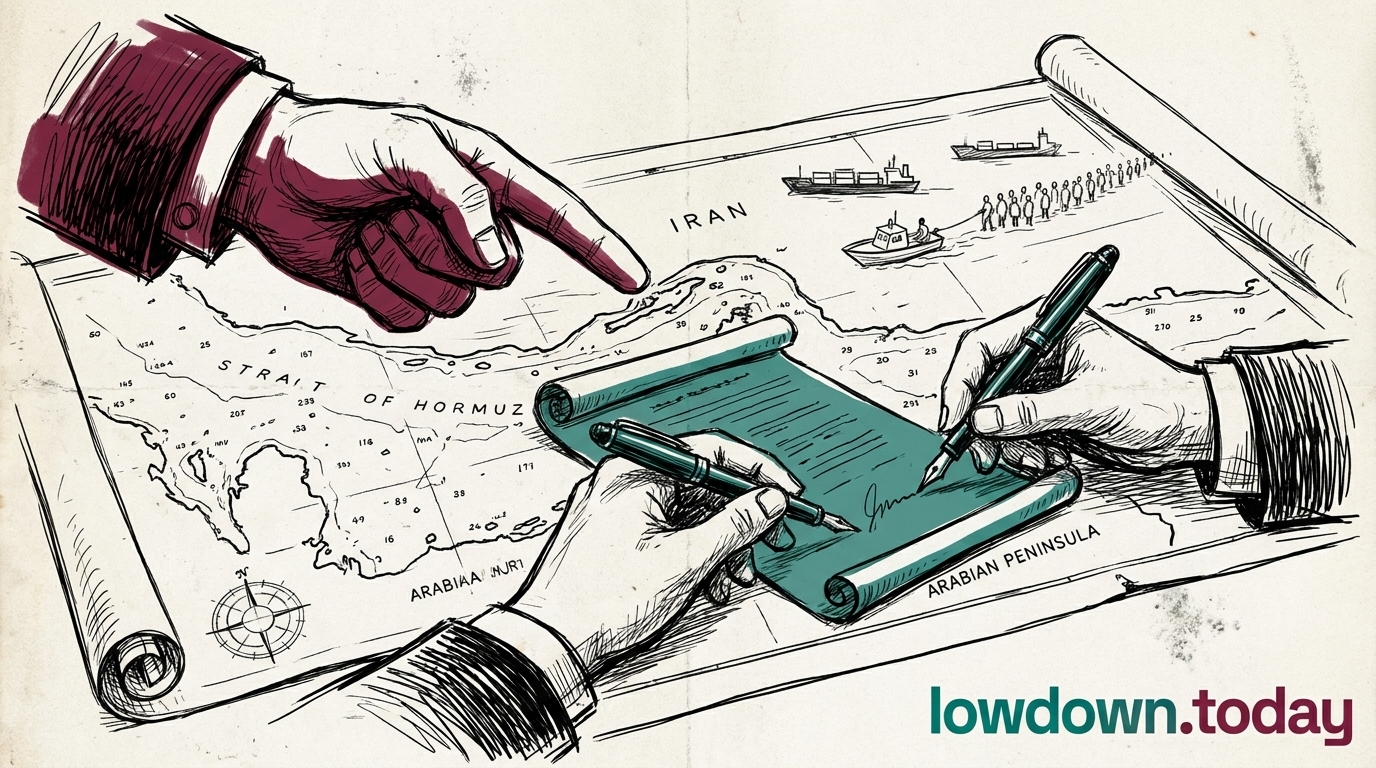
Two hours before his fifth Hormuz ultimatum was due to lapse, the president converted the deadline into a two-week diplomatic window.

ConflictDeveloping
Key takeaway

The sixth deadline produced a paused war signed against a goal list that no longer contains Hormuz.

Trump's Truth Social acceptance came as the carriers required to enforce the deadline remained 1,100 km from Iran's coast, repositioned out of the missile envelope . Each previous Hormuz reformulation had produced an extension under the same pattern: rising rhetoric, flat operational ceiling. The fifth extension on 6 April was the immediate predecessor ; the 10-point Iranian framework that Pakistan had brokered the same day became the document Trump now describes as 'workable'. The acceptance is the sixth deadline outcome.

The White House framing relies on a four-item Clear and Unchanging Objectives page dated 1 April that does not list reopening the strait of Hormuz. The 'met and exceeded' claim is narrowly true against that list and only that list. Briefing #61 documented the silent omission; today's signing confirms it was infrastructure for the climbdown, not a clerical accident.


Deep Analysis

In plain English

Trump had been threatening for six weeks to bomb Iran's power stations and refineries unless Iran reopened the Strait of Hormuz. Tonight he signed a two-week pause instead. The deal asks Iran to allow shipping through the Strait under Iran's coordination, which is what Iran has already been doing for friendly buyers since mid-March. Both sides are calling it victory.

Deep Analysis
Synthesis

The sixth deadline produced the outcome that the prior five had been pre-positioning: a face-saving exit framed as victory against a narrowed goal list.

Root Causes

The operational ceiling was flat throughout the war. Interceptor depletion at critical thresholds and Pacific-stock JASSM-ER consumption left no tool to convert civilization-ending rhetoric into operations.

The Hormuz objective was dropped from the official goal list before the ceasefire because retaining it would have required either a victory the operations could not deliver or an admission of failure the politics could not absorb.

Escalation

De-escalation without resolution. The pause holds for two weeks but contains no enforcement mechanism, no published text, and no agreed terms on Lebanon. Probability of resumption inside the window is non-trivial; probability of structural reversal of Iran's Hormuz position is near zero.

What could happen next?
  • Consequence

    The Islamabad meeting on 10 April becomes the test of whether a published text exists or the ceasefire is rhetorical only.

    Short term · High
  • Risk

    Without enforcement, a single high-volume Iranian strike or US escalation could collapse the pause inside its first week.

    Immediate · Medium
  • Precedent

    Any future US president inherits a Hormuz arrangement Iran controls, codified by acceptance rather than diplomacy.

    Long term · Medium
First Reported In

Update #62 · Two victories, two different lists

Times of Israel· 8 Apr 2026
Read original
Different Perspectives
Shipping and insurance industry
UKMTO counted about 20 US-facilitated Hormuz transits a day to 11 September against only 6 visible on AIS, with traffic still around 90% below the 138-a-day pre-war baseline. War-risk underwriters cannot price hulls they cannot see, or resolve whether the tanker El Gaia hit a mine, as Iran claims, or a missile and drone, as CENTCOM says.
European refiners
European refiners
European refiners, including Poland's Orlen, absorbed a roughly $26 gap between Dated Brent at $130.80 on 15 September and ICE Brent futures settling at $103.87 on 18 September, a spread that widened from $13.45 on 9 September rather than newly opening. Their futures hedges no longer cover what they now pay for physical barrels.
Saudi Arabia
Saudi Arabia
Saudi Aramco zeroed European term customers' October allocations and rerouted roughly 60 million barrels to Asia through Ras Tanura and Sohar, using Red Sea and Gulf terminal capacity built years ago to cut Hormuz exposure. Riyadh reallocated existing supply rather than negotiating a shortfall with Europe.
Qatar
Qatar
Qatar's energy minister Saad al-Kaabi told Bloomberg at the Qatar Economic Forum on 20 September that Bessent's two-year Hormuz-obsolescence forecast is wrong, and that Doha has deliberately built no bypass pipeline. Qatar's gas exports run through one waterway by choice, not oversight.
Iran (foreign ministry and Majlis)
Iran's foreign ministry and 130 Majlis deputies moved toward NPT withdrawal this week, with lawmaker Hossein-Ali Haji Deligani filing a triple-urgency bill on 20 September that Speaker Qalibaf has not yet scheduled. Tehran treats treaty membership as leverage still on the table, not yet spent.
Russia and China
Russia and China
Moscow and Beijing vetoed the Panel of Experts' renewal, maintaining Resolution 2231 lapsed in October 2025 and the 2025 snapback was never validly triggered, so the sanctions architecture the Panel enforces has no current legal standing. Both governments frame the veto as upholding law, not shielding Tehran.



