Skip to content
You can now search across every topic, entity and event.What's new
Iran Conflict 2026
21JUN

Ghalibaf names three ceasefire breaches

2 min read
17:51UTC

Iranian Parliament Speaker Mohammad Bagher Ghalibaf publicly named three ceasefire violations: Israel's continued strikes on Lebanon, a drone incursion into Iranian airspace, and the US refusal to accept Iran's enrichment rights. He set two preconditions for Saturday's talks to begin.

ConflictDeveloping
Key takeaway

Iran has publicly written its walkout script before the talks begin.

Mohammad Bagher Ghalibaf, speaker of Iran's parliament, publicly listed three ceasefire violations on Thursday: Israel's continued strikes on Lebanon, a drone incursion into Iranian airspace, and the US refusal to accept Iran's enrichment rights 1. His two preconditions for Saturday's talks beginning are a Lebanon ceasefire and the release of Iran's blocked foreign-exchange assets. This advances the framework rejection he issued two days earlier .

President Masoud Pezeshkian told a cabinet meeting in Tehran this week that continued Israeli strikes on Lebanon would make negotiations "meaningless" 2. Netanyahu has signalled readiness to open Lebanon negotiations through the US State Department next week, Al Jazeera reported, but Trump privately asked him to "low-key it" on Lebanon ahead of Islamabad 3. The Iranian delegation is therefore publicly staking positions Saturday's talks were supposed to resolve but cannot, because the physical violations Iran is citing continue in real time.

Iran arrived in Islamabad via its Parliament speaker, not its foreign minister alone, because Mojtaba Khamenei needs domestic cover . Ghalibaf's three violations give the new Supreme Leader's inner circle a pre-built justification for walking out at any moment. Pakistan's modest success bar, "keep talks going", now reads as a realistic assessment of what the format can actually produce.


Deep Analysis

In plain English

Iran turned up to the Islamabad talks, but before beginning any conversation with the Americans, its delegation publicly announced three ways the other side had already broken the ceasefire — and two conditions that must be met before talks can formally begin. This is a negotiating tactic with a specific domestic purpose: if the talks fail or Iran walks out, Tehran can point to this codified list and say 'we left because the other side broke the deal first'. It is less a negotiating position than a prepared exit narrative.

Deep Analysis
Root Causes

Iran's codified violations list reflects the structural problem the ceasefire created: Mojtaba Khamenei authorised a pause without resolving the fundamental incompatibilities between the two sides' stated terms.

By formalising violations rather than withdrawing from talks, Tehran is managing the tension between the domestic victory narrative — state television called the ceasefire a 'crushing defeat of the United States' — and the reality that none of Iran's core demands (enrichment rights, Lebanon ceasefire, frozen assets) have been met.

The preconditions mechanism also serves a structural function: it shifts the burden of proof for any breakdown from Iran to the parties that continue the violations Iran has named.

First Reported In

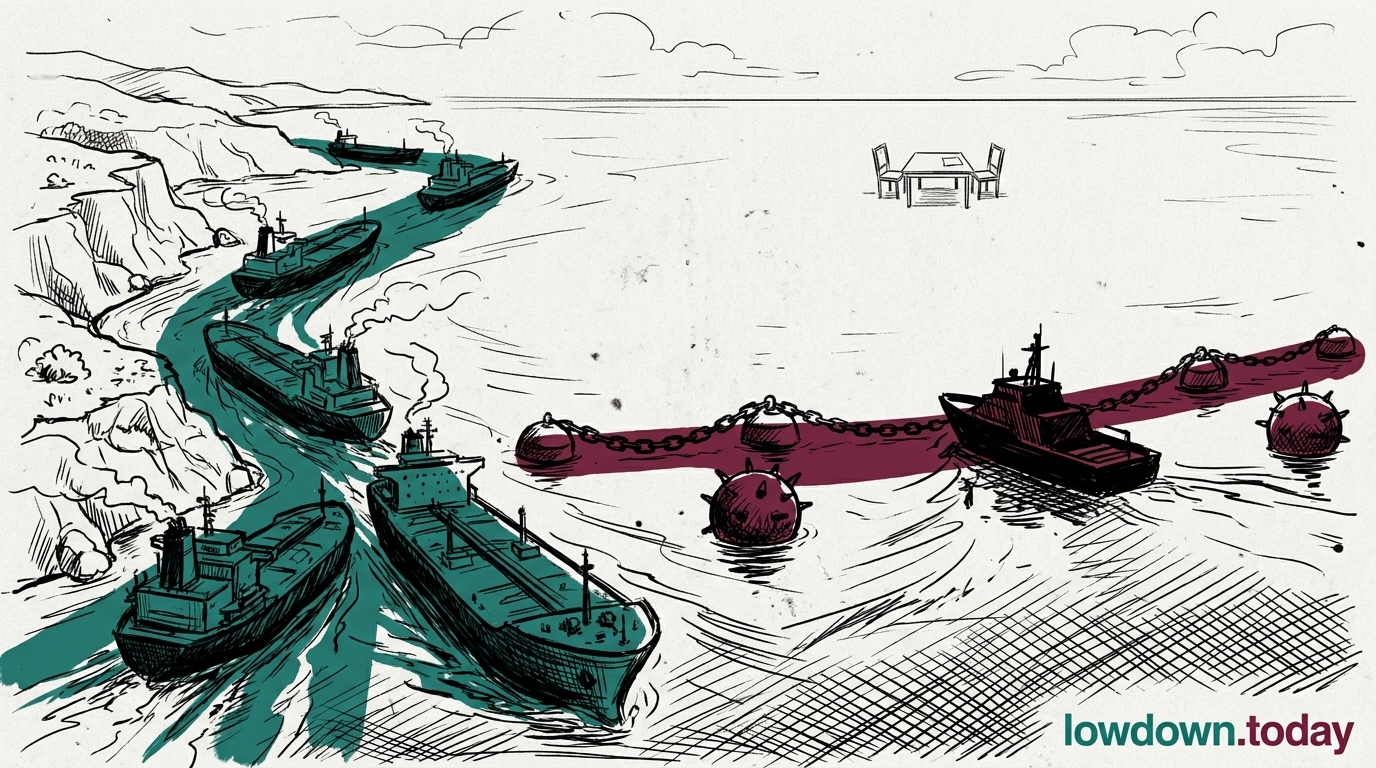
Update #65 · Iran lost its own minefield

Al Jazeera· 11 Apr 2026
Read original
Different Perspectives
Shipping and insurance industry
UKMTO counted about 20 US-facilitated Hormuz transits a day to 11 September against only 6 visible on AIS, with traffic still around 90% below the 138-a-day pre-war baseline. War-risk underwriters cannot price hulls they cannot see, or resolve whether the tanker El Gaia hit a mine, as Iran claims, or a missile and drone, as CENTCOM says.
European refiners
European refiners
European refiners, including Poland's Orlen, absorbed a roughly $26 gap between Dated Brent at $130.80 on 15 September and ICE Brent futures settling at $103.87 on 18 September, a spread that widened from $13.45 on 9 September rather than newly opening. Their futures hedges no longer cover what they now pay for physical barrels.
Saudi Arabia
Saudi Arabia
Saudi Aramco zeroed European term customers' October allocations and rerouted roughly 60 million barrels to Asia through Ras Tanura and Sohar, using Red Sea and Gulf terminal capacity built years ago to cut Hormuz exposure. Riyadh reallocated existing supply rather than negotiating a shortfall with Europe.
Qatar
Qatar
Qatar's energy minister Saad al-Kaabi told Bloomberg at the Qatar Economic Forum on 20 September that Bessent's two-year Hormuz-obsolescence forecast is wrong, and that Doha has deliberately built no bypass pipeline. Qatar's gas exports run through one waterway by choice, not oversight.
Iran (foreign ministry and Majlis)
Iran's foreign ministry and 130 Majlis deputies moved toward NPT withdrawal this week, with lawmaker Hossein-Ali Haji Deligani filing a triple-urgency bill on 20 September that Speaker Qalibaf has not yet scheduled. Tehran treats treaty membership as leverage still on the table, not yet spent.
Russia and China
Russia and China
Moscow and Beijing vetoed the Panel of Experts' renewal, maintaining Resolution 2231 lapsed in October 2025 and the 2025 snapback was never validly triggered, so the sanctions architecture the Panel enforces has no current legal standing. Both governments frame the veto as upholding law, not shielding Tehran.



