Skip to content
You can now search across every topic, entity and event.What's new
Iran Conflict 2026
21JUN

Asia clears the LNG queue first

3 min read
17:51UTC

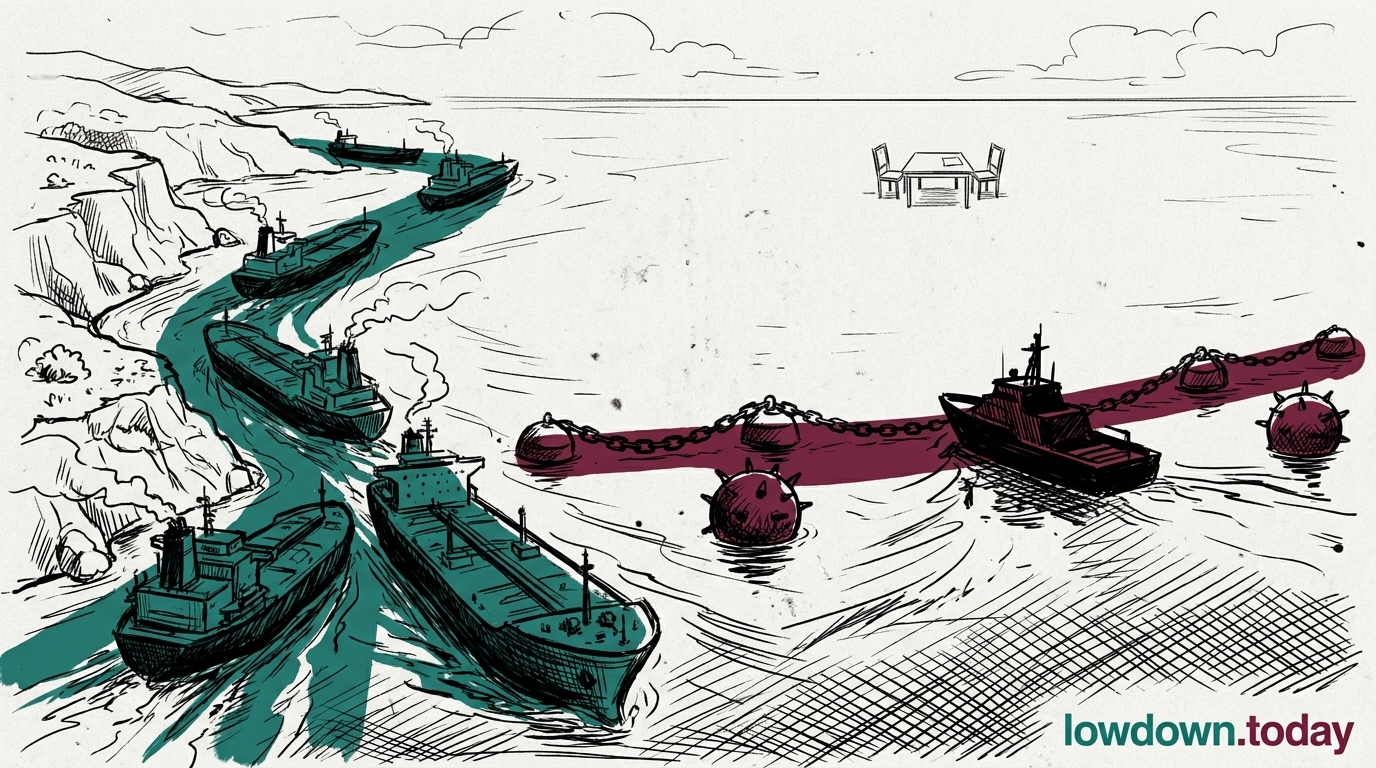
Goldman Sachs pushed Hormuz LNG normalisation to end-July from end-June on 17 June, citing roughly 500 vessels still anchored outside the strait; the first post-conflict carrier routed to India, not Europe.

ConflictDeveloping
Key takeaway

Goldman pushed Hormuz LNG normalisation to end-July as 500 vessels queued and the first carrier cleared India.

Goldman Sachs revised its Hormuz LNG normalisation timeline to end-July from end-June on 17 June, citing roughly 500 commercial vessels still anchored outside the strait despite the US-Iran memorandum 1. The bank held its 2H 2026 TTF forecast at €41/MWh but flagged an upside tail above €100/MWh if the blockade persists. A two-to-three-month mine-clearing and security-assessment tail means the physical cargo benefit arrives after the heart of the July injection window 2, with Qatar's partial restart clock (covered in event 5) layered behind that.

The arbitrage tells the same story. The JKM-TTF spread, the gap between the Japan-Korea Marker for Asian spot LNG and the European benchmark, compressed to roughly $4.35/MMBtu by 18 June from $5.26 on 12 June as TTF fell faster than JKM on the Hormuz deal 3. The compression is real but partial: the arb still sits above the $2.50 to 3.00 freight-adjusted diversion threshold, so uncommitted Atlantic cargoes still route east rather than into European terminals.

The physical flow confirms the routing. The Disha, the first LNG carrier to cross Hormuz after the conflict, transited on 15 June bound for Dahej in India, not a European berth 4. The first post-conflict cargo cleared an Asian terminal while Europe's regas berths stayed the losing bid. The narrowing margin is the early signal of European storage re-entering the cargo auction, not yet its return: front-month TTF has fallen on a diplomatic deal that the physical cargo flow has not yet routed to a European regas berth.


Deep Analysis

In plain English

Liquefied natural gas tankers can choose where to deliver, to Europe or to Asia, depending on which destination pays more. The price difference between Asia (measured by the Japan-Korea Marker, or JKM) and Europe (TTF) determines the routing choice. When Asia pays $4.35 more per unit than Europe, after accounting for the cost of the longer journey, tanker owners route east. The first LNG ship to sail through the Strait of Hormuz after the conflict ended was the Disha. Despite months of European concern about gas shortages, the Disha went to India, the commercial signals pointed there, not to a European terminal. Until TTF rises enough to narrow the gap with Asian prices, the same pattern will repeat: available LNG flows to the highest bidder, which is currently Asia.

Deep Analysis
Root Causes

The JKM-TTF arb persists above the diversion breakeven because two independent conditions hold simultaneously: first, Asian spot LNG demand has not yet been destroyed sufficiently by high prices, as Japanese utilities and South Korean importers face winter 2026-27 procurement obligations and are rebuilding storage; second, Atlantic LNG cargo owners face a choice between a €41 TTF equivalent (approximately $14.2/MMBtu) and a JKM above $18/MMBtu, with freight costs of approximately $2.50/MMBtu for a Europe-versus-Asia diversion, leaving $1.35 of net advantage for routing east.

The Disha routing to Dahej confirms that even the first post-conflict Hormuz transit, which might have been expected to prioritise European storage security as the diplomatically significant choice, followed commercial routing logic: India offered a closer destination and a JKM-linked offtake price that beat any European terminal bid at current TTF levels.

What could happen next?
  • Risk

    Every week the JKM-TTF arb stays above USD 4/MMBtu, European storage injection misses approximately 700 GWh of LNG supply that would otherwise arrive at Northwest European terminals under a routing-neutral arb environment.

  • Consequence

    India and other South Asian LNG importers receiving the first post-conflict Hormuz cargoes establish an emerging commercial pattern that could persist into the winter procurement window, structurally competing with European buyers for Qatari restarter volumes.

First Reported In

Update #19 · German spark spread flips +EUR 15 in 48hrs

InvestingLive· 18 Jun 2026
Read original
Different Perspectives
Shipping and insurance industry
UKMTO counted about 20 US-facilitated Hormuz transits a day to 11 September against only 6 visible on AIS, with traffic still around 90% below the 138-a-day pre-war baseline. War-risk underwriters cannot price hulls they cannot see, or resolve whether the tanker El Gaia hit a mine, as Iran claims, or a missile and drone, as CENTCOM says.
European refiners
European refiners
European refiners, including Poland's Orlen, absorbed a roughly $26 gap between Dated Brent at $130.80 on 15 September and ICE Brent futures settling at $103.87 on 18 September, a spread that widened from $13.45 on 9 September rather than newly opening. Their futures hedges no longer cover what they now pay for physical barrels.
Saudi Arabia
Saudi Arabia
Saudi Aramco zeroed European term customers' October allocations and rerouted roughly 60 million barrels to Asia through Ras Tanura and Sohar, using Red Sea and Gulf terminal capacity built years ago to cut Hormuz exposure. Riyadh reallocated existing supply rather than negotiating a shortfall with Europe.
Qatar
Qatar
Qatar's energy minister Saad al-Kaabi told Bloomberg at the Qatar Economic Forum on 20 September that Bessent's two-year Hormuz-obsolescence forecast is wrong, and that Doha has deliberately built no bypass pipeline. Qatar's gas exports run through one waterway by choice, not oversight.
Iran (foreign ministry and Majlis)
Iran's foreign ministry and 130 Majlis deputies moved toward NPT withdrawal this week, with lawmaker Hossein-Ali Haji Deligani filing a triple-urgency bill on 20 September that Speaker Qalibaf has not yet scheduled. Tehran treats treaty membership as leverage still on the table, not yet spent.
Russia and China
Russia and China
Moscow and Beijing vetoed the Panel of Experts' renewal, maintaining Resolution 2231 lapsed in October 2025 and the 2025 snapback was never validly triggered, so the sanctions architecture the Panel enforces has no current legal standing. Both governments frame the veto as upholding law, not shielding Tehran.



