Skip to content
Briefings are running a touch slower this week while we rebuild the foundations.See roadmap
Iran Conflict 2026
6JUN

White House signs no Iran instrument on day 71

4 min read
12:17UTC

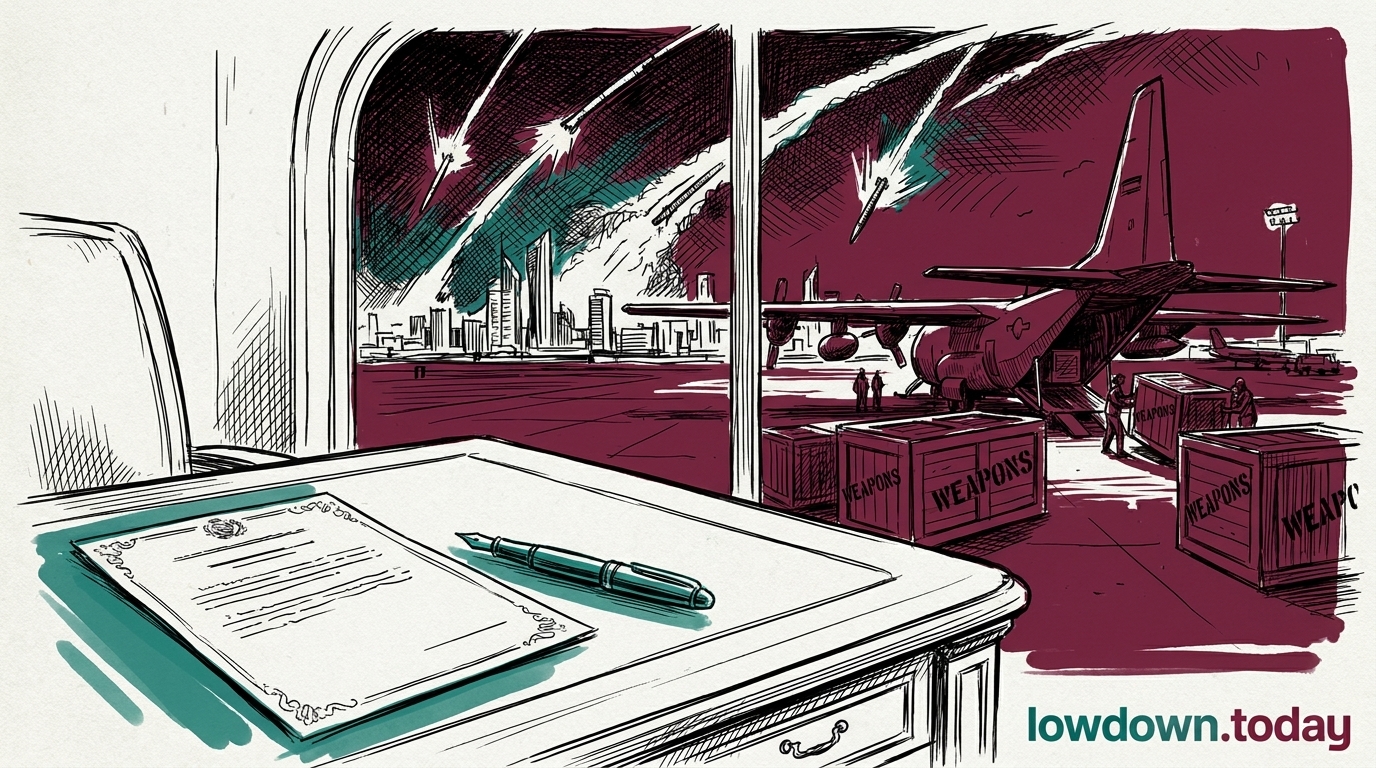
The White House presidential-actions index recorded zero Iran-related signatures on 8 and 9 May. The verbal track has now run for seventy-one consecutive days without a single signed document.

ConflictDeveloping
Key takeaway

Seventy-one days without a signed Iran document; allied governments are now pricing presidential statements at zero against actual orders.

The White House presidential-actions index recorded zero Iran-related instruments on 8 and 9 May, extending the unsigned-document gap to seventy-one consecutive days. The most recent Iran-adjacent signature, the 1 May War Powers Resolution termination letter to Congress, declared the war over; OFAC's same-day General Licence W (GL-W) treated it as live . Nothing has been signed since to reconcile the two. Within the same period, Donald Trump has issued more than a dozen public Iran statements, none of which carries the legal force of a Treasury designation, a CENTCOM rules-of-engagement order, or an executive instrument.

On 8 May alone, Trump posted on Truth Social that "we'll knock them out a lot harder, and a lot more violently, in the future, if they don't get their Deal signed, FAST!" 1. He told CBS News at the Lincoln Memorial Reflecting Pool that morning it was "too soon" for new direct talks. He told ABC News that the kinetic exchange was a small matter and said Iran had agreed to the deal. Three registers, one day, no signature.

The pattern stretches across the whole 71-day window. Trump verbally announced a 15,000-personnel CENTCOM Hormuz escort on 3 May , and verbally paused the resulting Project Freedom and declared Operation EPIC FURY concluded on 5 May , then verbally asserted Iran had agreed to a deal on 8 May. None of those statements is on signed paper. The instruments his services act on (blockade orders, sanctions designations, IDF coordination) are running their own track on their own clocks.

The parallel is the Reagan administration's 1986 Iran-Contra interval, in which presidential statements ran ahead of signed authorisations and allied governments learned to discount them. Reagan paid the cost via the Tower Commission and a constitutional crisis. Trump's verbal-only methodology has run longer than 1985-86 without comparable institutional pushback. The War Powers Resolution mechanism that exists to force this question has been voted down six times in this Congress. European NATO allies have started drafting their Northwood planning on the assumption no signed US instrument will arrive; allied insurers and shipping desks are pricing Truth Social posts at zero against signed CENTCOM orders.

Deep Analysis

In plain English

Since the war with Iran began 71 days ago, President Trump has made many public statements about Iran: threats, claims of deals reached, descriptions of military strikes as trivial. But he has signed no official legal documents about Iran. This matters because in the US system, a presidential statement on social media is not a law or an order. The US military, Treasury sanctions officials, and allied governments work from signed executive documents: orders, designations, military authorisations. A Truth Social post, by contrast, gives CENTCOM no operational instruction and gives Tehran no enforceable commitment. On 8 May alone, Trump posted a threat to bomb Iran 'a lot harder', told one broadcaster the strikes were 'a love tap', and told another it was 'too soon' for new talks. These cannot all be true at once. The US government's military and sanctions operations are running on their own track, while the President's public statements run on a separate one.

Deep Analysis
Root Causes

The verbal-only track has a structural origin that is distinct from Trump's personal communication style.

The **National Security Council interagency process** exists precisely to convert presidential intent into signed instruments: presidential findings, executive orders, CENTCOM operations orders, Treasury designations, State Department demarches. Every one of these requires review by legal counsel, OMB coordination, and interagency sign-off.

The Trump second administration has systematically reduced the staffing and authority of this process. **Mike Waltz**, NSC Advisor, was replaced in April 2026, leaving the Iran portfolio without a confirmed NSC principal to drive the paper trail. Without an NSC principal pushing instruments through the interagency, presidential intent remains verbal because the machinery that converts statements into signatures is operating below capacity.

The secondary structural cause is the constitutional grey zone the administration has chosen to inhabit. Signing an executive instrument on Iran either triggers or resolves the War Powers Resolution clock. The White House legal counsel's preference for the verbal track is partly a deliberate choice to avoid forcing that constitutional question while the war remains in its current phase, before the 14 May summit either produces or forecloses a diplomatic resolution.

What could happen next?
  • Risk

    Allied insurance underwriters and shipping desks have begun pricing Truth Social posts at zero against signed CENTCOM orders; if the gap persists into the 14 May summit window, allied governments may begin drafting policy on the assumption no US signed instrument will arrive, which would harden the diplomatic isolation of the US Iran position.

    Short term · 0.82
  • Consequence

    Senator Murkowski's AUMF route, filing the week of 11 May, acquires force precisely from the 71-day unsigned gap; the constitutional argument has migrated from 'can the President wage this war alone?' to 'can the President wage it on social media alone?'

    Immediate · 0.88
  • Precedent

    A war conducted for 71 days without a single signed presidential instrument creates a precedent for future administrations that the War Powers Resolution clock can be indefinitely suspended by keeping all authorisations verbal.

    Long term · 0.75
First Reported In

Update #92 · An MOU asking Iran to surrender what nobody can count

The War Zone· 9 May 2026
Read original
Different Perspectives
Israel
Israel
The IDF struck a Lebanese army unit on 6 June, killing a colonel, and privately told Moscow that shelling near Bushehr was accidental, per Putin's SPIEF disclosure. Israel is advancing in Lebanon past an unenforced ceasefire text while maintaining a back-channel to Russia on nuclear-site deconfliction.
Lebanon
Lebanon
President Aoun told CNN on 5 June that Iran uses Lebanon as a bargaining chip and urged Hezbollah toward diplomacy; on 6 June an IDF strike killed a Lebanese army colonel on the Khardali-Nabatieh road. The Lebanese state is publicly rejecting Iranian tutelage while the army sustains casualties from Israeli fire and the Washington framework remains unenforced.
Bahrain
Bahrain
Bahrain's US Fifth Fleet headquarters was among the targets in the 5-6 June two-country salvo; its PAC-3 magazine stands at 87 per cent depletion with an 18-month resupply gap and no comparable arms sale has been announced. The state is defending a critical US regional command on a thinning interceptor stock.
Kuwait
Kuwait
Kuwait received a $1.98bn US counter-drone sale approval on the same day IRGC missiles targeted its bases; it expelled two Iranian diplomats on 4 June and filed a formal protest. The arms approval gives Kuwait a future capability but leaves a 6-18 month delivery gap that the salvo tempo is already pressing.
Russia
Russia
Putin reaffirmed Russia's offer to hold Iran's 440.9 kg HEU at SPIEF on 6 June, said Russia is not arming Iran, and disclosed that both the US and Israel privately told Moscow that shelling near Bushehr was accidental. The restatement casts Moscow as the only remaining mediator both sides call, a position serving Russian interests whatever the nuclear file produces.
Iran
Iran
The IRGC, per Iranian state media, fired seven ballistic missiles at US bases in Kuwait and Bahrain, the largest two-country salvo of the war, and framed the launches as lawful retaliation; Foreign Minister Araghchi rejected Aoun's bargaining-chip accusation and Velayati warned Beirut against diplomatic naivety. Tehran has sent no HEU counter-proposal since Araghchi confirmed no progress on 4 June.