Skip to content
Briefings are running a touch slower this week while we rebuild the foundations.See roadmap
Iran Conflict 2026
4JUN

Missile debris hits Dubai's Burj Al Arab

3 min read
11:25UTC

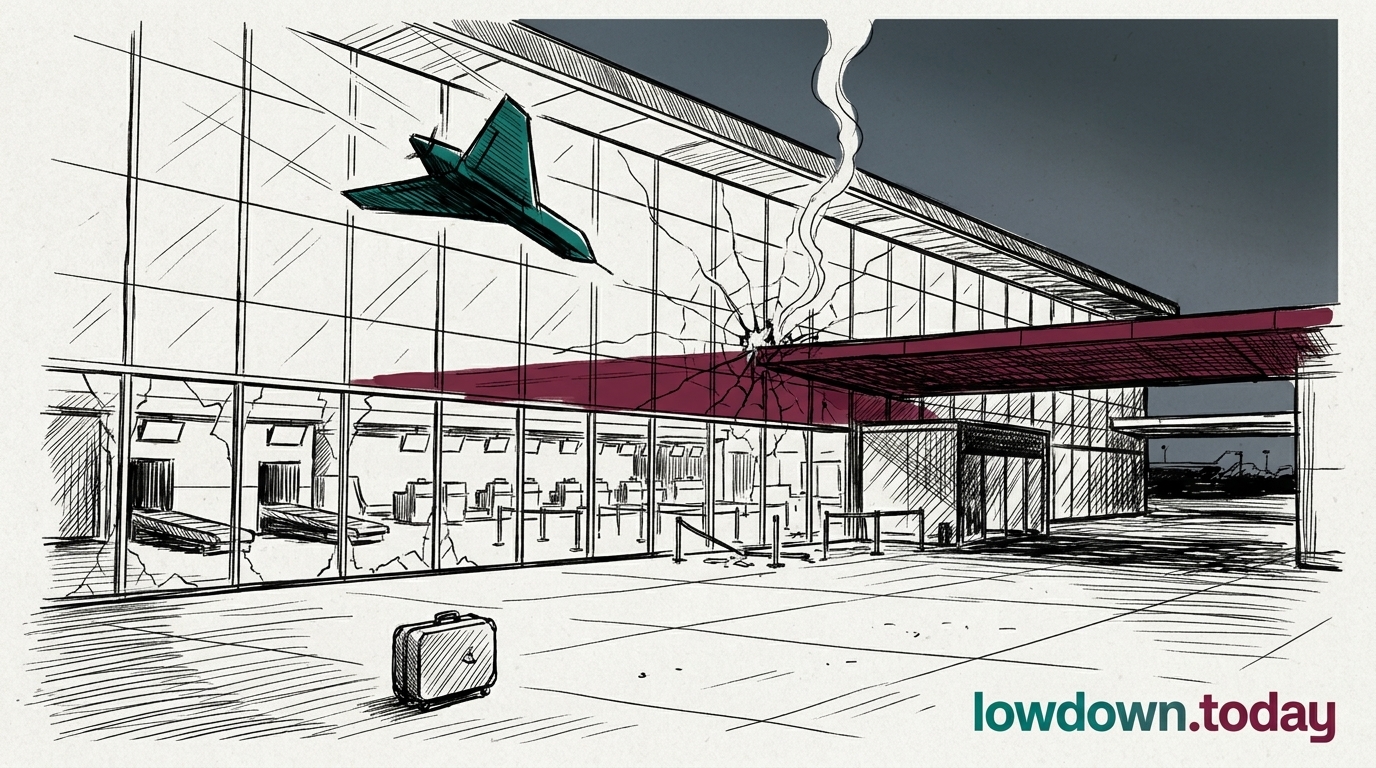
Fragments from intercepted Iranian missiles damaged one of the most recognisable buildings on earth — the first confirmed hit on a major civilian structure in a Gulf financial centre.

ConflictDeveloping
Key takeaway

Damage to the Burj Al Arab transforms Dubai from a neutral financial spectator into a visible casualty of the conflict, with measurable consequences for UAE political calculus, Gulf capital confidence, and the global perception of Gulf commercial safety.

Fragments from intercepted Iranian missiles fell on Dubai overnight, damaging the Burj Al Arab hotel — the first confirmed damage to a major civilian building in a Gulf financial centre since the conflict began. The damage came not from a direct Iranian strike but from debris produced by a successful interception: the by-product of air defence systems doing exactly what they were built to do.

The UAE has intercepted 165 ballistic missiles, 2 cruise missiles, and 541 drones since operations began . At those volumes, every successful shoot-down produces fragments that fall somewhere over populated territory. The Burj Al Arab — a 321-metre sail-shaped tower on an artificial island off Dubai's coast — is among the most photographed structures in the world. Physical damage to it communicates the war's reach more immediately than any military briefing. The image travels globally at the speed of a photograph.

Dubai's economic model — tourism, real estate, financial services, logistics — was built on the premise that the city exists at a remove from regional instability. International capital, hotel chains, and multinational headquarters located there precisely because Gulf security risks appeared to stop at the border. The June 2025 Twelve-Day War tested that premise but left UAE-Iran commercial channels intact . This second round has already produced a drone strike on the US consulate in Dubai and now visible damage to the city's most iconic building. The insulation that underwrote two decades of Dubai's growth has been physically breached.

The practical question is whether the damage accelerates capital flight or proves absorbable. Property transactions, commercial insurance premiums, and forward hotel bookings will answer over the coming weeks. But the damage also feeds into the broader political calculus facing Gulf States. The UAE, Kuwait, Bahrain, and Qatar are absorbing Iranian fire because they host US forces or sit within range — not because they chose this war. As interception volumes continue and debris accumulates over cities, the pressure on Gulf governments sharpens: strike back to stop the missiles, or demand Washington negotiate an end.


Deep Analysis

In plain English

The Burj Al Arab is one of the most photographed buildings on Earth — a seven-star hotel shaped like a sail that became the global symbol of Dubai's transformation into a world city. Missile fragments hitting it is the equivalent of a stray shell chipping the Eiffel Tower: the physical damage may be limited, but the image travels instantly and signals to the world that no civilian landmark in the Gulf is outside the conflict's reach. Dubai has functioned throughout this crisis as a neutral commercial hub — that status is now visibly punctured.

Deep Analysis
Synthesis

Dubai has functioned as a de facto neutral financial clearing house throughout this conflict — hosting capital flows, maintaining commercial links across lines, and providing a location where back-channel contacts could operate. Visible damage to its most iconic landmark punctures that neutrality narrative and may trigger capital reallocation away from a jurisdiction that can no longer credibly present itself as outside the conflict zone. The secondary effect — corporate reassessment of Dubai as a regional HQ hub — could be more economically consequential than the physical damage itself.

Escalation

The UAE is one of the eight signatories to the joint statement reserving 'the option of responding to the aggression.' Burj Al Arab damage — visceral, globally visible, commercially resonant — provides Emirati leadership with both domestic and international justification to exercise that option. UAE decision-making timelines may have compressed materially: Abu Dhabi now has a public, symbolic grievance to match Axios reporting that it was already considering strikes on Iranian missile launch sites.

What could happen next?
  • Consequence

    UAE symbolic neutrality in the conflict is no longer commercially or reputationally sustainable, accelerating pressure on Abu Dhabi to seek explicit US protection guarantees or exercise the offensive option formalised in the eight-nation joint statement.

    Short term · Assessed
  • Risk

    Global corporate risk teams reassessing Dubai as a regional HQ hub could trigger capital and operational relocations that structurally damage Dubai's position as the Middle East's premier financial centre, with effects lasting well beyond the conflict's end.

    Medium term · Suggested
  • Precedent

    The first confirmed damage to a major Gulf civilian landmark establishes that Iranian strike debris can reach iconic commercial targets, undermining the assumption that Gulf air defence architecture provides effective protection for commercial activity in Gulf financial centres.

    Immediate · Assessed
First Reported In

Update #20 · Hormuz sealed; Senate war powers bill fails

Breaking Defense· 5 Mar 2026
Read original
Causes and effects
This Event
Missile debris hits Dubai's Burj Al Arab
The first confirmed damage to a prominent civilian building in a Gulf financial centre breaches the perception of insulation from regional instability that underpins Dubai's economic model as a global tourism, finance, and logistics hub.
Different Perspectives
Israel
Israel
IDF Chief Eyal Zamir declared on 3 June there was no ceasefire for his forces, and strikes killed at least 10 civilians and one Israeli soldier on 4 June. The IDF killed Hezbollah's chief engineer and warned three south Lebanon villages to evacuate on 5 June, advancing into ground the unsigned Washington framework has not caught.
Hezbollah / Lebanon
Hezbollah / Lebanon
Naim Qassem rejected the Washington Lebanon framework on 4 June as "absurd, humiliating and insulting", blocking a ceasefire instrument that required Hezbollah to withdraw north of the Litani before any Israeli withdrawal. Over one million Lebanese remain displaced; the framework's collapse prolongs that toll.
Iran
Iran
Foreign Minister Araghchi publicly coupled the Lebanon ceasefire to the Iran-US nuclear track on 4 June, carrying IRGC authority rather than his own civilian mandate. The IRGC delegation has sent no HEU counter-proposal since Araghchi confirmed no progress that same day; Mojtaba Khamenei's 21 May order to keep the 440.9 kg stockpile inside Iran remains operative.
United States
United States
Rubio placed the Iran-US deal at 95 per cent complete on 4 June while the administration signed no Iran instrument and OFAC designated only Cuban targets. Trump separately disclosed and rejected an airlift plan to collect Iran's HEU stockpile, claiming the material is "entombed", a claim the IAEA cannot verify.
China
China
Beijing's MOFCOM Blocking Rules constrain OFAC enforcement on the mainland; China has not corroborated Trump's verbal account of any bilateral summit, and the rial's failure to hold its Rubio bounce, combined with the IRGC's stablecoin rail closure, increases Chinese yuan-denominated oil-payment exposure through Hormuz.
Bahrain
Bahrain
The IRGC struck Bahrain on 3 June as its sirens sounded and its PAC-3 magazine neared exhaustion; excluded from Rubio's 2 May emergency resupply, Bahrain received a 50-round Federal Register notice on 1 June on an 18-month delivery timeline, meaning it is defending the US Fifth Fleet headquarters on the last rounds it has.



