Skip to content
Briefings are running a touch slower this week while we rebuild the foundations.See roadmap
Iran Conflict 2026
1JUN

Young becomes fourth Republican on AUMF

3 min read
08:32UTC

Senator Todd Young of Indiana joined Susan Collins, John Curtis, and Thom Tillis as the fourth Republican co-sponsor of Lisa Murkowski's draft Iran AUMF; Murkowski confirmed an 11 May filing target on the Senate floor.

ConflictDeveloping
Key takeaway

Murkowski has four Republican co-sponsors before filing; 11 May tests whether the floor coalition is real.

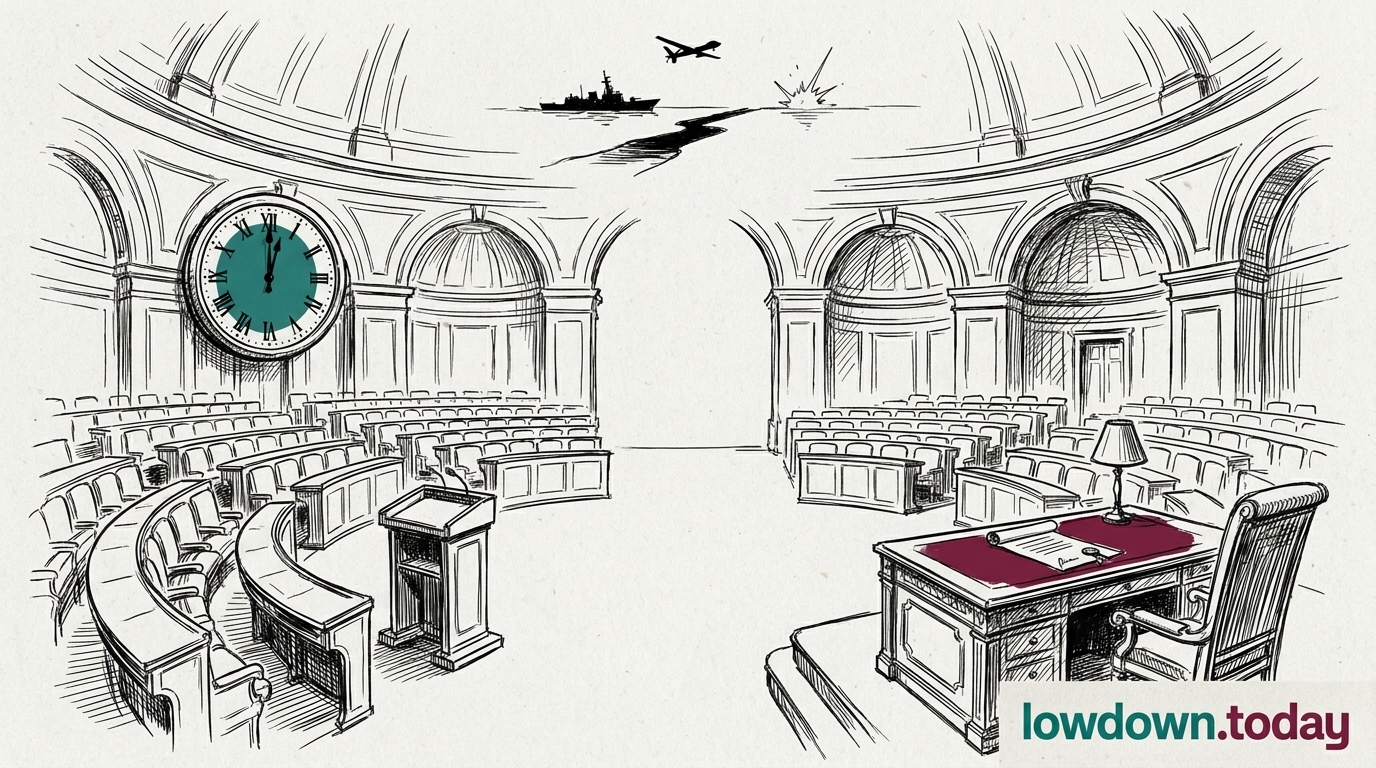
Senator Lisa Murkowski confirmed on the Senate floor that she will introduce her Iran Authorisation for Use of Military Force (AUMF) when the chamber returns from recess on 11 May, the deadline she set the administration to produce a credible plan . 1 Todd Young of Indiana joined Susan Collins of Maine, John Curtis of Utah, and Thom Tillis of North Carolina as the fourth Republican co-sponsor by 3 May.

An AUMF is the statutory instrument by which Congress authorises the use of military force; the most recent broad authorisation was the 2001 post-9/11 AUMF, which has since been stretched across four administrations. Murkowski said the bill "recognises reality that US military is already engaged and provides structure and clarity". The framing is procedural rather than substantive; the AUMF is being marketed as a constraint Congress imposes on existing operations, not a blank cheque for new ones.

Senate Iran-related WPR motions in the past decade have rarely commanded more than two Republican signatures pre-filing; Murkowski has four before the AUMF reaches paper. Young's Indiana base sits closer to the defence-hawk register than the Collins-Murkowski-Curtis-Tillis profile, which means the coalition reaches into the chamber's mainstream rather than its libertarian-moderate fringe.

The arithmetic still does not close. The 30 April Iran WPR motion failed 47-50 , with Collins the first Republican supporter . Four committed Republicans against the chamber that delivered 47 per cent on 30 April leaves the bill at least three votes short of passage at filing, before counting Democratic defections. Murkowski's 11 May filing date arrives one week after Project Freedom is operational; the floor pressure cycle now runs directly on top of the first kinetic test of the escort mission. Missing the date for a third time would damage Murkowski's credibility as a procedural anchor; filing on schedule is the first hard test of whether the floor coalition is real.

Deep Analysis

In plain English

The United States has been fighting in the Strait of Hormuz for more than two months with no formal vote by Congress authorising the war. A group of US senators, led by Lisa Murkowski of Alaska, wants to change that by filing a bill called an Authorisation for the Use of Military Force, or AUMF. Four Republicans have now signed on to co-sponsor it. The unusual part is the timing: this authorisation would be filed on 11 May, one week after 15,000 US troops entered the Strait of Hormuz. The 2002 Iraq AUMF was at least signed before the first ground troops crossed the border; the Murkowski bill would arrive after Project Freedom is already operational. The bill would give the military clearer legal rules but would also give Congress more oversight over what the military can do.

Deep Analysis
Root Causes

Todd Young's addition as the fourth co-sponsor reflects Indiana's specific economic exposure: Indiana has significant aerospace and defence manufacturing, and Young's support for the AUMF can be read as protecting military contracts and base employment while providing legal cover for a war that has no signed instrument. The pattern of Republican AUMF sponsors from states with defence-industry concentration (Alaska, Maine, Utah, North Carolina, Indiana) is not coincidental.

The 11 May filing target reflects a structural pressure: the Murkowski AUMF coalition conditioned its support on evidence of diplomatic activity, and the Pakistan written reply on 3 May provides that evidence. Without the diplomatic signal, the AUMF coalition risked appearing to authorise indefinite military action without constraint.

What could happen next?
  • Precedent

    A retroactive AUMF filed one week after a 15,000-personnel deployment establishes that presidential military action can precede congressional authorisation by an indefinite period, as long as co-sponsors can be assembled before public attention runs out.

    Long term · 0.77
  • Risk

    If the Murkowski AUMF is drafted narrowly to cover Project Freedom's escort mission, the administration may argue its terms also retroactively cover the blockade, expanding the authorisation's scope beyond what the four co-sponsors intend.

    Short term · 0.64
  • Opportunity

    A four-Republican co-sponsor coalition approaching 11 May may attract Democratic support sufficient to pass the Senate if paired with sunset and reporting provisions, creating the first legal framework for the Iran war and reducing the legal vacuum that leaves military personnel exposed.

    Short term · 0.58
First Reported In

Update #88 · 15,000 troops unsigned; Pakistan carries first reply

Alaska Public Media· 4 May 2026
Read original
Causes and effects
This Event
Young becomes fourth Republican on AUMF
Four Republican co-sponsors before the bill is filed is a procedural anomaly for a Senate Iran-related war-powers measure, and the 11 May date puts the floor pressure cycle directly on top of Project Freedom's first operational week.
Different Perspectives
Human rights monitors (Hengaw, Amnesty International, Iran HRM)
Monitors documented a second death sentence for Zahra Tabari, 68, reported cemetery record deletions at Behesht-e Zahra, and a poll showing 81.5% of medical residents want to emigrate, against a background of 200+ confirmed executions since February. Iran's security courts operate at uninterrupted wartime tempo regardless of the diplomatic track.
Pakistan (mediator)
Pakistan (mediator)
Islamabad carried Trump's revised MOU demanding HEU destruction to Iranian negotiators, formally inheriting the role of sole active mediator after Oman's forced withdrawal. Pakistan lacks Oman's banking infrastructure for frozen-asset routing and carries its own regional stakes, making it a less structurally neutral broker.
Kuwait
Kuwait
Kuwait intercepted Iranian missiles and drones for a second time in days on 1 June, with air-raid sirens sounding nationwide, after invoking Article 51 self-defence on 28 May following the Ali Al Salem ballistic-missile strike. The repeated interceptions test whether Kuwait's domestic politics can sustain hosting US forces as a de facto co-belligerent.
China (PRC)
China (PRC)
Beijing sent scholars to Shangri-La rather than its defence minister and addressed Taiwan without mentioning Iran, maintaining bilateral energy corridor protection with Tehran while refusing diplomatic exposure at multilateral forums. Trump barred China as an HEU custodian on 27 May, removing Beijing from the deal architecture while China continues supplying DPI hardware that caps Iran's internet.
Lloyd's of London / war-risk underwriters
Lloyd's held its Hormuz war-risk designation at $10-14 million per voyage while Brent recovered to $93.91, maintaining the structural divergence from futures pricing that has persisted since late May. Underwriters require a UN Security Council resolution or government certification letter, not diplomatic optimism.
Gulf Cooperation Council states (Saudi Arabia, UAE, Bahrain, Qatar)
Five Gulf states wrote to the IMO on 21 May rejecting Iran's PGSA transit authority over international waters; Saudi Arabia and the UAE have not confirmed participation in the European Hormuz mission. The GCC is navigating between US security guarantees and exposure to Iranian fire, with no Gulf state formally co-belligerent except Kuwait.